
OPINION: Blaming social media for the drop in support for the ICC prosecution of former president Rodrigo Duterte is a convenient story. It’s also a little embarrassing.
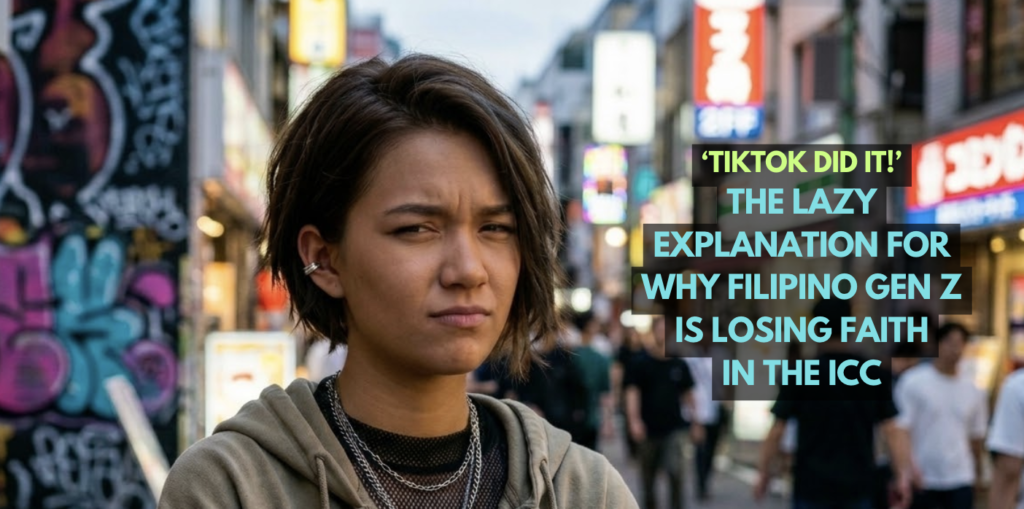
EVERY few months, a new poll lands, and the same headline writes itself: young Filipinos are being fed lies about Rodrigo Duterte’s International Criminal Court case, and they’re believing them. The disinformation machine is working. Gen Z is being manipulated. Someone should really do something about TikTok.
It’s a clean narrative that requires almost no thinking. And it’s become the lazy default for anyone covering Philippine public opinion who can’t be bothered to read past the top line.
The latest WR Numero survey, published this week and reported by the South China Morning Post and the Daily Guardian, shows that only 30% of Gen Z Filipinos now support the ICC’s prosecution of Duterte — a jaw-dropping fall from 69% in March 2024. Both outlets reached for the disinformation explanation. But nobody, apparently, thought to keep reading the data — or, for that matter, to check whether the research outfit had written or said anything else about it.
It had. On his own Substack, published six days before the SCMP piece ran, WR Numero’s senior research associate Petronilo Figueroa III laid out the same data with considerably more care — including a methodological caveat that neither outlet thought worth mentioning. Figueroa noted that the March 2024 and April 2025 surveys “were conducted under markedly different conditions,” that the earlier question focused on the investigation while the later one named the charges and trial explicitly, and that “these methodological differences complicate a direct comparison.” He then added something more striking still: that across all generations, “the most significant pattern is not the rise in opposition, but the expansion of uncertainty.”
Not disinformation. Uncertainty.
One could argue that that disinformation may have caused or fed into that uncertainty but here is where the coverage gets embarrassing: the WR Numero survey asked no questions about social media use or disinformation exposure. Not one. The TikTok explanation that SCMP so prominently mentioned did not come from the survey’s findings — it came from interpretive commentary that cited an entirely separate document, the 2025 Reuters Institute Digital News Report, which found that Facebook and TikTok were the leading platforms where Filipinos encountered disinformation. That is a finding about platform exposure in general — not about whether disinformation on those platforms caused the specific shift in ICC opinion that WR Numero measured. Nobody asked a single respondent whether a TikTok video or a Facebook post changed their mind about the ICC. The causal link that the outlets ran with exists entirely in the gap between one researcher’s inference and what the data actually shows.
That is not a minor caveat. That is the story.
Because WR Numero’s own Philippine Public Opinion Monitor, reviewed across three survey waves — March 2024, April 2025, and November 2025 — tells a significantly more complicated story than anyone has reported. One that would have taken, at most, an extra hour to find. The disinformation angle isn’t wrong as a hypothesis. It’s just not supported by the data being cited to prove it — and using it as the primary frame for this shift is, at this point, a failure of analysis dressed up as concern.
Opposition Surge
Start with what the survey actually shows at the national level, because the headline figure understates the complexity. Between March 2024 and April 2025, opposition to the ICC’s actions surged from 29% to 46% — a 17-point jump that is real and should not be minimized. That is a significant move, and it deserves to be called what it is.
But here is what sits right next to that number: the undecided pool simultaneously grew from 13% to more than 22%. Nearly one in four Filipinos, by April 2025, had no firm position. Figueroa, writing in his own Substack before either news outlet ran a word on this data, put it plainly: across all generations, “the most significant pattern is not the rise in opposition, but the expansion of uncertainty.”
That’s not the profile of a successfully radicalized public. Radicalized people don’t answer “I’m not sure.” What the data describes is a country simultaneously polarizing and fragmenting — with a sizable chunk of the population that hasn’t been won over to Duterte’s side so much as it has been lost to confusion and disengagement. Both outlets missed this entirely, despite the researcher having flagged it in plain language days before their stories ran.
Those are two different problems. They require two different responses. Collapsing them into “disinformation did it” is not analysis. It’s a shrug with a byline.
Continued-Detention Number
Here is the finding that received almost no attention in either the SCMP or the Guardian piece, and it fundamentally complicates the Gen Z collapse narrative: when WR Numero asked a different but related question — whether Duterte should remain under ICC custody and personally face his case in The Hague — Gen Z showed the smallest decline of any generation between April and November 2025. Their support fell from 60% to 50%, a 10-point drop. Millennials fell 21 points. Gen X fell 24.
Read that again. The generation supposedly most decimated by TikTok disinformation actually held up better than every working-age cohort when asked the more concrete accountability question. Gen Z’s dramatic-looking collapse in the headline figures reflects their sharp movement on the general “do you support the ICC investigation” question — a question Figueroa himself noted was asked differently across survey waves, and one that carries far more ambient political noise than the sharper question of whether a specific man should face a specific trial.
That distinction is analytically significant. It suggests Gen Z hasn’t abandoned the concept of accountability so much as it has grown skeptical of the political scaffolding around it. Again: a very different problem from “they’ve been lied to and believe it” — and one that no amount of TikTok fact-checking will fix.
Baby Boomer Anomaly
Also buried in the data: baby boomers recorded the sharpest increase of any generation in support for Marcos cooperating with the ICC — rising from 44% to 52% and bucking the downward trend seen across every other working-age group. And separately, 45% of baby boomers disagreed that the drug war was ineffective, making them the cohort most likely to view Duterte’s crackdown favorably. And yet they remained the most resilient supporters of ICC accountability across both waves.
That is a genuinely paradoxical finding. It suggests that for this generation, support for accountability and even appreciation of the drug war’s stated goals can coexist — a nuance that neither the disinformation frame nor the simple partisan frame can explain. The most plausible answer is memory. Filipinos born between 1946 and 1964 came of age under or in the shadow of Ferdinand Marcos Sr.’s martial law, a period defined by state-sanctioned killings and disappearances that went unaccounted for decades. That lived reckoning with impunity could be functioning as a cultural immune system against the revisionism now coursing through social media. It’s a theory no one has yet tested in the data, but it’s worth asking — and it’s exactly the kind of question that only emerges if you’re doing more than finding a social media angle and calling it a day.
Class Dimension
The survey’s income breakdown, published in the Daily Guardian but otherwise unremarked upon, may be the most underreported finding of all. Among Gen Z respondents in November 2025, 64% of Class ABC — higher-income Filipinos — supported Duterte remaining under ICC custody. Among Class E, the poorest respondents, that figure dropped to 47.9%. A 16-point gap within the same generation.
This matters because disinformation does not distribute itself along income lines so neatly. What does distribute itself along income lines is economic anxiety, precarity and the accumulated distrust of institutions that have historically failed the poor. If lower-income Gen Z is more skeptical of the ICC proceedings, the more honest question isn’t “what TikTok videos did they watch?” It’s “why would they believe this particular set of institutions is working for them?” That question has no comfortable answer — but it’s the right one, and it’s nowhere in the coverage.
Partisan Picture
Perhaps the most underreported nuance in WR Numero’s body of work is what its CEO and president, Cleve Arguelles, told The Philippine Star back in December, publicly available to anyone with a search bar: even among self-identified Duterte supporters, 39% still believed the ICC plays an important role in accountability, while only 46.4% dismissed it outright, short of a majority. His read then was that the Duterte base is “not a monolith,” and its views on the ICC are “more textured and open than the elite factional infighting makes it appear.”
A separate WR Numero survey from May 2025 found that 40% of Filipinos self-identified as pro-Duterte, a significant bloc that includes a large share of younger voters for whom support is more emotional than ideological. If Gen Z skews toward that self-identification, then the decline in their ICC support is not simply a function of coordinated online content. It is, at least in part, a partisan realignment story: a generation circling its wagons around an identity, not just passively absorbing false claims.
The Real Reason
Here is perhaps the most striking gap in the coverage: Figueroa, in both the full Substack piece he published before either news outlet ran its story and in the report both outlets were covering, explicitly identified the elite power struggle as a driver of the shift in younger Filipinos’ views. He said directly that for young Filipinos who already distrust political elites, “what was unfolding in The Hague was as much a contest between rival dynasties as it was a pursuit of justice.”
The SCMP buried this. The Daily Guardian mentioned it briefly. Neither outlet gave it the weight it deserved — which is considerable, because it is the polling firm’s own researcher naming the exact dynamic that coverage has been treating as a fringe interpretation. And both outlets had the Substack piece available to them before they filed.
It isn’t hard to see why that reading has traction. Rodrigo Duterte was arrested and flown to The Hague in March 2025 by a Marcos administration with which he had been in open, vicious political warfare for the better part of two years. The same government that had repeatedly and publicly refused to cooperate with the ICC — Marcos himself declared in January 2024, in a statement he would repeat on a visit to Germany two months later, that Manila would “not lift a finger” to help the court — suddenly discovered its obligations to international justice at precisely the moment Duterte had become his most dangerous political liability. The timing was, let’s say, convenient.
Young Filipinos who took to the streets in the Trillion Peso March protests of September and November 2025 — furious about corruption scandals implicating figures across both dynasties — are not naive about any of this. Philippine Star columnist Pia Roces Morato named the same suspicion circulating on Filipino social media: that the case has become a tool for elite political maneuvering, aimed at neutralizing a rival rather than delivering accountability. To treat that skepticism as the product of AI-generated Facebook posts is not just analytically lazy. It’s condescending to the very generation the coverage pretends to explain.
Baseline Was Always Artificial
There’s also a statistical problem with how the “collapse” is being framed that nobody wants to say out loud: March 2024 was almost certainly an artificial peak, and anchoring the entire narrative to it produces maximum drama while minimizing actual insight.
That figure came at the height of organized civil society mobilization around the ICC case — peak media attention, peak activist coordination, peak institutional momentum. But the problem goes beyond context. Figueroa himself, in his Substack, noted that the March 2024 and April 2025 survey questions were actually worded differently: the earlier one asked about the investigation, the later one named the charges and trial explicitly. He was careful to say that “these methodological differences complicate a direct comparison, but they do not explain away a collapse of this magnitude.” Fair enough. What they do explain, however, is why treating the gap between those two specific data points as the primary measure of a “collapse” produces a figure that is simultaneously dramatic and analytically slippery — a point the researcher made in public, in writing, before either news story ran.
The question WR Numero’s data is actually well-positioned to answer — whether the erosion began before the latest wave of AI-generated disinformation or because of it — is one nobody has yet asked. Perhaps because the answer would complicate the story.
What the Data Actually Demands
None of this is an argument for going easy on the disinformation machine. Rappler’s documentation of more than 100 ICC-related false claims debunked between March 2025 and February 2026 — fake quote cards, fabricated return-to-Davao stories, coordinated platform manipulation at scale — is serious and important work. The disinformation ecosystem around this case is real, well-resourced and effective.
But Figueroa himself, in the report the coverage was supposed to be about, listed three separate factors shaping how younger Filipinos assess justice and accountability: sustained political messaging, elite conflict, and competing online narratives. Elite conflict and disinformation appear on that list as distinct entries — not as synonyms. The coverage reported one and forgot the other two.
More to the point: the survey never measured disinformation exposure. It measured opinion. The leap from “opinions changed” to “disinformation changed them” is not a finding — it is an assumption. And it is an assumption that conveniently sidesteps the harder questions the data raises: about class, about institutional distrust, about a generation that watched two rival dynasties spend years weaponizing every available institution against each other and has drawn its own conclusions about who the ICC is really for.
As Figueroa warned in his closing note, “the window for building durable public support for accountability may be narrowing.” That is a genuine alarm. He wrote it. He published it. It was available. The coverage just didn’t read it. (Rights Report Philippines)