
Rolan Popatco Jr., the first Aeta to become a medical technologist, deserves every word of praise he gets. The Philippine press deserves a kick in the shin for ignoring the larger significance of his story.
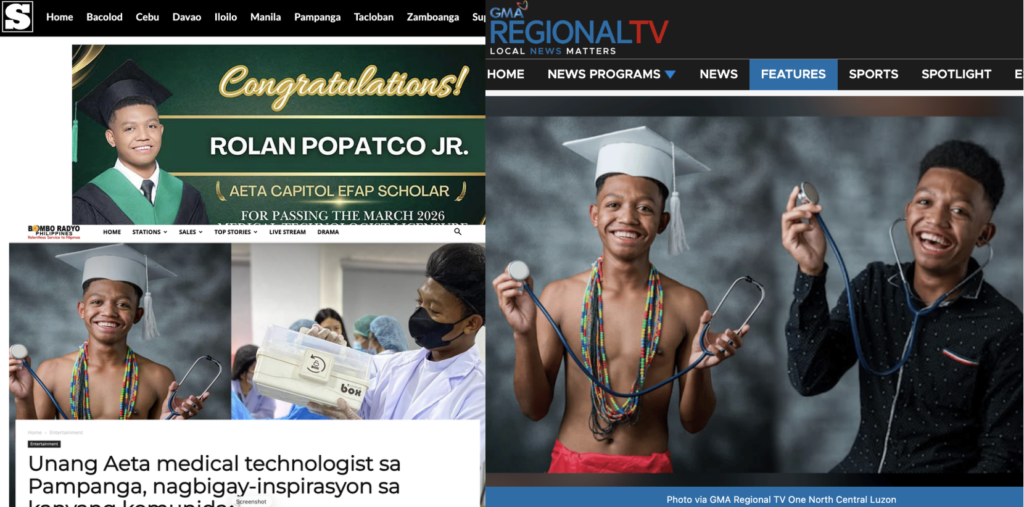
EARLIER this week, GMA Network’s 24 Oras Weekend broke the story of Rolan Popatco Jr., a 22-year-old from Barangay Camias in Porac, Pampanga, who passed the March 2026 medical technologist licensure examination — becoming the first licensed Aeta medical technologist in the province. He grew up in the mountains, came down to study in the lowlands, earned his degree from the College of Our Lady of Mount Carmel Pampanga through the provincial government’s Educational Financial Assistance Program, served as SK chairman while in school, and never stopped pushing — not for himself, but for his community.
That last part tells you more about indigenous life in the Philippines than anything else published about him this week. And that’s exactly the problem.
The story spread quickly. SunStar Pampanga, GMA Regional TV, Bombo Radyo across four stations, and The Global Filipino Magazine all picked it up. Every single one told roughly the same story: a young man, a mountain upbringing, scholarships, a board exam passed. Warm, brief, inspiring. Then — nothing. Nothing on why his milestone matters beyond the personal.
That question is the one sitting right there in every headline: Why is this the first time?
If Popatco is Pampanga’s first Aeta medical technologist in 2026, that is not just a personal triumph. That is an indictment. A responsible press should have the spine to say so, collectively.
The Aeta have long faced discrimination and marginalization due to their indigenous status, making education, healthcare, and economic opportunities significantly harder to access. The 1991 eruption of Mount Pinatubo compounded centuries of dispossession. After the eruption, the Aetas were displaced from their ancestral land and settled in resettlement areas, thrust into a lowland economy that viewed them as outsiders. The country’s estimated 9.4 million indigenous people disproportionately reside in areas of social conflict and poverty. For the Aeta, this is not history. It is their present.
Discrimination persists as one of the most disturbing experiences of indigenous students inside schools, and is one of the leading causes of dropouts and a barrier to pursuing higher education. Research documented Aeta university students being physically struck by classmates and told they were “wild hunters” who should not be approached. Far fewer indigenous people in the Philippines have earned college degrees than non-indigenous people — and the data almost certainly understates the gap.
Popatco navigating all of that — the geography, the poverty, the prejudice, the board exam — and emerging as a licensed professional is not an inspiration reel. It is a story about structural injustice and a system that should not require superhuman effort just to produce one licensed professional from an entire province’s indigenous population.
As one education advocate put it: “Either indigenous peoples like the Aeta are invisible in society, or their presence is framed and narrated by others. This is instrumental in the continuous marginalization of these peoples.” When the same “inspiration” framing appears across every newsroom that touches a story, it stops being an editorial choice and starts being a pattern worth examining.
What the Law Requires and What’s Actually Happening
The Philippines already has the roadmap. What’s missing is the will to follow it.
The Indigenous Peoples’ Rights Act of 1997 guarantees indigenous children the right to all levels of education. The 1987 Constitution requires the state to protect that right without discrimination. The UN Declaration on the Rights of Indigenous Peoples, which the Philippines voted to adopt in 2007, guarantees under Article 14 non-discriminatory access to all levels of education. The International Covenant on Economic, Social and Cultural Rights — ratified by the Philippines in 1974 — requires the same under Article 13. These are not aspirational suggestions. They are binding legal commitments.
In 2025, the UN Committee on Economic, Social and Cultural Rights reviewed Philippine compliance. Committee experts pressed the Philippines specifically on indigenous land rights, noting that indigenous peoples continued to face violations of their economic, social and cultural rights through the destruction of ancestral lands by extractive industries approved by the State. The committee was not satisfied with the government’s answers.
DepEd Order No. 62 has required culturally responsive IP education since 2011 — when Popatco was seven. Research published in 2025 found that implementation remains only moderate, with improvements still needed in culturally responsive curricula, teacher training in indigenous pedagogy, and indigenized instructional materials. Fourteen years later, “moderate” is not a passing grade.
What Must Change
DepEd must fully fund and monitor IP education implementation — not treat it as a compliance checkbox. Teacher training in indigenous education must be mandatory. CHED must develop a binding framework for indigenous students in higher education, ensuring that scholarship programs like the EFAP Popatco relied on are consistently funded and accessible — without requiring exceptional luck to find. The National Commission on Indigenous Peoples needs real institutional authority, not a mandate routinely overridden by agencies serving mining and development interests.
And the Philippine press must stop treating indigenous achievement as a warmhearted anomaly. Popatco’s story deserved context, not just celebration. The outlets that covered him this week had that opportunity. Most of them didn’t take it.
Popatco wants to become a doctor and bring healthcare to indigenous communities in the mountains. He is 22, still seeking scholarship funding, and still putting his community first. That is not a lifestyle story. It is a mirror held up to a country that has made it this hard for someone this determined — and a press corps that looked into that mirror and chose to smile back without asking why. (Rights Report Philippines)