ANALYSIS AND A CALL TO ACTION: Alvin Aragon’s statements against LGBTQ people and parents are being dismissed as celebrity drama. They shouldn’t be. His language tracks — almost word for word — the talking points that have blocked a landmark anti-discrimination law in Congress for 25 years. And the law he may be breaking has not been enforced against him.
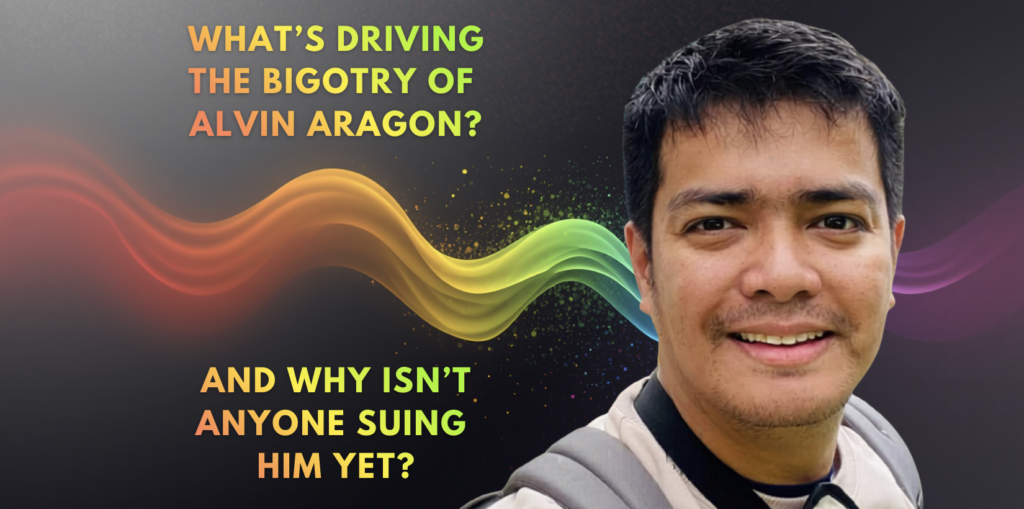
WHEN Alvin Aragon went on Facebook last Monday and called on GMA Network to pull Boy Abunda’s talk show off the air — because, he argued, it was telling Filipinos that “walang masama (there’s nothing wrong)” in being gay, trans, or queer — the country’s entertainment press did what it usually does: filed the story under celebrity controversy and moved on.
That reflex is a mistake. And it may be exactly what certain forces are counting on.
Aragon is not a lone provocateur trolling the LGBTQ community from his Facebook page. His statements — made repeatedly over the past six weeks on radio, online, and in the press — deploy the same arguments, and in some cases the same exact phrases, used by organized conservative blocs to block the SOGIE Equality Bill from becoming law for 25 consecutive years. He is framing LGBTQ identity as harmful to children and Filipino values. He is targeting parents who support their LGBTQ kids. And he is explicitly trying to remove LGBTQ voices from public media.
This is a playbook. The fact that nobody — not the government, not the broadcaster, not the mainstream press — has examined it through a legal or rights lens tells its own story.
What Aragon Actually Said
The controversy began in February when Aragon gave an interview on DWAR Abante Radyo addressing his stepdaughter Sofia Trazona, a transgender woman, and the LGBTQ community. According to GMA News Online and Philstar, he told Sofia and others in the LGBTQ community:
“God will throw you to hell if you continue to do homosexuality. Mamuhay ka, and you don’t want to believe in Jesus? I assure you that God will throw you to hell if you don’t stop, repent, and believe in the gospel.”
He repeated the threat in broader terms, according to a report by PEP:
“The gays will be thrown into hell. Ang mga bading, itatapon Niya sa impiyerno. If you don’t stop, God will throw you to hell.”
In a post on his Instagram account, he called LGBTQ people “real zombies because you want real men and real women to be like you.” In another Instagram post, he urged Filipinos — especially the young — not to adopt LGBTQ practices, calling homosexuality “Hindi Normal, Hindi Tama, Hindi Mabuti” (not normal, not right, not good).
He also publicly called out celebrity parents K Brosas, Ian Veneracion, and Gloc-9 for accepting their LGBTQ children, saying their support violated God’s commandments — a charge reported across GMA News Online, the Inquirer, and Cebu Daily News.
Boy Abunda responded on his show on Feb. 25, saying Aragon had “crossed a line” but kept his rebuttal firmly in the language of faith and dignity. Women’s group Gabriela called his remarks “manifestations of a systemic culture that seeks to dominate, commodify, and control women.” His church asked for public grace.
And then the news cycle moved on.
The Playbook
For 25 years, opponents of the SOGIE Equality Bill have relied on a specific, recurring set of arguments to justify blocking it: that LGBTQ identity is harmful to children, contrary to Filipino values, that the bill grants “special rights,” and that LGBTQ visibility is itself a moral harm.
Now read Aragon’s statements again.
“Hindi Normal, Hindi Tama, Hindi Mabuti sa mga Batang Pilipino.” That is almost verbatim the framing used by lawmakers who have blocked the SOGIE bill for a generation. Time magazine documented in 2023 how the bill’s most vocal opponents — including Senator Joel Villanueva and his father, megachurch founder Eddie Villanueva — promoted disinformation claiming the bill would legalize same-sex marriage and bestiality. “We have elected officials talking about how the SOGIE Equality Bill is going to legalize bestiality,” advocate Reyna Valmores of Bahaghari told Time. “It’s a circus.”
Aragon belongs to Victory Church, one of the Philippines’ fastest-growing evangelical megachurches which has publicly supported the actor. ILGA Asia has documented how online disinformation campaigns against the SOGIE bill coincided with rising homophobic sentiment online, particularly from conservative Christian networks. The bill, refiled in July 2025 according to Senate records, has yet to reach a floor vote.
He is not the movement’s strategist. But he is its amplifier. And every time his remarks are treated as showbiz gossip rather than political speech, the movement benefits.
What the Law Says — and What’s Not Being Enforced
The Safe Spaces Act
Republic Act 11313, the Safe Spaces Act (Bawal Bastos Law), signed in 2019, expressly prohibits “unwanted transphobic, homophobic and sexist remarks and comments online whether publicly or through direct and private messages” — per the Philippine Commission on Women’s own FAQ on the law. It covers harassment in streets, workplaces, schools, and online spaces. Aragon’s Facebook posts — publicly available, widely circulated, directed at a defined community, and framing their identity as immoral and dangerous — arguably meet the law’s definition of gender-based online harassment causing psychological distress. The PNP Anti-Cybercrime Group is the designated body for receiving such complaints. As of this writing, no complaint appears to have been filed, and the government has issued no public statement.
The Philippines’ International Obligations
The Philippines ratified the International Covenant on Civil and Political Rights in 1986. Article 20 obligates states to prohibit “any advocacy of national, racial, or religious hatred that constitutes incitement to discrimination, hostility, or violence” — language cited by the Office of the UN High Commissioner for Human Rights in its guidance on hate speech. The government’s failure to act on such speech, combined with its rejection of UN recommendations to pass the SOGIE bill during its last Universal Periodic Review — documented by the Commission on Human Rights — suggests the country is in breach of its treaty commitments. The breach is not Aragon’s doing. It is the state’s.
None of this analysis has appeared anywhere in Philippine coverage of this controversy. By leaving the legal dimension unexplored, no accountability mechanism is triggered, no precedent is set, and the next person who wants to run a sustained anti-LGBTQ campaign online knows exactly what they can get away with.
A Rollback in Real Time
It would be easier to treat Aragon as an outlier if the broader picture weren’t so concerning.
Two transgender women were killed in the Philippines in early 2025, the Commission on Human Rights confirmed. The CHR called it a “disturbing pattern of transfemicide” driven by misogyny, transphobia, and “a systemic belief that their lives are disposable.” Outright International’s 2025 research found that lesbian, bisexual, and queer women in the Philippines face widespread online hate speech — and that anti-LGBTQ stigma actively prevents them from seeking official redress.
President Marcos signed an executive order in 2023 establishing a Special Committee on LGBTQIA+ Affairs. But based on Outright International’s country profile, as of 2025 it has not been implemented. The SOGIE bill remains off the administration’s legislative priority list. And the country — which the Pew Research Center surveys as one of the most socially accepting in Asia toward LGBTQ people — has produced not a single national anti-discrimination law in 25 years of trying.
That gap between social tolerance and legal protection is precisely where organized opposition to LGBTQ rights operates most effectively. It doesn’t need to change most people’s minds. It just needs to keep lawmakers inactive.
What Needs to Happen Now
To the Philippine Government: Certify the SOGIESC Equality Bill as urgent legislation — something advocates and over 200 international organizations have called for since 2024 with no result. Implement EO 51, which created a Special Committee on LGBTQIA+ Affairs but has yet to be operationalized. Direct the CHR — which has the mandate as Gender and Development Ombud — to issue a formal statement on Aragon’s campaign and evaluate complaints under the Safe Spaces Act. Direct the PNP Anti-Cybercrime Group to assess whether sustained public homophobic and transphobic online campaigns trigger RA 11313, and to issue guidance.
To Philippine Media: Stop covering this as a celebrity dispute. Ask the legal questions. No major Philippine outlet appears to have asked whether Aragon’s statements trigger the Safe Spaces Act — a question that was raised almost immediately when lawmaker Bong Suntay made similar remarks just days later against actor Anne Curtis. Contextualize every story: the SOGIE bill has been blocked for 25 years, and Aragon is speaking its opponents’ language. Interview gender rights lawyers and CHR commissioners, not just celebrities.
To Philippine LGBTQ Groups: File a formal complaint under the Safe Spaces Act. Even if it does not result in prosecution, a complaint creates a public record and forces a government response. Document this controversy for the next Universal Periodic Review as evidence of the enforcement gap between existing law and LGBTQ Filipinos’ lived reality.
To International LGBTQ Rights Organizations: Name this case. Outright International,ILGA Asia, Human Rights Watch, and Amnesty International have all documented the Philippine LGBTQ rights situation. None has yet connected this specific controversy to that body of work. Call on the UN Special Rapporteur on Sexual Orientation and Gender Identity to issue a public statement.
The Bottom Line
Alvin Aragon did not invent the arguments he is making. But he is broadcasting them to a mass audience, at a moment when the SOGIE bill is stalled again and LGBTQ killings continue to occur. Treating that as showbiz gossip is not just a media failure. It is, in a very real sense, part of the problem.
The law exists. The international obligations exist. The political moment exists. What is missing is the will — from the government, from regulators, and from the press — to use them. (Rights Report Philippines)