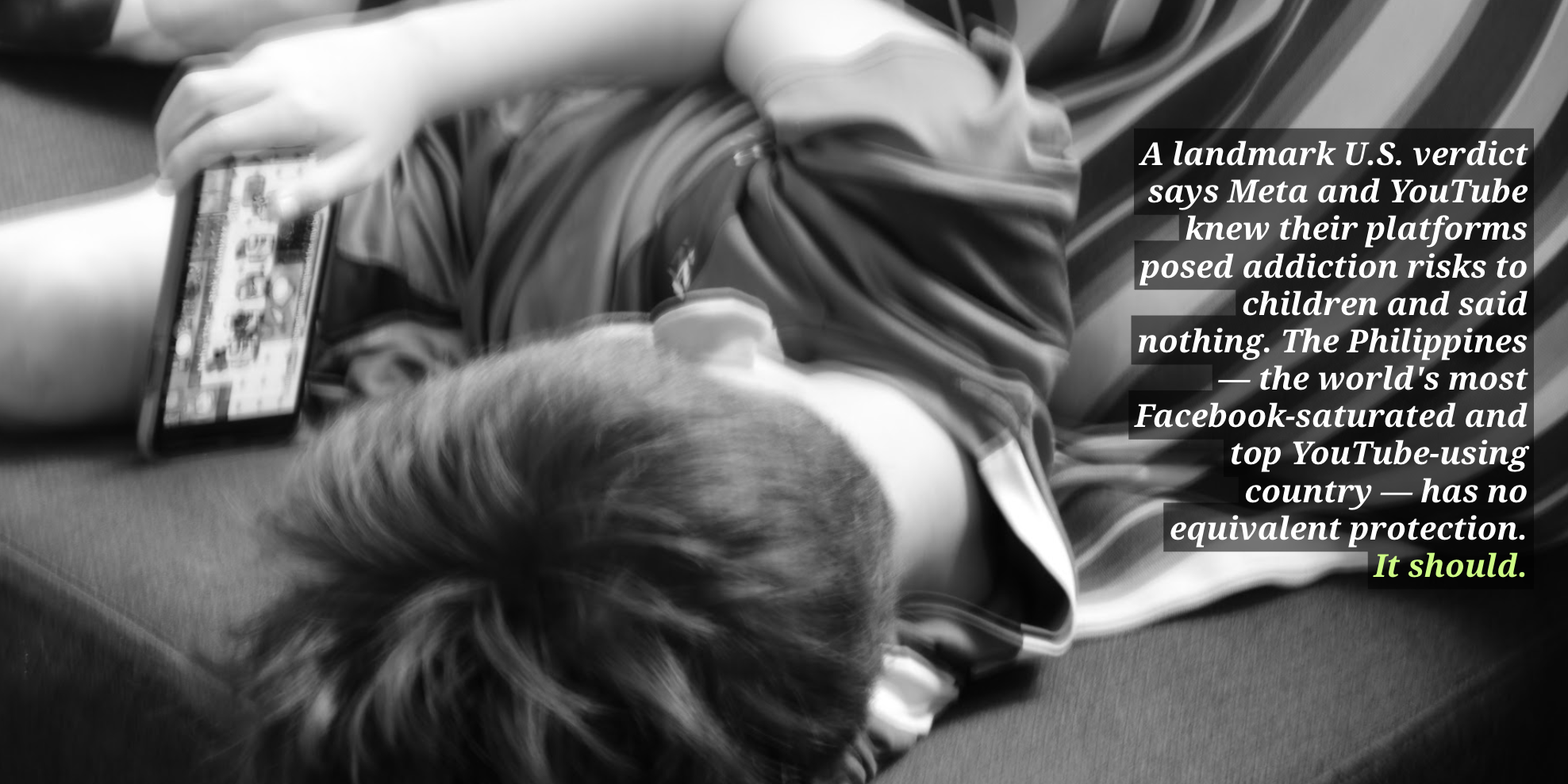

EVERY day, Filipinos wake up and reach for their phones in a country where Facebook is less a social media app than a basic utility, where more people per capita use YouTube than almost anywhere else on earth, and where nearly 1.5 million young people have, at some point, attempted to end their lives. On March 25, a jury in Los Angeles handed down a verdict that speaks directly to all three of those facts — finding that Meta and Google’s YouTube negligently built platforms they knew posed addiction risks to children, and that doing so caused real, documented harm.
The verdict found both companies negligent and awarded a total of $6 million in damages — $3 million in compensatory damages, with Meta bearing 70% of the liability and YouTube 30%, plus additional punitive damages after the jury decided the companies had acted with “malice, oppression, or fraud.” The plaintiff, a 20-year-old California woman identified only as K.G.M., testified that she began using YouTube at age 6 and Instagram at age 9, was on social media “all day long” as a child, and that those platforms contributed to depression and suicidal thoughts.
It is a decision that resonates far beyond California, nowhere more so than in the Philippines.
The Philippines holds a pair of distinctions that, in light of this week’s verdict, no longer sound quite like compliments.
According to DemandSage, the country has the highest Facebook penetration rate of any nation in the world at 88.32% — not the most raw users, but the deepest saturation relative to its population. And the Digital 2026 report from Meltwater and We Are Social found something just as striking: the Philippines ranked first globally in YouTube usage, with 85.5% of Filipinos aged 16 and above using the platform at least once in the past month — nearly 30 percentage points above the global average of 55.4%.
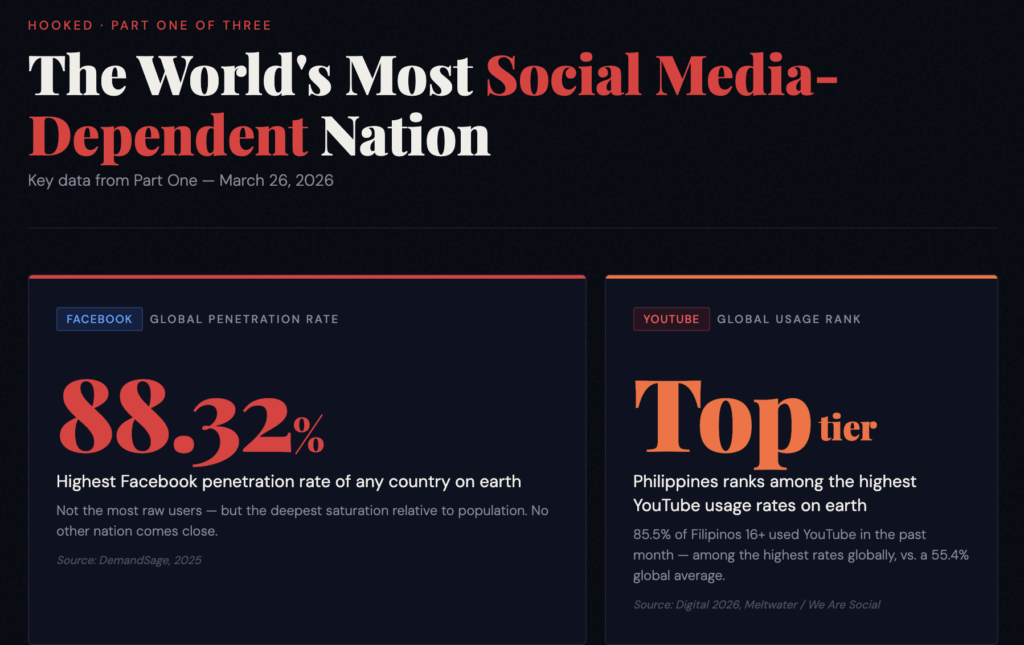
Put those two facts together. The world’s most Facebook-saturated country is also the world’s top YouTube nation. Both platforms were on trial in Los Angeles. Both were found liable.
Filipinos are not just heavy users — they are among the most devoted users anywhere. The same Digital 2026 report found that 99.5% of Filipino internet users had used at least one social media or messaging platform in the past month, and that the average Filipino spends 13 hours and two minutes per week just browsing social media, second only to Kenya globally.
Separately, Filipinos ranked second worldwide in time spent watching online videos —over 20 hours per week, the equivalent of more than five full days of video consumption every week. Filipinos also spend roughly 25 hours and 26 minutes monthly on YouTube alone.
There were 90.8 million social media user identities in the Philippines as of January 2025, equivalent to 78% of the total population. Many of those users are children.
The California trial placed particular scrutiny on what plaintiff attorneys called “engineered addiction” — design features like infinite scrolling, autoplay, and endless push notifications built to keep users, especially young ones, glued to a screen. Nowhere has that design philosophy found more fertile ground than in the Philippines, where short-form video has become a daily staple.
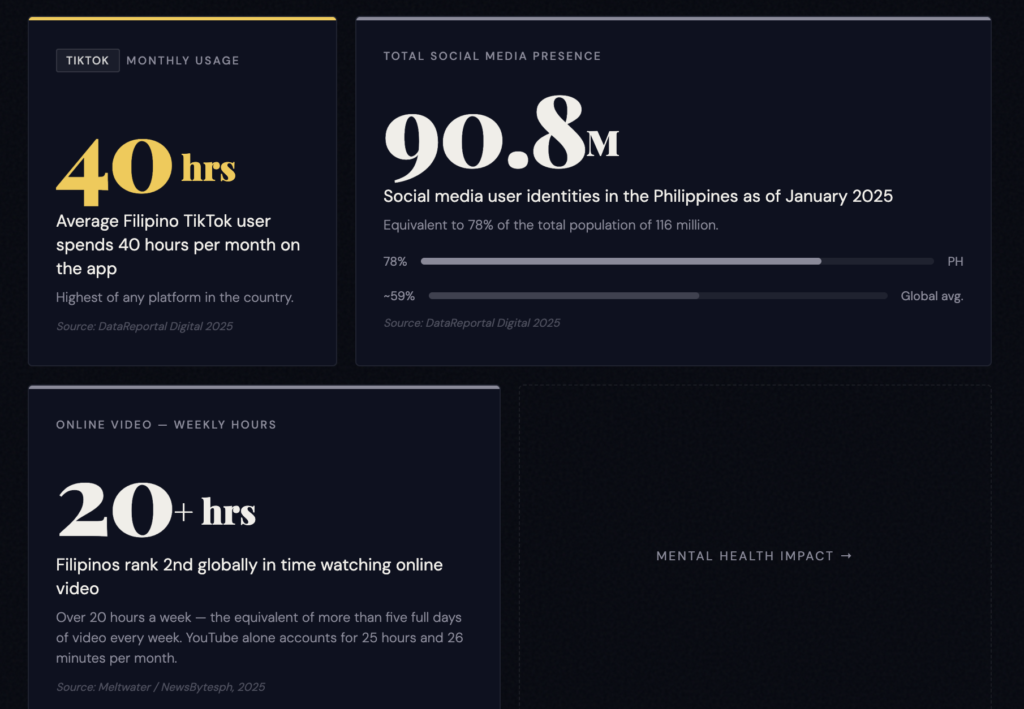
TikTok is now the platform where Filipinos spend the most time of all. According to DataReportal’s Digital 2025 Philippines report, TikTok had 62.3 million Filipino users aged 18 and above in early 2025 — a figure that excludes the under-18 population that uses the app but isn’t counted in advertising data. TikTok’s potential ad reach in the Philippines grew by 13.3 million users, or 27%, in just one year. Average time spent on TikTok runs to about 40 hours per month — the highest of any platform in the country. The Philippines is consistently cited as one of the top five countries globally for TikTok engagement, alongside Vietnam, Indonesia, Malaysia, and Thailand.
“The world’s most Facebook-saturated country is also the world’s top YouTube nation. Both platforms were on trial in Los Angeles. Both were found liable.”
YouTube Shorts is the second front. The feature, launched by Google as its direct answer to TikTok, now generates between 70 and 90 billion daily views globally, with an engagement rate of 5.91% — higher than TikTok’s. In the Philippines, where YouTube already claims 58 million users and is the most-used video platform in the country, Shorts has become central to how Filipinos consume content. The country’s two biggest YouTube channels — ABS-CBN Entertainment and GMA Network — together draw nearly 96 million subscribers, and both have pivoted heavily toward short-form video to reach mobile users.
This matters because the same design features at the heart of the California lawsuit — autoplay, recommendation algorithms, and what plaintiff attorneys called the deliberate hijacking of “dopamine-driven feedback loops” — are embedded in both TikTok and YouTube Shorts. The lawsuit did not just target long-form YouTube; it targeted the architecture of engagement itself. That architecture is fully operational in the Philippines.
TikTok has acknowledged some responsibility. Between July and September 2024, it removed about 4.5 million videos in the Philippines for violating its community guidelines. Critics argue the sheer volume of removals is itself evidence of how little the platform’s recommendation engine discriminates before content reaches young eyes.
The verdict in Los Angeles centered on a single woman’s documented experience: platforms that posed addiction risks contributed to her depression and suicidal ideation. The data from the Philippines suggests that experience is not isolated.
A nationally representative study by the University of the Philippines Population Institute found that depressive symptoms among Filipino youth aged 15–24 worsened significantly between 2013 and 2021, with the share reporting frequent feelings of loneliness, sadness, and social rejection nearly doubling.
A peer-reviewed study published in Global Mental Health in April 2025 confirmed the trend, finding a rising and widening prevalence of moderate-to-severe depressive symptoms across Filipino youth. Overall, mental disorders are estimated to affect between 11.3% and 11.6% of the Philippine population — roughly 12.5 million Filipinos — with depression and anxiety the dominant conditions. The sharpest increase, according to healthcare provider PhilCare, is among Filipinos aged 15 to 19.
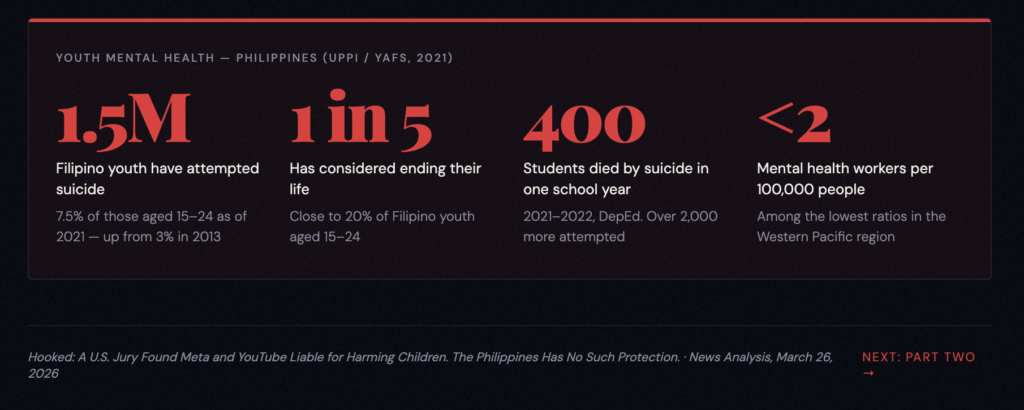
On suicide, the data is more alarming. The UPPI found that the share of Filipino youth who had ever attempted suicide more than doubled — from 3% in 2013 to 7.5% in 2021 — the equivalent of nearly 1.5 million young people. Close to one in five had at some point considered ending their life. The Department of Education reported that during the 2021–2022 school year alone, around 400 students in public schools died by suicide, with over 2,000 attempting to take their lives. A senior DOH psychiatrist reported that one in 10 students in the country had seriously attempted suicide.
Research from Ateneo de Manila University and UP Diliman has drawn direct links between social media use and higher rates of anxiety and depression among the young. Against all of that, the Philippines has fewer than two mental health workers per 100,000 people — among the lowest ratios in the Western Pacific region.
The California trial did not center on whether social media content is dangerous. It focused on whether the platforms themselves — their architecture, algorithms, and design choices — were built in ways that endangered minors.
Plaintiff attorneys argued that features like infinite scrolling, autoplay, and constant push notifications acted as a “Trojan horse” to create compulsive use. The jury found that both companies had known their platform architectures posed risks to young users and chose not to disclose those risks to the public.
Plaintiff attorneys called it “bigger than one case,” saying the companies had for years profited from targeting children while hiding what their platforms were designed to do — and that a day of reckoning had finally arrived.
Meta said it “respectfully disagrees” with the verdict and will appeal, arguing that teen mental health is too complex to be attributed to any single platform. Google said the case “misunderstands YouTube, which is a responsibly built streaming platform, not a social media site.” Both companies said they would appeal.
The same companies — running the same algorithms, the same infinite scroll, the same autoplay — operate in the Philippines, at greater intensity. The plaintiff in the California case began using YouTube at age 6. In the Philippines, children start even younger; one Senate bill noted that one in three children aged 0 to 18 uses the internet, and that 60% of children aged 10 to 17 are already active users.
For a country living inside these platforms more intensely than almost any other, the trial was never just an American story.
If you or someone you know is experiencing mental health challenges, contact the National Center for Mental Health Crisis Hotline at 1553 (available 24/7), or the In Touch Crisis Lines at (02) 893-7603.
LAST week’s Los Angeles verdict against Meta and YouTube did not come with a Philippine address. But the question it raises does.
The legal theory the jury accepted — that a platform can be held liable not for what users post, but for how the platform was designed to keep users addicted — is a meaningful departure from how Big Tech has traditionally been regulated. In the United States, Section 230 of the Communications Decency Act has long shielded platforms from liability for user-generated content. The California lawsuit found a way around that shield by targeting the design and architecture of the platforms themselves, not the content on them. That distinction matters everywhere.
Other countries are already moving in this direction through legislation. The European Union’s Digital Services Act, fully in force since 2024, requires very large platforms to assess and mitigate systemic risks — including risks to the mental health of minors — and imposes fines of up to 6% of global annual turnover for non-compliance. The United Kingdom’s Online Safety Act, which entered into force in March 2025, places a statutory duty of care on platforms to assess and manage risks, particularly around harm to children. Brazil’s Supreme Court in June 2025 significantly expanded platform liability, ruling that companies can now be held accountable for failures to prevent foreseeable harms — not just for ignoring specific takedown orders. India’s proposed amendments to its Digital Personal Data Protection Act would explicitly prohibit platforms from processing children’s personal data in ways that could harm their mental health, including through behavioral profiling and targeted advertising.
“Because the Philippines has no local law holding platforms liable for design-based harm, the verdict’s practical effect on Filipino children’s experience of these platforms is, at least for now, zero.”
The Philippines has none of these frameworks in place. Under current Philippine law, platforms are largely self-regulating on the question of design-based harm. The Cybercrime Prevention Act of 2012 and the Data Privacy Act provide some guardrails, but neither addresses algorithmic design or addictive features. Unlike Brazil, the Philippines has not legislated a “duty of care” for platforms. Unlike the EU, it has no binding risk-assessment requirements for the largest tech companies.
That gap is not merely academic. Because the Philippines has no local law holding platforms liable for design-based harm, and because Meta and YouTube are U.S.-headquartered corporations with no obligation to implement the reforms a California jury demanded, the verdict’s practical effect on Filipino children’s experience of these platforms is, at least for now, zero.
The Philippine Senate has not been entirely idle. In July 2025, Sen. Panfilo “Ping” Lacson filed a bill that would prohibit anyone under 18 from using social media platforms, citing UNICEF research on social media’s links to anxiety, depression, and online harm. Sen. Erwin Tulfo filed Senate Bill 595, which would ban children 12 and under outright and require parental consent and age-appropriate access for those aged 13 to 17.
A Senate committee hearing was held on Feb. 11 on five related bills. Sen. Robin Padilla’s version would specifically require platforms to limit features driving compulsive use — including autoplay, infinite scroll, notification systems, and rewards for time spent. These are precisely the design features a California jury just found negligently harmful. Sen. Camille Villar’s bill went further, defining a social media platform as one that employs algorithms to select content and features “addictive features,” including “infinite scroll” and “continuously loading content.”
At that February hearing, representatives of Meta, Google, and TikTok said they supported an “age-appropriate framework” rather than an outright ban — the same position both companies maintained throughout the California trial, where they argued they had always prioritized teen safety. A jury disagreed.
No legislation has been enacted.
If you or someone you know is experiencing mental health challenges, contact the National Center for Mental Health Crisis Hotline at 1553 (available 24/7), or the In Touch Crisis Lines at (02) 893-7603.
THE U.S. verdict against Meta and YouTube has no teeth in the Philippines — not yet. But waiting for a law is not the only option.
Legislation is only one lever, and historically in the Philippines, not the most reliable one. There is meaningful work that government agencies can do with the tools and mandates they already have — if they choose to use them.
DepEd has a new law and needs to actually implement it. President Marcos signed Republic Act 12080, the Basic Education Mental Health and Well-Being Promotion Act, on December 9, 2024. The law mandates school-based mental health programs at every public and private basic education institution, requires every Schools Division Office to establish a Mental Health and Well-Being Office, and creates plantilla positions for school counselors. The Implementing Rules and Regulations were released in March 2025. On paper, this is comprehensive. In practice, a draft DepEd order revealed that as of the 2022–2023 school year, the country had only 1,962 guidance counselors nationwide — nowhere near enough for a student population of millions. The urgency is not in writing new rules; it is in staffing, funding, and actually building the Care Centers the law requires.
DepEd and the DICT can integrate digital literacy into the curriculum. Children are handed smartphones and broadband access without any structured education in how those tools are designed to capture and hold their attention. Teaching students — as early as elementary school — how recommendation algorithms work, what infinite scroll is designed to do to their brains, and how to recognize the signs of compulsive use is something the education system can do without waiting for legislation. The UP Diliman Department of Psychology has already called “digital literacy, critical thinking, and media education” indispensable complements to any regulatory framework. DepEd’s curriculum teams can act on that recommendation now.
The DOH can fund and publicly track the data. One of the most persistent problems in addressing youth mental health in the Philippines is that the data is patchy, delayed, and rarely connects social media use to clinical outcomes in a way that creates policy urgency. The DOH, working with the Philippine Council for Mental Health, can commission regular, nationally representative studies that specifically examine the relationship between platform use and mental health indicators among minors — data that would give legislators and regulators something concrete to act on, and that would put the platforms on notice that their impact is being measured.
The National Privacy Commission can flex its existing authority. The NPC has the power to investigate data processing practices that harm users, including children. Platforms routinely collect behavioral data on Filipino minors to fuel the recommendation engines at issue in the California trial. The NPC has not yet initiated any investigation into whether this data collection — aimed at maximizing engagement among children — complies with the Data Privacy Act’s prohibition on processing that causes undue harm. It could.
Laws take years. Agency programs take budgets. What parents and guardians can do takes neither — only attention.
Know the signs. The Child Mind Institute and clinical specialists in adolescent digital behavior identify a consistent set of warning signs that a child’s social media use has moved from heavy to harmful: losing interest in activities they once enjoyed; withdrawing from family and in-person friendships; becoming irritable, anxious, or defensive when the phone is taken away; sleep disruption from late-night scrolling; declining grades; and using social media as the default response to boredom, stress, or difficult emotions rather than talking to someone. Younger children (roughly ages 8–12) may become secretive about their device use, imitate online trends obsessively, or lose interest in offline play. Teenagers show the pattern differently — prioritizing their online persona over real-life identity, and experiencing what clinical specialists describe as anxiety or distress disproportionate to the situation whenever they are separated from their device.
“Six in 10 Filipino youth who had considered suicide did not tell anyone about it — not a friend, not a parent, not a counselor. The most protective thing a parent can do is make themselves the kind of adult a child will actually talk to.”
The key distinction mental health professionals draw is not time alone — it is impact. A child spending four hours on YouTube on a weekend is different from a child whose schoolwork, sleep, and real-world relationships are all deteriorating because of daily platform use.
Start the conversation before it becomes a crisis. The UPPI’s YAFS data found that six in 10 Filipino youth who had considered suicide did not tell anyone about it — not a friend, not a parent, not a counselor. The most protective thing a parent or guardian can do is make themselves the kind of adult a child will actually talk to. That means approaching the topic of social media use with curiosity rather than accusation. Ask what they watch, what they like, who they follow. Make it a conversation, not an interrogation. Experts at the Social Media Victims Law Center suggest setting up one-on-one time in a setting the child enjoys before directing the conversation to their online habits — creating enough comfort that the child does not shut down.
Use the tools that already exist. Both iOS and Android have built-in screen time tracking and limits. YouTube and TikTok have parental control features, though their effectiveness is mixed — TikTok announced restrictions on beauty filters for under-18s in late 2024, blocking face-slimming and eye-enlarging effects, while still allowing other filters. These tools are imperfect, but better than nothing. A peer-reviewed study published on PubMed Central found that active parental monitoring and setting clear, consistent boundaries around acceptable online behavior are among the most effective interventions available — more reliably effective, in fact, than waiting for platforms or governments to act.
Know when to get professional help. If a child is showing signs of persistent depression, significant withdrawal from daily life, or any indication of self-harm or suicidal thinking, that is beyond the scope of parental conversation. The National Center for Mental Health’s crisis hotline is available 24/7 at 1553, and the In Touch Crisis Lines at (02) 893-7603. Seeking out a licensed guidance counselor or psychologist is not an overreaction — given how thin mental health resources are in the Philippines, early access to those professionals matters enormously.
The verdict in Los Angeles does not apply in the Philippines. Meta and YouTube are not facing Filipino lawsuits over addictive design — at least not yet.
But the underlying question is not uniquely American. It is one every country with millions of young, daily social media users must eventually answer.
In the Philippines, where Facebook is less a platform than a public utility, where TikTok commands 40 hours of Filipino user attention per month, and where YouTube is used more heavily than almost anywhere else on earth — and where youth depression and suicide rates have climbed in lockstep with social media’s rise — that question carries a particular weight.
The California jury said the harm was real, the design was deliberate, and accountability could no longer wait.
The Philippines is still deciding if it agrees.
If you or someone you know is experiencing mental health challenges, contact the National Center for Mental Health Crisis Hotline at 1553 (available 24/7), or the In Touch Crisis Lines at (02) 893-7603.