
NEWS ANALYSIS: Decades of policy failure — from the OPSF to oil deregulation — have left ordinary Filipinos with no real shelter from the worst fuel shock in the country’s history.
A QUEZON City tricycle driver named Jimmy Gariga, 60, spent three decades behind the wheel. When the government rolled out its PHP5,000 fuel subsidy in mid-March, he was on the list of qualified beneficiaries but was too ill to claim it himself. His daughter Shikinah lined up in his place, armed with an authorization letter her father had signed from his hospital bed and a medical certificate explaining why he couldn’t come. She was turned away. Jimmy Gariga died on March 20 without ever receiving the money. The government later sent someone to his wake, with burial assistance.
Separately, transport group Manibela has documented a pattern of legitimate drivers left off subsidy lists entirely while “ghost beneficiaries” — people who had no right to the aid — collected it. Quezon City’s own social services office has since acknowledged the errors.
These are not bureaucratic footnotes. They are the human face of a crisis decades in the making — and a government response that has so far been more spectacle than substance.
Marcos Has the Power
On March 24, President Marcos declared a state of national energy emergency. Transport unions called it a band-aid. The government has rolled out cash subsidies — PHP5,000 for traditional jeepney drivers, PHP10,000 per bus unit — but Piston, the national transport federation, points out that with daily fuel expenses now exceeding PHP3,000, the PHP5,000 grant barely lasts a day and a half.
Yesterday, President Marcos signed a bill that gives him the power to suspend fuel excise taxes — which would bring diesel down by PHP6 per liter and gasoline by PHP10. Note that he has not actually suspended anything; what the law does is give him the power to do that at his discretion. Whether he will is another question.
Before he signed the bill, the president was actually hedging; he said he had been watching price trends and making” complicated calculations,” citing a potential PHP136 billion revenue loss. That may be fiscally prudent. For a driver who can’t afford to run his jeepney, it is not.
It is against this backdrop of hesitation and limited tools that some unlikely voices have started reaching for old remedies.
Revive the OPSF?
The Freedom from Debt Coalition called for the revival of “an oil price stabilization fund to help control price spikes.” To be fair, FDC’s secretary-general Rovik Obanil did not specifically name the Oil Price Stabilization Fund, a mechanism it knows failed catastrophically the first time around. This is an organization that has spent decades fighting exactly the policies that burden the public with debt and drain the national budget. The original OPSF did both. The FDC knows this.
That the FDC is reaching for an OPSF-like intervention anyway is not an endorsement of the old OPSF but it is a confession about the absence of alternatives. When groups that understand the history best end up clutching at a tool they’ve long opposed, the message isn’t that the OPSF was good policy. It’s that everything else has run out.
All of this plays out against the backdrop of what the Department of Energy has called the highest jump in domestic fuel prices in Philippine history. The U.S.-Israel war on Iran and the resulting closure of the Strait of Hormuz, through which roughly 21% of global oil transit normally flows, has sent pump prices past PHP100 per liter. The Philippines imports 98% of its crude oil and has a single functioning refinery, capable of meeting only 40% of the country’s fuel needs. There is no strategic petroleum reserve to soften the blow. When a war breaks out thousands of miles away, Filipinos feel it immediately and fully.
Failed Fund, Failed Alternative
To understand why the government has so few tools to work with — why it can’t cap prices, can’t draw on a reserve, can’t do much more than hand out cash that runs out in 36 hours — you have to understand what the Philippines tried before, and why both attempts failed.
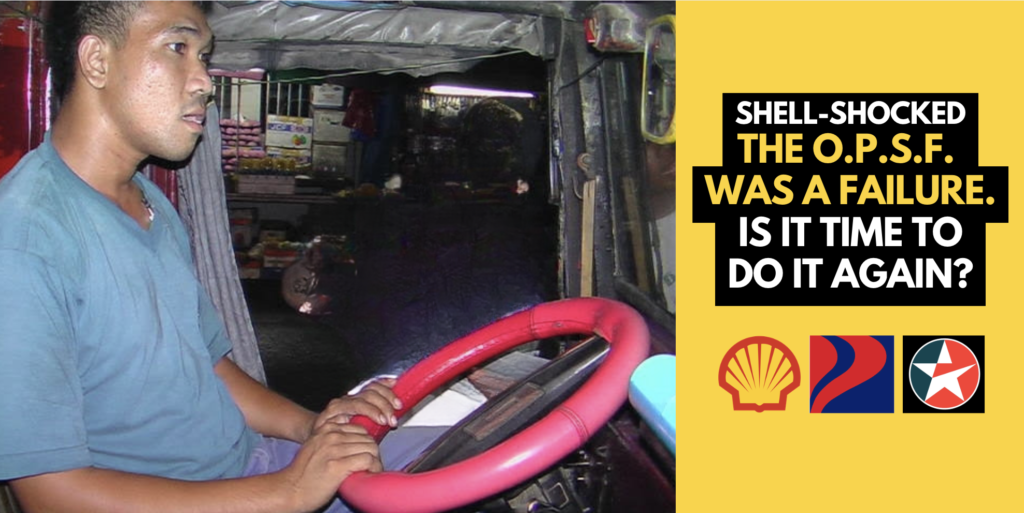
The OPSF, created in 1971 and formally codified in 1984 under President Ferdinand Marcos Sr., was built on a simple premise: oil companies pay into a government buffer when prices are low; the fund covers their costs when prices spike. Consumers are shielded. It didn’t hold. When oil prices surged in 1979 following the Iranian Revolution, the fund buckled. Politicians refused to adjust regulated prices upward even when economics demanded it. The fund was diverted for unrelated uses. By the early 1980s, ordinary Filipinos were subsidizing fuel consumption through the national budget. And the biggest beneficiaries were the heaviest consumers: businesses and the wealthy. The Philippine Institute for Development Studies concluded flatly: the fund was anti-poor. The OPSF was abolished in 1996.
Its replacement, the Downstream Oil Industry Deregulation Act of 1998, promised that competition would do what the OPSF couldn’t: keep prices fair and supply reliable. It hasn’t delivered. Since 1998, diesel prices have surged 714% and gasoline by 563%. The Big Three — Petron, Shell, and Caltex — still control roughly 45% of the market, and their prices move in near-lockstep. Most damningly, the Department of Energy has acknowledged that the deregulation law gives it no authority to cap pump prices. By law, the regulator is a spectator.
OPSF 2.0?
So should the OPSF be revived then, or something like it? Ibon Foundation has a similar take as the FDC’s. In its March 2026 report, it says the government needs price stabilization mechanisms — including, “a petroleum price stabilization fund learning from past errors.” Like FDC, Ibon is not calling for the revival of the OPSF as it was; it’s calling for something like it, but reformed and transparent. An upgraded OPSF – OPSF 2.0.
For this to happen, though, the Oil Deregulation Law should be repealed. On this, both Ibon and FDC agree. Ibon executive director Sonny Africa, speaking to BusinessWorld this month, said: “The very premise of deregulation of such a strategic commodity with such far-reaching impact has to be overturned, the law repealed, and a new law regulating the oil industry enacted.” He called for regulated pricing bands, price smoothing authority, a petroleum stabilization fund that learns from the OPSF’s failures, and a genuine strategic reserve.
Clearly, OPSF 2.0 and full re-regulation are long-game solutions, and the same industry interests that have shaped Philippine oil policy for three decades will not yield ground easily or quietly.
Structural Weaknesses
So here’s where the Philippines stands in 2026: the OPSF gone, deregulation entrenched, and a war in the Middle East exposing every structural weakness the country never got around to fixing.
Reviving the old OPSF certainly would not help the poor. The PIDS research is unambiguous: a blanket fuel subsidy disproportionately benefits heavy consumers — businesses and the wealthy — while ordinary Filipinos foot the bill through the national budget. It is a political gesture wearing the costume of policy. Rolling back deregulation, while seemingly the sensible thing to do given the present context, would take years of legislation, face fierce industry resistance, and carry real investment risks. It is a debate worth having, but it rescues no one today.
What experts broadly agree would actually help in the immediate term are targeted direct cash transfers to the poorest households, mandatory price transparency from oil companies, a genuine strategic petroleum reserve — none of these exist in sufficient form. The government is operating without any of the structural tools that would give it real leverage in a crisis like this one.
Bite the Bullet
There is an exhausting pattern to how the Philippines weathers oil crises. Prices spike. The poor protest. The government announces committees, convenes agencies, promises bayanihan. Some aid reaches some people — eventually, partially, bureaucratically. A driver dies waiting for help. Others line up only to find their names not on the cash subsidy list. Nothing structural changes.
The ripple effects are already moving through the economy: transport costs rising, food prices climbing, small businesses calculating whether they can stay open. Over 36% of the Philippine consumer price basket is tied to oil prices. This crisis will not stay in the fuel lane.
The Filipino poor did not create this crisis. A war thousands of miles away did, yes — but decades of policy choices made sure the Philippines would have no cushion when it arrived. No reserve, no price controls, no fund that works. Just a deregulation law that, by design, leaves the government powerless to intervene and a PHP5,000 subsidy that runs out in a day and a half.
The drivers standing in that line weren’t waiting for a miracle. They were waiting for the government to do the basic thing governments are supposed to do: protect the people who have no other protection. Many of them ran out of patience, some ran out of time. The question now is whether the system will run out of excuses before more people do.

A Word on PIDS
While its research on the OPSF is substantive and its core findings are broadly corroborated by independent analysts, it is not a neutral actor. As a government agency steeped in the mainstream economic thinking of the 1990s — and operating during a period when the Philippines was under heavy IMF pressure to liberalize its economy — PIDS was producing anti-OPSF research at precisely the moment industry players needed intellectual cover for deregulation. Its “anti-poor” framing of the fund, while not factually wrong, was also rhetorically convenient. More telling is what PIDS consistently chose not to find: for over 27 years, its reviews of post-deregulation competition repeatedly cleared the oil industry of cartel behavior, while producing nothing approaching the same rigor it brought to documenting the OPSF’s failures. That asymmetry — rigorous on the failures of state intervention, generous on the assumptions of market competition — deserves to be named. (Rights Report Philippines)