CONTEXT CHECK: The Commission on Human Right endorsed and celebrated the Philippines’ removal from the UN list of countries with grave violations against children in armed conflict. Here are reasons why that’s a problem.
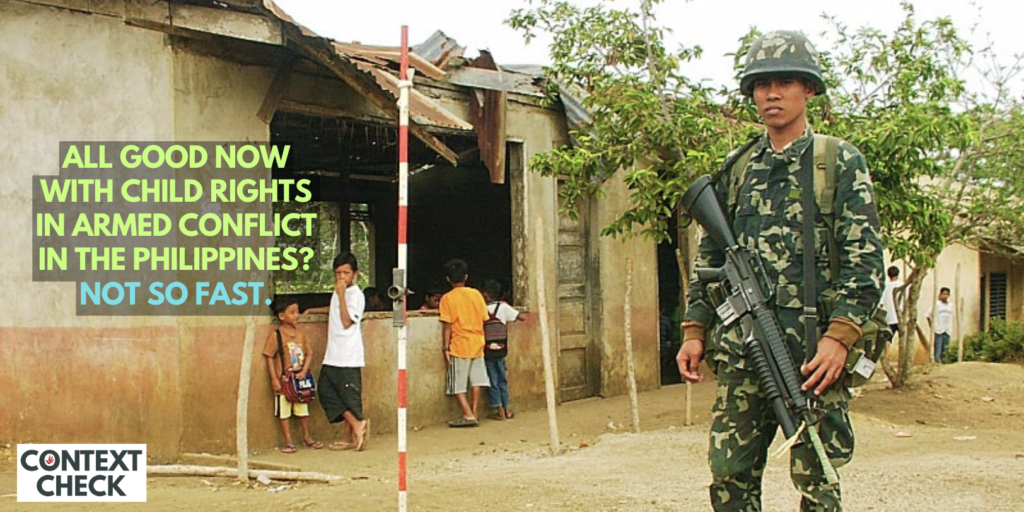
THE Commission on Human Rights made headlines last week when it celebrated the Philippines’ removal from the United Nations list of countries with grave violations against children in armed conflict. After 22 years on that list — the Philippines first appeared in 2003, though the watchlist’s own January 2026 report places the origin in 2002, when the UN secretary-general published the first such list — CHR Chairman Richard Palpal-latoc called the development a milestone – the result, he said, of sustained national efforts to protect Filipino children caught in conflict zones.
Most media coverage of the CHR’s statement ran with the celebration. What most stories didn’t do was look behind it — at the forces and lobbying that produced the delisting in the first place, and at what the CHR’s own framing reveals about whose interests its statement was serving.
The CHR is a constitutionally mandated independent watchdog, created under the 1987 Constitution specifically to investigate human rights violations and monitor the conduct of duty bearers, including the military, police, and other government agencies. It is not a government communications office. It is not in the business of amplifying or validating official claims — particularly claims that bear directly on its own mandate to hold those same agencies accountable.
So when the CHR issues a statement that credits the Armed Forces of the Philippines as a child protection success story without acknowledging the AFP’s documented record of violations against children, it isn’t just incomplete – it raises a harder question about whose interests the statement actually serves.
The removal is real. The diplomatic work that produced it was real. But the CHR’s statement left out context that matters: about who actually lobbied for the delisting, what the data behind it does and doesn’t show, and what was still happening to children in conflict areas while the government was making its case to the UN. Rights groups and children’s advocates have spoken up, often sharply. The government and military have their own account. Here is what the coverage so far has largely missed — and what both sides are saying.
1. The CHR didn’t actually lead the push for the delisting — Malacanang did.
The CHR is an independent constitutional body. Its role in the removal was, at best, supporting. Records from the government’s own Special Committee on Human Rights Coordination show the actual lobbying was led by the Department of Foreign Affairs, the Department of Social Welfare and Development, and the Council for the Welfare of Children — executive agencies working under the Marcos administration. At its June 18, 2025 meeting, the SCHRC’s own minutes show the DSWD presenting progress reports specifically framed around “the ongoing process of delisting the Philippines from the United Nations’ Child Abuse Watchlist.”
At that same meeting, the CHR attended only as an observer — on record as expressing “continuing support” for the government’s efforts under the Fourth Philippine Human Rights Plan. The CHR issued its celebratory statement nine months after the delisting was secured. That’s not a watchdog claiming credit. That’s an institution catching up to a win it didn’t drive.
WHY IS THIS IMPORTANT? The CHR’s constitutional role is to act as an independent check on the government — not to echo its achievements. When the country’s principal human rights watchdog issues a statement claiming partial credit for a diplomatic outcome engineered by executive agencies, and does so without any or with limited critical distance, it muddies the public’s understanding of who is accountable to whom. It also raises a question the CHR has not answered: if the executive branch led the lobbying, and if the CHR was merely an observer in those meetings, on what basis does the CHR now vouch for the outcome?
2. The body that coordinated the lobbying is routinely confused with the CHR — and that confusion isn’t accidental.
The actual engine behind the diplomatic push was the Presidential Human Rights Committee Secretariat, led by Undersecretary Severo Catura, an executive office under the Office of the President. Catura himself has acknowledged the confusion in remarks to the diplomatic corps, noting that while the independent CHR monitors the entire government, his office focuses on making sure executive agencies comply with human rights obligations.
What he didn’t say: the PHRCS’s primary function is presenting the administration’s human rights record favorably before international bodies. It was the PHRCS that listed the delisting as a signature win of the Marcos administration at its October 2025 committee meeting, alongside the DFA. Catura also simultaneously serves as the Philippines’ representative to the ASEAN Intergovernmental Commission on Human Rights — meaning the same official managing the government’s domestic human rights image represents it in regional forums. In a 2019 address to the UN Human Rights Council, Catura characterized civil society critics of the government as “terrorist front organizations masquerading as non-government organizations and human rights defenders” — a statement, though made in the context of the drug war then – he has never publicly disavowed, and which remains the diplomatic posture of the office that drove this outcome.
Children’s rights advocates have been blunt about what they see as the real motive. Celine Cadag of the Children’s Rehabilitation Center said the delisting was “a clear attempt of Marcos Jr. to posture himself and his administration as a human rights champion.” CRC executive director Olivia Bernardo, in launching the new Children For Just Peace Alliance as a direct response to the delisting, said the administration’s peace program was “ultimately widening state repression under the guise of upholding ‘peace’ with no actual justice for children and communities who are victims of extrajudicial killings, bombings, displacement, and constant fear.”
WHY IS THIS IMPORTANT? When media coverage and government statements conflate the PHRCS with the CHR — two bodies with fundamentally different mandates and loyalties — readers are left with the false impression that an independent human rights body validated the government’s record. In reality, the body celebrating the delisting most loudly is a presidential office whose job is to make the government look good internationally. The distinction is not bureaucratic fine print. It goes to the heart of whether what happened here was genuine progress on child protection, or a coordinated diplomatic image campaign.
3. The CHR’s statement doesn’t name a single group responsible for harming children.
For a document marking a milestone in child protection, the CHR’s statement is striking for what it omits. It never identifies any armed group — not by name, not even by category — as having been responsible for the violations that put the Philippines on the watchlist in the first place.
The UN’s own reports have been far less reticent. The most recent UN Secretary-General report on the Philippines verified violations attributed to the New People’s Army, the Dawlah Islamiyah-Maute group, and the Armed Forces of the Philippines — which was responsible for 12 percent of verified violations in the last full reporting period, primarily killings, maiming, and attacks on schools. In earlier periods, the AFP’s share was higher. The CHR’s statement credits the AFP as a key actor in child protection without mentioning any of this.
Salinlahi Alliance for Children’s Concerns has put specific names to what it says are AFP killings of children in conflict areas during the Marcos administration: 14-year-old JP Osabel, shot and killed in Uson, Masbate on December 27, 2024, while walking home from a Christmas party, in a killing that the Children’s Rehabilitation Center explicitly characterized as a grave child rights violation under international humanitarian law; 17-year-old Rey Belan, killed in June 2024 in Dimasalang, Masbate, during what the military described as an armed encounter with the NPA, but which human rights groups say occurred as Belan and companions were walking home from hunting; and 9-year-old Kyllene Casao, shot in the head by soldiers of the 59th Infantry Battalion in Taysan, Batangas in July 2022, while tending her family’s goats — after soldiers accused her family of being NPA supporters and opened fire as she fled.
None of these cases appear in the UN’s verified violation counts — a fact that is not a reason to dismiss them, but is itself part of the story. They document the gap between what gets officially counted and what rights groups say is actually happening in conflict-affected communities.
WHY IS THIS IMPORTANT? Accountability requires naming names. A human rights statement that celebrates progress on child protection without identifying any of the actors responsible for violations — not the NPA, not the AFP, not any of the armed groups the UN itself named repeatedly across two decades — is a statement designed to produce diplomatic warmth rather than genuine reckoning. Children weren’t harmed by unnamed “armed conflict.” They were harmed by specific groups, some of them state actors. A watchdog institution that cannot or will not say so in a milestone statement is not functioning as a watchdog.
4. The AFP has a long, documented record of falsely labeling children as combatants — but says it has reformed.
This is not a fringe allegation. Human Rights Watch documented in 2011 that the Philippine Army had publicly declared children as NPA rebels — and after investigation found the military had fabricated the children’s alleged involvement. The children were released, but the army subsequently continued to harass them and their families.
That pattern persisted. The AFP and its allied task forces have been documented presenting thousands of “surrenderees” to the press in short windows — figures that independent analysts say are impossible to reconcile with the military’s own estimates of NPA strength, and that disproportionately implicate members of red-tagged farmers’ groups, labor unions, and community organizations rather than actual armed fighters.
The government’s position is that this history has been addressed. The CHR’s statement credits the AFP for ensuring that children encountered in operations are now treated as “victims and rights-holders” — a policy shift it says is one of the key achievements that earned the delisting. The AFP has not publicly addressed the contradiction between that claim and its continued appearance in UN verified perpetrator data.
WHY IS THIS IMPORTANT? The AFP’s fabrication history matters for a specific reason: it directly contaminates the data used to justify the delisting. If the military has a documented practice of falsely tagging civilians — including children — as combatants, then its role in generating the verified violation numbers that drove down the Philippines’ count is not a neutral one. Celebrating reduced numbers without accounting for who produced those numbers, and what their track record is, treats a data quality problem as a protection success story.
5. The monitoring system used to build the case for delisting has a structural conflict of interest.
The Children’s Rehabilitation Center, an organization that works directly with child survivors of armed conflict, was among the groups that opposed the delisting before it took effect. Its concern was specific: the Inter-Agency Committee on Children in Situations of Armed Conflict — the body now responsible for monitoring and reporting violations — is dominated by government agencies, including the PNP and AFP. Both agencies appear in UN-verified perpetrator data. The CRC questioned whether a monitoring body where the accused sits alongside the monitor can produce credible, independent documentation.
The UN’s own Security Council working group reinforced this concern independently, noting in its conclusions that “access constraints imposed by parties to conflict” had limited the verification process, and that the data in the secretary-general’s report “does not represent the full extent of violations committed against children in the Philippines.” Notably, this caveat appears not just in the working group’s conclusions but in the main body of the 2025 secretary-general’s annual report itself, which states plainly that the information it contains “does not represent the full scale of violations against children.” The watchlist removal was based on numbers that the UN itself acknowledged were incomplete.
The government, for its part, has pointed to the IAC-CSAC as evidence of institutional progress — a coordinated whole-of-government mechanism that it argues improves accountability. The DSWD has highlighted the committee’s role in standardizing reporting, referral of child survivors, and coordination among agencies. Whether that institutional architecture adequately compensates for the absence of independent civil society oversight remains the central unanswered question.
WHY IS THIS IMPORTANT? A monitoring system is only as credible as its independence from the parties it monitors. The UN’s monitoring framework was built on precisely this principle — governments cannot sit on the Country Task Force on Monitoring and Reporting (CTFMR) because they are parties to conflict. Replacing that system with one where the AFP and PNP hold seats at the table doesn’t just raise procedural questions. It means that the body now counting violations is composed, in part, of agencies that commit them. Any reduction in numbers produced by that system carries a built-in credibility problem that the CHR’s statement makes no effort to address.
6. Three indigenous children were killed in a military bombing two months before the CHR issued its statement — and the AFP and rights groups tell sharply different stories about it.
On Jan. 1, 2026, AFP helicopters bombed a community in Abra de Ilog, Occidental Mindoro. Three Mangyan-Iraya children died. Their mother was injured. More than 760 people were displaced. The AFP’s account and the rights community’s account are in direct conflict.
The AFP said the operations were a legitimate response to armed threats, rejected allegations of indiscriminate bombing, and described the NPA’s declared holiday ceasefire as a “calculated ruse intended to catch security forces off guard.” The 203rd Infantry Brigade’s commander said the operation aimed to protect residents and was conducted according to rules of engagement.
Rights groups and lawmakers disputed that account on multiple grounds. Karapatan secretary general Cristina Palabay said the AFP was “denying these crimes by brazenly spreading lies against the victims and sowing fear in the community,” and called on the CHR and independent international monitors to investigate immediately. Kabataan Rep. Renee Co condemned the strikes, saying the air attacks “do not protect communities — they terrorize them,” and warned that those who ordered the operations must be held accountable.
ASEAN Parliamentarians for Human Rights called for a prompt, impartial investigation by the CHR into the January 1 operations and urged ASEAN institutions and international partners to press for accountability. Multiple groups — including Karapatan, the National Union of Peoples’ Lawyers, and indigenous peoples’ alliance Katribu — noted that the bombing occurred on ancestral Mangyan land in an area facing pressure from mining and energy projects, and said the pattern of militarization in Mindoro is inseparable from corporate resource extraction.
Adding to the controversy: a 25-year-old Filipino-American community researcher, Chantal Anicoche, went missing in the aftermath of the strikes and was later found in AFP custody, where she was shown in a video being interrogated by soldiers — a development that lawyers and rights groups said raised serious concerns about arbitrary detention and the military’s conduct toward civilians.
The CHR’s statement celebrating the delisting, issued in March 2026, made no mention of Mindoro, the Mangyan-Iraya children, Anicoche, or the CHR’s own constitutional mandate to investigate these exact kinds of incidents.
WHY IS THIS IMPORTANT? The Mindoro bombing is not a separate story. It is evidence, dated and specific, that the situation the CHR was celebrating had not, in fact, been resolved. The killing of children in a military operation in an indigenous conflict-affected community is precisely the category of violation the UN’s children and armed conflict framework was designed to track — killing and maiming of children, attacks on civilian communities during armed conflict. The CHR had calls from multiple organizations — including ASEAN legislators and national lawyers’ groups — to investigate this specific incident under its own constitutional mandate. It has not done so publicly, and it did not acknowledge the bombing in the very statement it issued about child protection progress. For a watchdog body, silence on an incident that directly contradicts the milestone it is celebrating is not a neutral omission. It is a choice with consequences for accountability.
7. The delisting is conditional — the Philippines can be relisted — and it landed on a different international watchlist the same week.
This point has been almost entirely absent from media coverage. The UN secretary-general’s report did not declare the Philippines permanently free of child rights concerns in armed conflict. It said the Philippines would be removed from future reports unless “conflict dynamics in the country shift.” The removal followed a June 2025 road map agreement between the Philippine government and the UN — an agreement that implies ongoing obligations, not a clean bill of health.
Child rights groups, including Watchlist on Children and Armed Conflict, have noted that the underlying armed conflicts driving violations have not ended. The NPA, the Bangsamoro Islamic Freedom Fighters, and other groups remain active. Indigenous communities in Mindoro and Mindanao continue to report military operations and displacement — conditions that directly feed the kinds of violations the CAAC framework tracks.
What has received almost no coverage: on March 25, 2026 — the day before the CHR’s statement was circulating in media — CIVICUS Monitor, a global civil society tracker, placed the Philippines on a watchlist for the repression of civic space. CIVICUS researcher Josef Benedict cited “a deeply troubling pattern of state actions against protests that is restricting democratic space and stifling fundamental freedoms,” adding that it is “creating a chilling effect for many in the Philippines who seek to speak out and organize.” The Philippines has now been rated “Repressed” — the second worst rating — for five consecutive years.
Part of the basis for that rating: during September 2025 anti-corruption protests, Manila police detained 216 people including 91 children. Amnesty International found that peaceful protesters and bystanders were also violently targeted, and that many children were held for more than a week, with accounts of beatings and denial of medical care during detention. Salinlahi called it a large-scale children’s rights violation.
To be clear about the distinction: these protest arrests fall outside the UN’s CAAC framework, which specifically tracks grave violations — killing, recruitment, sexual violence, attacks on schools and hospitals — committed against children in the context of armed conflict. Police violence at a protest is a serious human rights issue, but it is governed by different international standards than those the UN watchlist measures. The two cannot be conflated.
But the juxtaposition matters for a different reason. It reveals the gap between a narrow diplomatic scorecard and the broader environment in which Filipino children actually live. The UN delisting measures one specific set of violations against one specific threshold. The CIVICUS rating measures whether the people working to document and prevent those violations — journalists, activists, rights defenders, civil society monitors — can operate freely. When those people are being red-tagged, detained, and prosecuted, fewer violations get reported, fewer cases get verified, and the numbers that feed the official count get smaller. Getting off one list while landing on another isn’t irony. It is a description of how impunity works.
WHY IS THIS IMPORTANT? The conditionality of the delisting has been glossed over in virtually all media coverage. The Philippines has not been declared safe for children in conflict settings — it has been placed on an honor system, with its own government monitoring its own compliance. If armed conflict dynamics deteriorate, or if violations increase, the country can be returned to the UN agenda. But with the CTFMR’s mandate ended, independent civil society under ongoing pressure, and the monitoring body dominated by government agencies, the question is whether anyone will have the standing or the safety to say so.
8. Getting off the list doesn’t just change a number — it changes who’s watching, and how. And that may be the most consequential thing of a
No part of this story has received less attention, and it may be the piece that matters most going forward.
When a country is on the UN’s children and armed conflict watchlist, it activates a specific international mechanism: the CTFMR. Co-chaired by UNICEF and the highest UN representative in the country, the CTFMR is mandated to gather accurate, timely, and independent information on the six grave violations committed against children in armed conflict. Field teams work directly in conflict zones — negotiating the release of children from armed groups, helping restore schools taken over for military use, and connecting survivors to rehabilitation programs. It is the primary independent verification body that puts personnel on the ground and produces the numbers that reach the Security Council. Critically, governments are explicitly excluded from the CTFMR — because they are parties to the conflict, they have no access to individual case files or the verification process. That structural independence is precisely what gave the CTFMR’s findings weight.
The CTFMR exists specifically for countries on the UN agenda. Once a country is removed from that list, the CTFMR’s formal mandate for that country ends. The Philippines’ delisting means that the body which independently co-verified violations — including those attributed to the AFP — no longer has the same standing or institutional backing to do so.
The Children’s Rehabilitation Center raised this alarm directly when the delisting was first announced, saying the removal poses a greater challenge on monitoring and reporting because of the possible weakening of the Philippine CTFMR, given the formation of the government-led Inter-Agency Committee on Children in Situations of Armed Conflict as its replacement. The difference between the two bodies is not administrative. The CTFMR was co-led by UNICEF, structurally independent from the parties to conflict, and reported upward to the Security Council. The IAC-CSAC is a government committee that includes the AFP and PNP — agencies that are themselves named in UN-verified perpetrator records.
The government also introduced the MAKABATA helpline as a new reporting mechanism. But the CRC described it as “insufficient and inaccessible,” requiring a device, signal, and data load to file a report — substantial barriers in the remote, conflict-affected indigenous communities where violations are most likely to occur, and where residents already live under military surveillance.
The listing mechanism was understood — by the UN’s own account — to function as a lever for accountability. The UN’s own documentation on the MILF’s 2017 delisting described the listing and delisting process as a key incentive for extracting concrete commitments on child protection, and for keeping dialogue with the UN alive through a peace process. That lever is now gone for the Philippines entirely. The UN’s own monitoring guidelines describe the secretary-general’s annual CAAC report as the gateway to Security Council attention on child protection — the primary basis for international pressure and diplomatic scrutiny. A country that no longer appears in that report no longer commands that attention from the Security Council, unless — as the delisting terms say — conflict dynamics visibly shift. Who makes that determination? The same government that spent two years lobbying for the removal.
The CHR’s own statement quietly acknowledges that the monitoring work now falls to domestic institutions — listing its own nationwide monitoring, guidelines development, and frontline training as the post-delisting framework. But the CHR is the same institution that issued a statement celebrating AFP child protection gains while three indigenous Mangyan children lay dead from an AFP bombing two months prior, and that simultaneously ignored calls from Karapatan, ASEAN lawmakers, and the NUPL to investigate that very bombing. The CHR’s own statement, meanwhile, acknowledges that funding constraints, limited mental health services, and gaps in reintegration programs still undermine protection outcomes for children in conflict areas — even as it celebrates the milestone.
WHY IS THIS IMPORTANT? Because the practical effect of the delisting is that the Philippines loses its most powerful international accountability mechanism at precisely the moment when domestic accountability mechanisms are weakest. The CTFMR — independent, UN-backed, with Security Council reach — is replaced by a government-dominated committee that includes the very agencies accused of violations. The independent international pressure that served as a lever for compliance is replaced by a road map whose fulfillment is monitored largely by those who signed it. In that environment, violations don’t necessarily stop. They just stop being counted by someone with the independence and standing to make the count matter. (Rights Report Philippines)
CHR statement, March 24, 2026
UN CAAC Report 2025 (A/79/878-S/2025/247)
PHRCS 3rd SCHRC meeting minutes, June 18, 2025
PHRCS 4th SCHRC meeting records, October 2025
UN Security Council Working Group conclusions on Philippines
Watchlist on Children and Armed Conflict: Philippines
Watchlist Philippines domestic law and policy report, January 2026
UN MRM guidelines on CTFMR mandate
AFP defense of Mindoro operation, Manila Bulletin, Jan. 3, 2026
Karapatan statement on Mindoro, January 7, 2026
ASEAN Parliamentarians for Human Rights on Mindoro
Children’s Rehabilitation Center/C4JPA, Bulatlat, Sept. 13, 2025
CRC on CTFMR weakening, Bulatlat, Aug. 4, 2025
Kyllene Casao, GMA News, August 2022
JP Osabel and Rey Belan, ICHRP
Amnesty International on September 2025 protest arrests
CIVICUS Monitor on Philippines, March 2026
HRW World Report 2026: Philippines