Meta/Facebook scrapped its fact-checkers. Now its own watchdog says the replacement – Community Notes – could backfire in places like the Philippines where disinformation is rampant. And that’s because the company is “cosplaying accountability.”
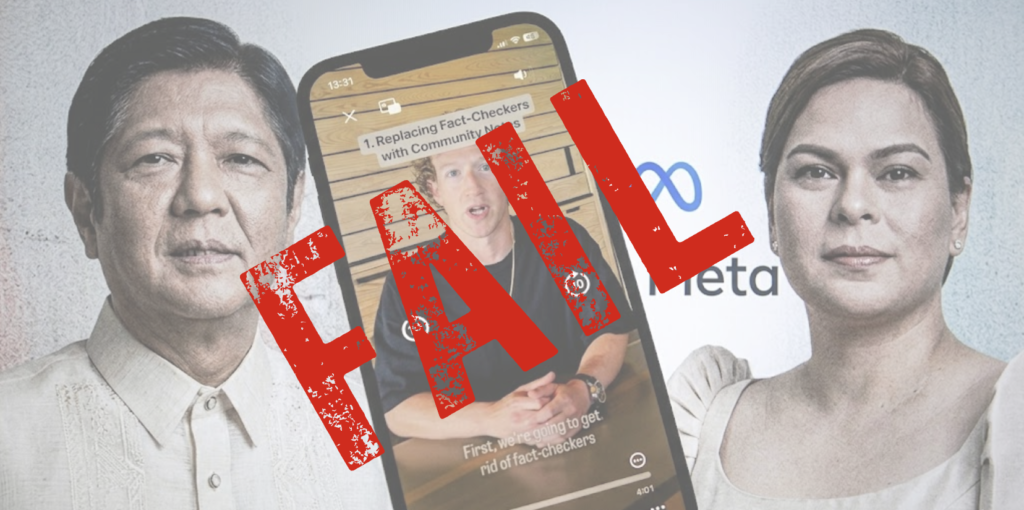
META’S independent oversight body is telling the company, which owns Facebook and Instagram, to hold off on expanding its new crowd-sourced fact-checking tool to countries with histories of coordinated disinformation, active political crises, and fragile information ecosystems — a checklist that reads like a portrait of the Philippines.
In a formal advisory opinion published March 26, the Oversight Board warned that Meta’s Community Notes program, which replaced professional fact-checkers in the United States earlier last year, could do more harm than good if deployed globally without serious safeguards.
The board found the system publishes only about 6% of flagged content and takes an average of more than 65 hours to post a note after a piece of misinformation goes up — far too slow to stop a viral false narrative in its tracks.
For the Philippines, a country Facebook’s own global politics and government outreach director once called the world’s “patient zero” for disinformation, the implications are hard to overstate.
“Everywhere you look, it’s the same false narrative appearing on different platforms,” said Celine Samson, head of digital verifications at Vera Files, one of Meta’s fact-checking partners in the Philippines. “On Facebook, TikTok, YouTube — so it feels like there’s a concerted effort to spread them.”
Samson made those remarks last April, during a surge of disinformation that followed former President Rodrigo Duterte’s arrest by the International Criminal Court on charges of crimes against humanity. Within 12 hours of that arrest, 200 Facebook pages and accounts flooded the platform with false narratives. One pro-Duterte influencer posted an AI-generated video of a slain drug war victim’s brother claiming to be alive and accusing his own sister — who had spoken publicly about his killing — of lying.
That is precisely the kind of fast-moving, targeted, AI-enabled disinformation that the Oversight Board says Community Notes is structurally unequipped to handle.
A System Built for a Different Internet
Community Notes works by letting users propose context labels on posts they believe are misleading. Other users then rate those labels. If enough people who typically disagree with each other agree that a note is helpful, it gets published. The system, borrowed from X — formerly Twitter — was designed largely with U.S.-style left-right political polarization in mind.
That’s a problem in a country like the Philippines, where political fault lines run along dynastic loyalties, regional identities, class divisions, and complicated personal histories between powerful families such as the Dutertes and the ruling Marcoses. The board explicitly warned that the system’s algorithm assumes social division can be modeled along a single axis — and in places where it can’t, the tool risks surfacing notes that reflect majority prejudice rather than factual accuracy.
“In contexts where division and disagreement cannot be easily modeled along a single axis,” the board wrote in its opinion, “this may not be an appropriate assumption.”
The Philippines, analysts say, is one of those contexts.
“Meta Is Cosplaying Accountability”
CarlJoe Javier, executive director of Data and AI Ethics PH, said the Oversight Board’s concerns are well-founded — but don’t go far enough. The real problems, he told Rights Report, are a “very clear lack” of algorithmic transparency and what he calls “reckless algorithmic amplification.” Community Notes, he said, addresses neither.
“There’s a fragile information environment and so many parties who are skilled at hijacking the algorithm to advance their narratives,” Javier said.
That hijacking, he argued, goes well beyond local politics. Meta’s platform has repeatedly been used to spread pro-China narratives, Russian state-sponsored divisive content, and large-scale scams — none of which Community Notes is designed to catch.
“Community Notes are basically cosplaying accountability,” he said. “They’re really just covering up that Meta isn’t fixing the real problems.”
These failures are crucial for the Philippines, where the current political landscape pits allies of President Ferdinand Marcos Jr. against supporters of the Duterte family, a split that has driven an explosion of dueling disinformation campaigns across Facebook, TikTok and YouTube. According to the Reuters Institute’s 2025 Digital News Report, 67% of Filipinos now say they are concerned about misinformation — a record high, and well above the global average of 58%.
“The Duterte administration institutionalized disinformation in the country,” wrote researcher Ross Tapsell in an analysis for the East Asia Forum last June, “then paved the way for the Marcos family’s return to power in 2022 through an alliance with Sara Duterte.”
Now both camps use disinformation as a weapon against each other — making the Philippines a textbook case of what the Oversight Board calls a “history of coordinated disinformation networks,” one of the key factors it says should trigger exclusion from any Community Notes rollout.
The Fact-Checker Question
At the center of this debate is what happens to Meta’s existing fact-checking infrastructure in the Philippines if Community Notes goes global.
Meta ended its third-party fact-checking program in the U.S. in January 2025, announcing Community Notes as the replacement. The company said it would refine the tool before extending it internationally. Its fact-checking partnerships in the Philippines — with Vera Files,Rappler, and Agence France-Presse — remain in place for now,.
The Oversight Board flagged that as a deeper problem embedded in the system itself: Community Notes, its review found, relies heavily on professional fact-checkers as sources. One recent study found that fact-checking organizations are among the most-cited references in notes that actually reach publication. Cutting funding to those organizations, the board warned, weakens the very foundation Community Notes depends on.
“Community notes and fact-checking should not be seen as mutually exclusive tools,” the board wrote, citing the UN Special Rapporteur on freedom of expression.
In the Philippines, that distinction carries real weight. Vera Files alone received roughly 300 disinformation tipoffs in the two weeks following Duterte’s arrest — far above its normal volume. The Philippine Center for Investigative Journalism documented an entire ecosystem of coordinated influence operations in 2025, from synchronized Facebook comment blitzes to TikTok networks pushing false claims about the ICC.
The AI Wildcard
What makes this development particularly urgent is the role of artificial intelligence. A 2025 OpenAI safety report identified a Manila-based tech firm that used AI to run a large-scale influence campaign pushing pro-Marcos and anti-Duterte content across Facebook and TikTok — analyzing political trends, drafting public relations strategies, and manufacturing engagement through shell accounts.
The Oversight Board warned that AI tools are making coordinated manipulation of Community Notes easier and cheaper, allowing bad actors to flood the ratings system with false consensus signals. The board said Meta has not demonstrated that its safeguards against such manipulation are adequate, and called for stress-testing under adversarial conditions before any international launch.
Meta told the board it does not plan to allow AI to submit notes directly, but acknowledged that human contributors may use AI to help draft them.
On the Board’s Own Radar
The Philippines is not an abstract concern for the Oversight Board. The body is currently reviewing a separate Philippines-specific case involving political misinformation and the role of third-party fact-checking — examining a video that falsely depicted crowds protesting in the Netherlands in support of Duterte following his ICC arrest. Meta’s own systems flagged the video as possible misinformation but it was never reviewed by fact-checkers and remained on the platform.
That case cuts to the same question at the heart of the Community Notes debate: in one of the world’s most disinformation-saturated countries, what system actually works — and who bears the cost when it doesn’t? (Rights Report Philippines)