
CONTEXT CHECK: Filipinos are struggling with housing, yes. But what the data actually shows is that the Philippines has an inequality problem — deep, structural, and decades in the making — and housing is simply where people feel it most acutely.
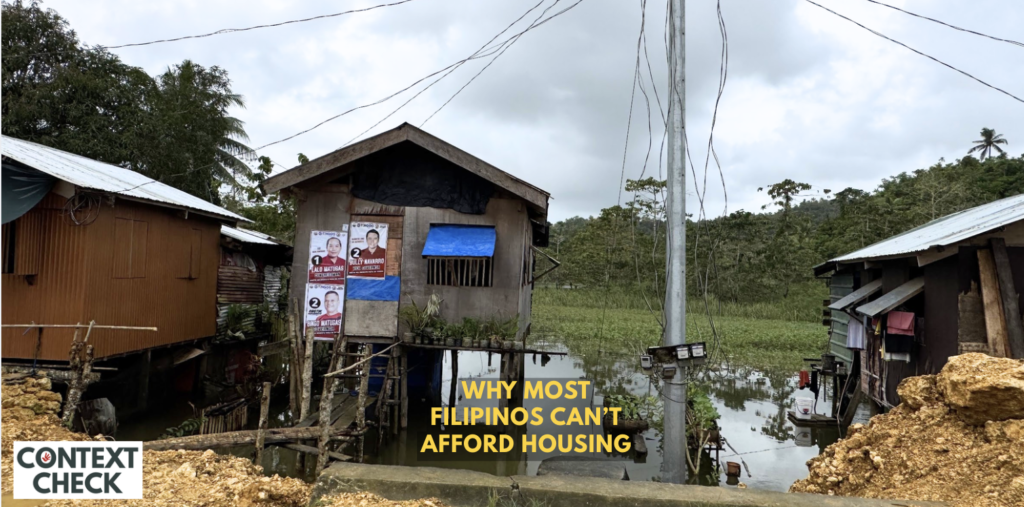

A RECENT item in The Economist cited Gallup World Poll data finding that more than half of Filipinos reported “housing-related difficulties” in 2025, the highest share in Asia, surpassing Sri Lanka and Myanmar, and ahead of wealthier countries like South Korea, Singapore, and Australia.
The framing – that this is a housing affordability crisis – is incomplete. It’s a category error, one that points toward the wrong diagnosis, and by extension, toward solutions that will keep missing the people who need them most. The Philippines does not have a housing problem that happens to look like an inequality problem. It has an inequality problem that happens to be very visible in housing.
What the Data Says — and Doesn’t
The Economist wasn’t reporting that rent in the Philippines costs more in absolute terms than anywhere else in Asia. According to Numbeo’s March 2026 data, rent in the Philippines is on average 80.7% lower than in the United States. Hong Kong, Singapore, and Tokyo all have far higher nominal rents.
What the data actually captures is a ratio — specifically, what rent costs relative to what people earn. According to the Urban Land Institute’s 2025 Asia-Pacific Home Attainability Index, the Philippines has the highest ratio of median monthly rent to median monthly income in Asia. The median monthly rent exceeds $1,000, which works out to 141% of the median monthly household income for Metro Manila. That means the median Filipino household cannot, by any conventional financial standard, afford the median rent. Not even close.
A Deutsche Bank Research study tracking 69 cities worldwide places Manila’s rent-to-salary ratio at 94% — meaning a typical Manila worker surrenders nearly their entire monthly paycheck on a one-bedroom apartment in the city center. Financial advisers generally consider anything above 30% a warning sign. Globally, several cities rank worse — Bogota at 120%, Mexico City at 118%, Cairo at 125% — but the Philippines holds the dubious distinction of being the worst in Asia specifically because its income base is so much lower than the cities above it on that list.
The problem isn’t the rent. The problem is the paycheck.
That last point is the key one, and it tends to get lost in the housing-focused framing: the problem isn’t the rent. The problem is the paycheck.
The Income Picture
The Philippine Statistics Authority’s 2023 Family Income and Expenditure Survey — the most recent available — found that the average Filipino household earned P353,230 annually, or roughly P29,435 a month. In Metro Manila, that figure rises to P513,520 annually, or about P42,793 a month.
Now set that against what housing actually costs. A studio unit in Makati runs between P25,000 and P35,000 per month, while a two-bedroom condominium in the heart of the city ranges from P120,000 to P180,000. The ULI found that condominium prices in Metro Manila are now 19.8 times the median annual household income, and townhouses 33.4 times. The globally accepted affordability benchmark is five times annual income. The Philippines isn’t nudging past that threshold — it’s four to six times beyond it.
Critically, household incomes in Metro Manila grew by only 20% since 2019, while residential property prices surged 62%, according to the BSP’s own Residential Property Price Index. The gap isn’t closing. It’s widening. And that’s not a housing market problem — it’s an income stagnation problem wearing a housing market’s face.
The Blame That Goes With It
There is a quieter narrative running underneath the housing affordability conversation, and it’s worth naming directly: the idea that Filipinos who can’t afford homes have mostly themselves to blame. You hear it constantly. The neighbor who bought a car before saving for a down payment. The family who spent remittances on a fiesta instead of a lot. The breadwinner who gambled. The couple who had too many children too soon. The graduate who took a government job instead of a private sector one.
This framing is seductive because it’s occasionally true in individual cases — and almost entirely useless as an explanation for a systemic problem. When the majority of a country’s population cannot afford the median rent on the median income, that is not a collection of bad personal decisions. That is a structural condition. Calling it a series of lifestyle failures doesn’t just misdiagnose the problem — it actively obscures it, by shifting attention from the concentration of wealth in a few hands to the spending habits of the people those structures have left behind.
When the majority of a country’s population cannot afford the median rent on the median income, that is not a collection of bad personal decisions. That is a structural condition.
The “irresponsible poor” framing also conveniently exempts from scrutiny the developers who built 80,000 units nobody at median income can buy, the banks that repriced mortgages into default territory, the landlords whose rents already consume 94% of a typical Manila paycheck, and a political class that has consistently treated socialized housing as a photo opportunity rather than a policy priority. Personal responsibility is a real thing. It is not, however, the culprit for low wages or a financial system built for something other than the top quarter of earners.
The Gini coefficient doesn’t care whose fault it is. Neither does the rent bill.
A Rights Failure, Not Just a Market Failure
Before this becomes simply a story about housing prices and wage gaps, it is worth stating plainly what the law — both Philippine and international — actually requires. Because what looks like a market failure also looks, viewed through the country’s own Constitution and its international legal obligations, like a state that is falling short of binding commitments it made decades ago.
Affordable is mandate in the 1987 Philippine Constitution. This is not aspirational language. It is a constitutional directive. Republic Act 7279, the Urban Development and Housing Act of 1992, operationalizes this by requiring developers to allocate a portion of projects to socialized housing. The right to affordable housing is codified. The gap between that codification and present conditions represents not just a policy shortcoming but a measurable departure from constitutional obligation.
The picture sharpens under international law. The Philippines signed the International Covenant on Economic, Social and Cultural Rights, which recognizes the right of everyone to an adequate standard of living, explicitly including housing. The UN Committee on Economic, Social and Cultural Rights identifies affordability as a core component: housing costs, the committee stated, “should be at such a level that the attainment and satisfaction of other basic needs are not threatened or compromised.” When the median monthly rent already exceeds 141% of the median monthly income, that threshold has not merely been crossed — it has been obliterated.
But the ICESCR’s obligations don’t stop at housing. The same covenant requires states to ensure fair wages sufficient to provide workers and their families a “decent living.” The ILO framework reinforces this further, with ILO Convention No. 99 on minimum wage fixing in agriculture. The Universal Declaration of Human Rights, which the Philippines helped draft and adopt in 1948, states that workers are entitled to “just and favorable remuneration ensuring for himself and his family an existence worthy of human dignity.”
The housing affordability crisis, in other words, is not simply a market that has failed to serve ordinary Filipinos. It is a state that has not met obligations it voluntarily undertook. This makes this not only an inequality problem but also a human rights failure. And it is not hyperbole – it is the law.
Then Who Is Buying?
This is where the inequality argument sharpens most clearly. Because despite these ratios, construction cranes haven’t stopped turning.
Townships in Laguna and Cavite are selling. BGC towers are still going up. Developers are still reporting revenues. If this were simply a housing affordability problem, none of that would make sense. But it makes perfect sense once you understand that the Philippine real estate market is not one market. It is several, layered along class lines, with almost no overlap between them.
The affordability crisis is not a crisis for the rich, because their incomes — old money, business income, investment returns — exist in a different economy.
At the top are the country’s wealthy families, professionals, and entrepreneurs — whose real incomes are simply not captured in any household survey. They buy in BGC, Rockwell, and Makati, where prices range from P150,000 to over P400,000 per square meter, and where a standalone house and lot can run P50 million to P100 million or more. The affordability crisis is not their crisis, because their incomes — old money, business income, investment returns — exist in a different economy from the one PSA surveys measure.
Below them, the market is sustained largely by overseas Filipino workers — all 10.8 million of them, working in 210 countries — sending home remittances that reached $29.2 billion in the first 10 months of 2025 alone. The World Bank estimates that 60% of those remittances flow directly or indirectly into real estate. OFWs are not buying on Philippine peso salaries. They’re buying on dollars, dirhams, and pounds — at Philippine prices. That’s a fundamentally different equation, and it’s what powers the mid-range township market in such places as Cavite, Batangas, Laguna, or Cebu.
Alongside them, the BPO industry — now valued at roughly $40 billion annually — has created a workforce earning well above the national median, and they too are buying into the township tier.
Everyone below these groups — which is most Filipinos, the ones The Economist’s Gallup data is actually measuring — is effectively locked out of the ownership market and trapped in a rental market priced for someone else’s income.
The Oversupply Tells the Real Story
The most damning evidence that this is an inequality problem, not a supply problem, is the glut sitting unsold in exactly the segment developers built for ordinary Filipinos. As of November 2025, Metro Manila had over 80,000 unsold condominium units, with the heaviest concentration in the upper-middle segment — units priced between P4 million and P12 million — accounting for 67% of unsold stock. Meanwhile, less than 1% of remaining supply sits in the low-income segment. Developers built for a middle class larger and richer than the one that actually exists in this country.
That is not a market that needs more units. That is a market that has consistently misjudged the income distribution of its buyers. And it keeps misjudging it because the inequality is so severe that the visible, purchasing, credit-worthy segment of the market — OFWs, BPO workers, old-money families — creates the optical illusion of a thriving middle class that simply isn’t there at the scale developers priced for.
Developers built for a middle class larger and richer than the one that actually exists in this country.
As the Bangko Sentral ng Pilipinas flagged in early 2025, the rise in residential non-performing loans is concentrated in the mid- and low-cost housing segments — the borrowers who stretched furthest to get in, and who have the least cushion when conditions tighten.
The Mortgage Trap
Lending rates compound the problem in ways that fall almost exclusively on the lower tiers. Philippine housing finance runs on two tracks, and the gap between them is another class divide in miniature. Pag-IBIG Fund offers rates of 5.75% to 6.25% for regular members, and a subsidized 3% for minimum-wage earners buying socialized housing. Those are genuinely reasonable numbers.
The problem is the ceiling. The subsidized 3% rate applies to socialized housing units priced at no more than P950,000 for house-and-lot packages and P1.8 million for condominiums — translating to monthly amortizations of roughly P4,000 to P8,400. Those figures sound manageable until you consider what P950,000 actually buys in 2025: essentially nothing in any urban area, and very little even in the provinces.
Once a buyer steps out of that tier, they’re in commercial bank territory. Commercial bank home loan rates as of early 2025 ranged from 6.82% to 7.94%, with effective rates between 7.18% and 8.78%. And most Philippine bank mortgages are not fixed for the full loan term — they’re repriced every one, three, or five years. BDO Unibank charges a 6% fixed rate on new housing loans for the first year, then subject to repricing — or 6.5% fixed for five years. Bank of the Philippine Islands and Metrobank show a similar trend.
The mortgage system, by design or default, amplifies the very inequality it was supposed to help bridge.
A borrower who locked in at 6% in 2021 and is now repricing into an 8%-plus environment faces a meaningfully higher monthly payment. On a P5 million loan over 20 years, standard amortization tables put that difference at several thousand pesos a month. For a household already at the edge of its means, that’s not a financial inconvenience — it’s the difference between staying current and defaulting. And Bloomberg reported in late 2025 that despite BSP rate cuts, commercial bank lending rates have remained stubbornly elevated — meaning the relief monetary easing was supposed to deliver simply hasn’t reached the borrowers who need it most.
The wealthy buyer in BGC has assets, savings, and family wealth to absorb a rate shock. The mid-range buyer who stretched — the BPO worker, the OFW family leveraging remittances — has none of those buffers. The mortgage system, by design or default, amplifies the very inequality it was supposed to help bridge.
An Inequality Problem
The Gallup data is real. The pain it captures is genuine. But “housing affordability crisis” is a politically safe diagnosis because it implies a technical fix — build more, regulate rents, reform zoning, improve mortgage products. These things matter at the margins. But they do not touch the root cause.
According to the Philippine Institute for Development Studies, the Philippines has the highest Gini coefficient — the standard measure of income inequality — among ASEAN’s six largest economies. A market economy with that level of income disparity will produce exactly what the Philippine housing market has produced: abundant supply at price points calibrated to the wealthy and the diaspora, a thinning mid-range propped up by borrowed purchasing power, and a vast, structurally unserved majority for whom ownership is not a financial stretch but a mathematical impossibility.
The Philippine property market didn’t create that inequality. But it reflects it with precision, and then reinforces it. Families who cannot afford to own don’t build equity. Families without equity can’t leverage assets. The gap between those who own property and those who don’t maps closely, and across generations, onto the gap between those who have and those who don’t. Housing wealth compounds. Housing poverty does too.
Families who cannot afford to own don’t build equity. Families without equity can’t leverage assets.
When a Gallup respondent in an informal settlement in Tondo reports housing difficulty, and a respondent in a Laguna township with a tight repricing mortgage says the same, both answers are honest — but they are describing consequences of the same underlying condition, not the same problem. One is locked out entirely. The other got in on borrowed time, at borrowed rates, in a market that was never really built for their income level. Aggregated into a single statistic and reported as a housing story, the class dimension disappears almost entirely.
What The Economist reported is that Filipinos are struggling with housing. What the data, read fully and honestly, is telling us is that the Philippines has an inequality problem — deep, structural, and decades in the making — and housing is simply where most people feel it most acutely, every single month, when the rent comes due or the bank reprices the loan.
The fix, if there is one, starts not with housing policy but with wages, with addressing the concentration of wealth in a handful of families that has defined this economy since before independence. Housing is the symptom. Inequality is the disease. Treating one without confronting the other is how you end up building 80,000 units that nobody earning a median income can afford to buy — and calling it a market. (Rights Report Philippines)