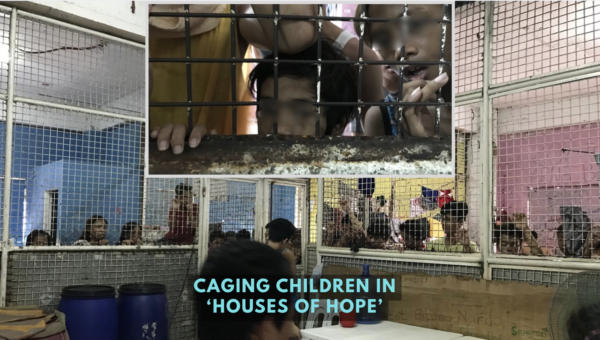


Interior Secretary Jonvic Remulla says young people loitering after 10 p.m. will be arrested. Well-meaning, perhaps, but legally infirm. A child caught out past curfew is supposed to be taken home, not taken into custody. The law treats it as a welfare issue, not a criminal one.

INTERIOR Secretary Jonvic Remulla made it plain at a press briefing Monday, April 6: streets in Metro Manila are no longer a place for young people at night. “If you are not studying or working, you should not be outside after 10 p.m. Go home. Those loitering on the streets will be apprehended,” Remulla said, referring to minors aged 18 and below.
The announcement was part of a broader push Remulla is calling the “Safer Metro Manila Plan,” which also covers a ban on public drinking, late-night karaoke, and men going shirtless outdoors. Remulla ordered the Philippine National Police to arrest individuals drinking on streets, using karaoke beyond prescribed hours, appearing topless in public, and violating curfew ordinances. The pilot, which he also referred in the briefing as “Safer Cities Initiative,” will run in Metro Manila this month before expanding to Cebu, Baguio, Bacolod, and Davao.
It sounds decisive and many Filipinos welcomed the initiative. The problem is it may not be legal.
No Warrant, No Arrest
Ephraim Cortez, president of the National Union of Peoples’ Lawyers, is direct about this: a Cabinet secretary does not have the power to order anyone arrested. That authority, under the 1987 Philippine Constitution, belongs to the courts, specifically through a judge-issued warrant of arrest. Warrantless arrests are allowed, he points out in a public post on Facebook, but only in three tightly defined situations: when a crime is about to be committed, is being committed, or has just been committed in the presence of an arresting officer. And critically, the act in question has to actually be a crime, not just something a Cabinet secretary has deemed undesirable.
That last point matters more than it might seem. A ministerial announcement does not create a crime. Only law or validly enacted ordinance can do that, and even then, the Supreme Court has laid down clear limits on when a violation of local ordinance can justify an arrest.
In its December 2023 ruling in Ridon vs. People of the Philippines (G.R. No. 252396), the Supreme Court ruled that a person who violates an ordinance that carries only a fine — not imprisonment — cannot be taken into custody on that basis alone. No warrantless arrest, and no valid search to follow. The court also drew a sharp line around “stop and frisk” searches: they require actual, pre-existing reasonable suspicion, not a hunch, and not the fact that someone flinched or walked away when approached by police. The court noted that fleeing after being accosted for an ordinance violation “does not necessarily indicate guilt” — the person may simply have not wanted to be apprehended, which is not, by itself, a crime.
Children Are Protected
Even setting aside constitutional limits on arrest, there is a law on the books that speaks directly to what Remulla is threatening: Republic Act 9344, the Juvenile Justice and Welfare Act of 2006, strengthened by Republic Act 10630 in 2013.
Under Section 57 of RA 9344 as amended, any conduct not considered an offense or not penalized if committed by an adult shall not be considered an offense and shall not be punished if committed by a child. The law goes further. Ordinances concerning juvenile status offenses such as, but not limited to, curfew violations, truancy, parental disobedience, anti-smoking and anti-drinking laws, as well as light offenses and misdemeanors against public order or safety shall be for the protection of children. No penalty shall be imposed on children for said violations, and they shall instead be brought to their residence or to any barangay official.
In plain terms: a child caught out past curfew is supposed to be taken home, not taken into custody. The law treats it as a welfare issue, not a criminal one. Instead of punishing juvenile offenders and treating them as criminals, the state and the community provide assistance to prevent them from committing future offenses.
International Law
The Philippines is a signatory to the United Nations Convention on the Rights of the Child, which obligates the state to treat the detention of a child only as a last resort and for the shortest appropriate period. Article 37 of the UNCRC prohibits arbitrary arrest and detention of children, while Article 40 requires that children in contact with the law be treated in a manner consistent with their dignity and age, with diversion and rehabilitation prioritized over punishment. As an offshoot of the UNCRC, RA 9344 intends to deal with children without resorting to judicial proceedings.
The UN’s Beijing Rules — the Standard Minimum Rules for the Administration of Juvenile Justice — similarly stress that contact between young people and the formal justice system should be minimized, and that deprivation of liberty should never be used as a punitive tool for minor infractions.
Threatening mass arrests of young people found outside after dark runs against all of this.
Intent vs. the Law
To be fair, Remulla’s stated goal is not entirely unreasonable: streets in many Metro Manila communities have real problems with gang activity and public disorder. During a press briefing, Remulla said he would strictly implement curfew for minors, explaining that streets are being turned into a haven for “rugby boys” and members of youth gangs.
Remulla himself pointed to a 60% drop in crime since 2016 as evidence that law enforcement is working. That figure, if accurate, raises a reasonable question: if the numbers are already moving in the right direction, why is the response a sweeping arrest threat against teenagers on sidewalks?
His press release is candid about what the initiative is really about: not crime reduction, but perception. “They trust the police,” Remulla said, “but their number one issue is criminality, because they don’t really feel the presence.”
But chasing teenagers off sidewalks after 10 p.m. may make streets look orderly but it does not make them safer. And it comes at the expense of rights the law explicitly protects. Sweeping declarations such as Remulla’s do not distinguish between a teenager walking home from a night shift and one looking for trouble. The law was written with exactly that distinction in mind.
What Remulla can legitimately order is enforcement of existing local government ordinances, where those ordinances carry criminal penalties. What he cannot do — and what the Constitution, the Supreme Court, and RA 9344 all prohibit — is turn a secretary’s press conference into a warrant of arrest. Good intentions do not fill that gap.
The DILG has not released a formal memorandum circular detailing the legal basis for the crackdown as of press time. Remulla said he intends to issue one directing local government units to create supporting ordinances, but that memo does not yet exist, which means the legal authority for the arrests he is promising is, for now, also nonexistent. (Rights Report Philippines)