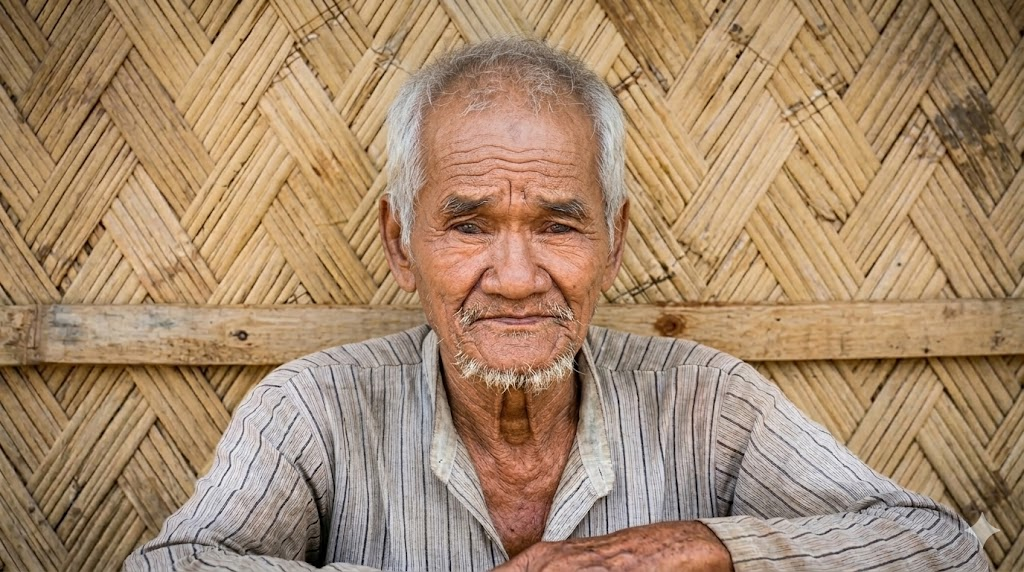

A MAJOR study finding that older Filipinos are financially vulnerable, nutritionally at risk, and underserved by existing health programs is getting fresh attention — and researchers say the country needs to act fast as its elderly population grows.
The study examined the health, nutrition, and quality of life of older adults living across three provincial cities and 12 barangays, with 562 participants taking part. Researchers describe it as among the most thorough examinations of elderly Filipino health and nutrition ever conducted.
The research, called the Healthy Aging Program for Pinoy, or HAPPY Senior Citizens, was published back in May 2025 in the journal AIMS Public Health. It was highlighted on Thursday by the University of the Philippines Office of the Vice President for Academic Affairs as part of its research communications effort — bringing renewed visibility to findings that deserve a wider audience.
The renewed attention comes at a telling moment. According to the Philippine Statistics Authority, the country could cross the United Nations threshold for an “aging population” as early as 2030, when 7 percent of Filipinos are projected to be 65 or older. Government projections suggest that share could reach 12 percent by 2050. The country is, in other words, aging faster than its systems are prepared for.
What the Study Found
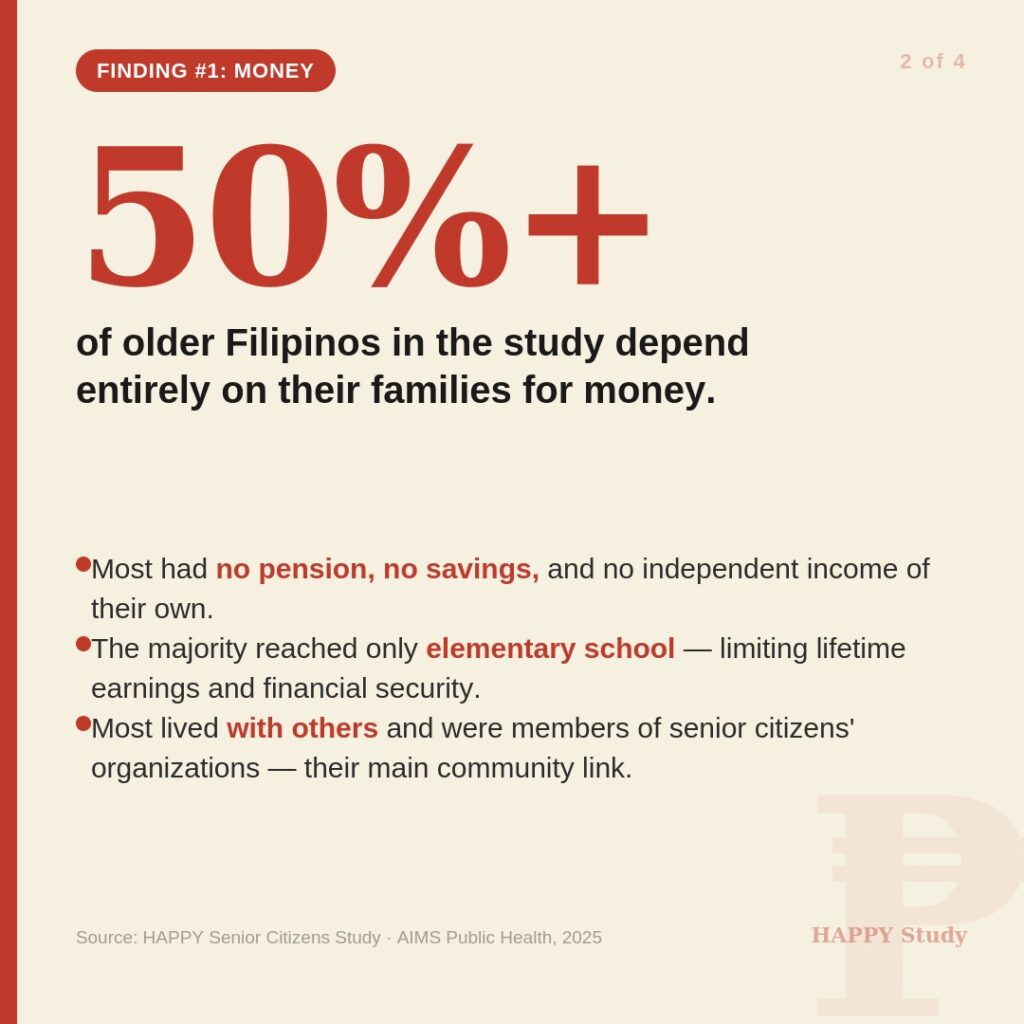
More than half of the study’s participants depend on their families for financial support, a finding that cuts to the heart of what retirement actually looks like for most Filipinos.
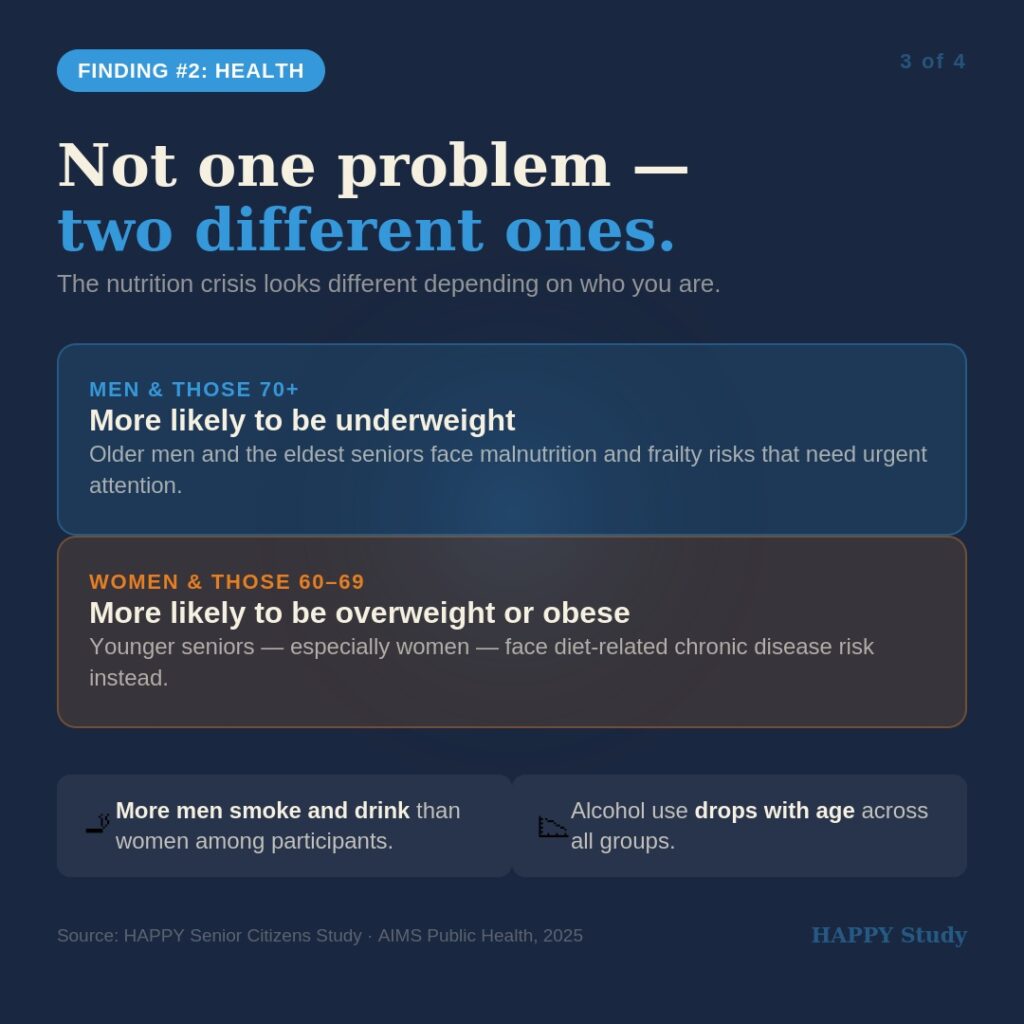
The health picture is split along gender and age lines. Men and those aged 70 and above are more likely to be underweight, while women and those between 60 and 69 tend toward being overweight or obese. That means malnutrition and diet-related chronic illness are happening simultaneously within the same population — a problem that demands different solutions for different groups. Male participants were more likely to smoke and drink, while drinking in general became less common among the oldest age groups.
The typical participant had no education beyond elementary school, shared a home with family or others, and was active in a local senior citizens’ organization — a profile that researchers say should directly shape how programs are designed and delivered.
Why There’s No Safety Net
The study does not examine retirement policy in depth, but its central finding — that most elderly Filipinos depend on family money — reflects a broader structural reality that external data helps explain.
There are no retirement plans like 401(k) in the Philippines. There is no widespread employer-matched savings system. The primary retirement mechanism for private-sector workers is the Social Security System, which pays monthly pensions based on how long and how much a worker contributed. Independent data suggest the amounts are modest at best, and many Filipinos never qualify at all.
According to the Department of Finance, the average monthly SSS retirement pension just before the government’s 2025 reform was about Php 4,923 pesos. A separate analysis by HelpAge International found that about a third of SSS retirees receive less than Php 2,000 a month. According to an independent social protection research, around 60 percent of the Philippine workforce is in the informal sector, meaning millions of workers were never consistently paying into SSS to begin with. For them, retirement savings simply don’t exist in any formal sense.
For the poorest seniors with nothing, the Department of Social Welfare and Development provides a social pension, but according to published government and media reports, that amounts to just Php 1,000, and as of late 2025, more than one million eligible seniors were still on the waitlist due to lack of funding.
Taken together, this external data helps contextualize what the HAPPY study found on the ground: when more than half of elderly Filipinos lean on family for money, that is not a cultural preference. It is a structural reality. In the absence of sufficient state support, the family is the retirement plan.
What Government Has Done — and Where It Falls Short
The HAPPY study does not evaluate government programs directly, but its call for “evidence-based policies” points toward a system that researchers believe has not yet risen to the challenge. A look at existing policy and independent evaluations helps fill in why.
Over the past three decades, the Philippines has built a legal framework for senior citizens that looks reasonably solid on paper. It started with Republic Act 7432 in 1992, which created the Office for Senior Citizens Affairs in every city and municipality. The OSCA is mandated to plan programs for seniors, maintain a list of registered elderly residents, issue identification cards, and help seniors assert their rights under the law.
That law was expanded in 2003 and again in 2010, when Republic Act 9994, the Expanded Senior Citizens Act, came into force. Under it, seniors are entitled to a 20 percent discount on medicines, medical services, transportation, restaurants, and leisure activities, along with VAT exemptions and priority lanes in banks, hospitals, and government offices.
More recently, according to the Department of Finance, the SSS launched a Pension Reform Program in 2025 that will increase retirement and disability pensions by about 33 percent over three years. But even a 33 percent increase on a pension averaging Php5,000 a month still leaves most retirees far below a living wage — a gap the HAPPY study’s findings implicitly underscore.
The gap between law and reality, meanwhile, has been well documented by independent researchers. A study by Eastern Visayas State University found that implementation of RA 9994 has been significantly inconsistent, particularly in hospitals, grocery stores, and the transportation sector, and that government directives were not successfully reaching the seniors they were meant to help. Separately, data from the Commission on Audit found that many LGUs fail to fully implement mandated benefits due to budget constraints or lack of infrastructure.
Birthday Cakes and Free Movies: When Care Looks Better Than It Is
Beyond national law, local governments have layered on their own perks — and some are genuinely generous, based on publicly available LGU records and local ordinances.
Makati City offers senior residents unlimited free movies at several malls, annual cash gifts ranging from Php3,000 to Php5,000 depending on age, free medicines, and subsidized health services. Taguig gives annual cash gifts ranging from Php3,000 to Php10,000, free cinema screenings at multiple malls, and operates a multi-story elderly center with free geriatric consultations. Cebu City provides Php1,000 monthly in financial assistance to all senior residents, plus additional cash aid for those 80 and above.
These are real benefits — and for seniors in well-resourced cities, they provide genuine relief. But, apart from the fact that these LGUs do these for political purposes, especially during elections, they also reveal something uncomfortable about how the country has chosen to frame aging.
Birthday cakes and cinema passes are visible. They are easy to photograph, easy to announce at a press conference, and easy to feel good about. They signal that a city cares about its elderly. What they don’t address is the reason an elderly person needs that birthday cash gift in the first place — because, as the HAPPY study found, more than half of them have no meaningful income of their own.
LGU benefits like free movie passes and birthday cash gifts are concentrated in cities like Quezon City, Cebu, and Makati, while implementation of even the most basic support remains uneven in rural areas where resources are more constrained. And crucially, according to legal analysis of existing statutes, there is no nationwide law guaranteeing a cash gift at age 80 — what many call the birthday gift typically comes from local ordinances that vary dramatically from one city or municipality to the next. For the majority of Filipino seniors who don’t live in a wealthy urban LGU, these perks simply don’t exist.
This patchwork system creates a troubling illusion. Programs and policies on the surface can look like a functioning safety net. Elderly Week celebrations, Elderlympics competitions, and Grandparents’ Day events are well-intentioned. But they also risk becoming a kind of theater that substitutes for the harder, more expensive work of structural reform: building a retirement system that doesn’t require seniors to win the geographic lottery of being born in Makati rather than a rural municipality in Samar. And according to social protection researchers, women are disproportionately left behind — they were less likely to have been in continuous formal employment, meaning fewer SSS contributions, smaller pensions, and greater dependence on family or whatever their LGU happens to offer.
What Researchers Say Must Change
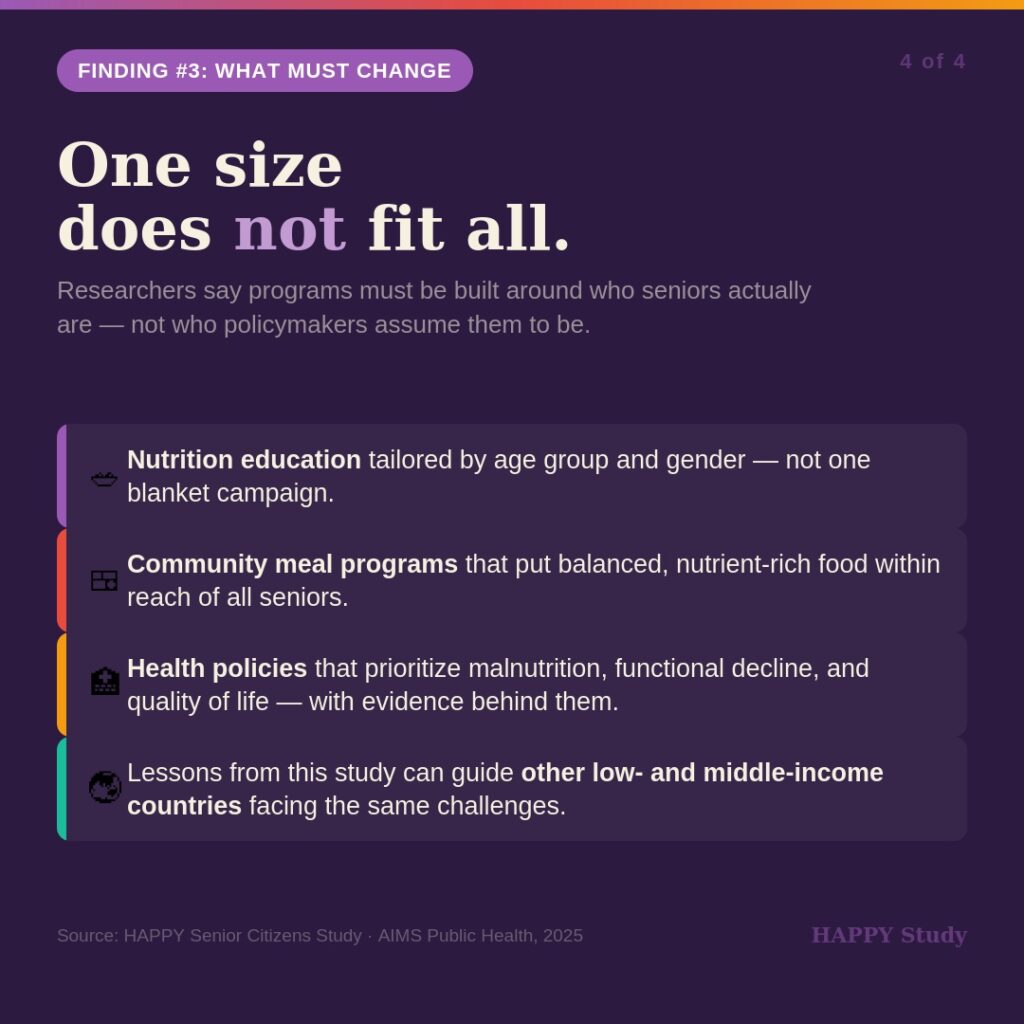
The HAPPY study was conducted as part of the United Nations’ Decade of Healthy Ageing initiative, a global effort running from 2021 to 2030. Its authors called for nutrition education, community meal programs, and evidence-based policies that address malnutrition and improve functional capacity — with programs tailored to different age groups rather than treating all seniors as one group.
Those recommendations land in a policy environment that, by the government’s own admission, is still catching up. The Commission on Population and Development has previously acknowledged that the country is still working toward full universal health care implementation even as the senior population climbs.
There are signs of movement on other fronts. Legislators have proposed a universal monthly pension of at least Php1,000 for all senior citizens, not just the indigent, but according to published reports, as of early 2026, that measure remains pending full legislative approval and is not yet law.
The study’s authors also noted that other countries with similar economies and demographics could draw lessons from their findings, making this more than a Philippine story. But for the more than 7 million Filipinos already 65 and older, the lesson is immediate, personal, and overdue. After all, a free movie pass, however welcome, does not put food on the table. (Rights Report Philippines)