

Transport groups have announced strike threat while Ibon Foundation calls government measures “cosmetic.” Because of the impacts, the increase also raises concern about violations of international human rights laws.
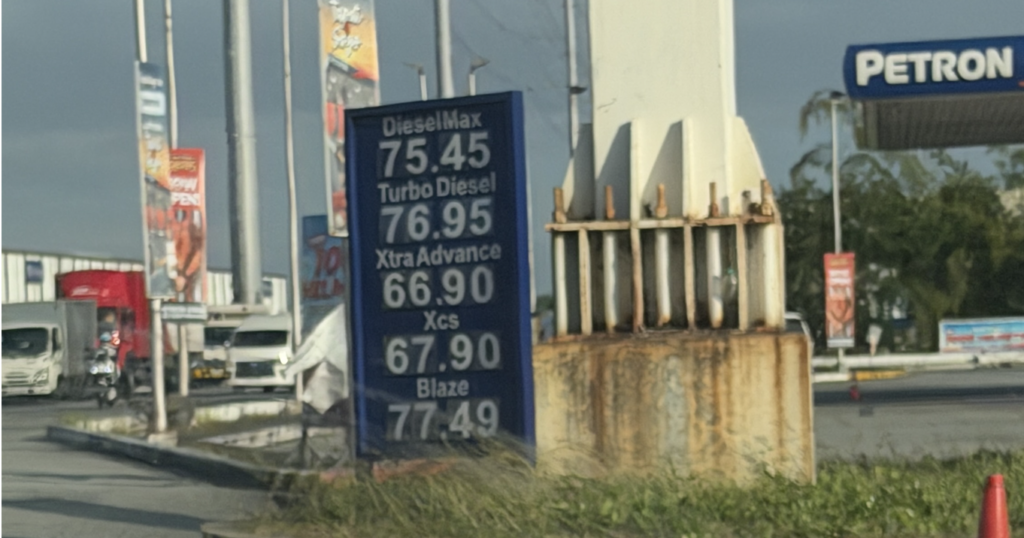
FOR jeepney drivers already absorbing 11 straight weeks of diesel price increases, for fisherfolk whose motorized bancas run on kerosene now set to jump by as much as P38.50 per liter, and for urban poor households spending the largest share of their incomes on fuel-dependent goods, Tuesday’s historic pump price hike is not an economic indicator. It is a direct assault on survival.
The Philippines on March 10 recorded its largest-ever single-week fuel price adjustment, with oil companies rolling out staggered increases of P17.50 to P24.25 per liter for diesel, P7 to P13 for gasoline, and P32 to P38.50 for kerosene — the increases to be implemented in tranches through the week. The hikes are the latest in an unbroken series driven by the escalating US-Israeli military campaign against Iran, which has sent global crude benchmarks to historic highs.
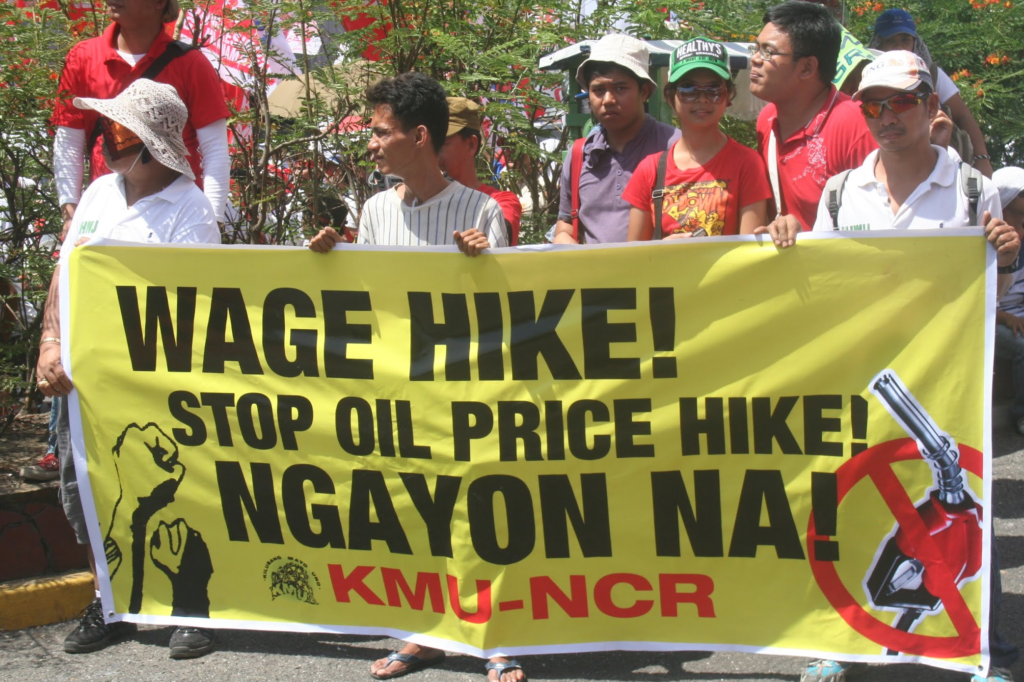
Transport alliance PISTON (Pagkakaisa ng mga Samahan ng Tsuper at Operator Nationwide)announced plans for a nationwide transport strike by the end of March. Spokesperson Sonny Floranda said drivers and operators have been losing income since the start of 2026, their earnings eroded by weekly fuel hikes while fares remain frozen pending a protracted regulatory approval process. He called for the outright repeal — not merely amendment — of theOil Deregulation Law (Republic Act 8479), which stripped government of price regulation authority in 1998. “In 28 years of implementation, it has not produced a single benefit for drivers, operators, or commuters,” he said.
Cascading Effects
Research group Ibon Foundation warned that the cascading effects of the hike will reach far beyond the pump. Rising fuel costs trigger increases across the entire supply chain — in transport fares, food prices, and the cost of basic goods — that fall heaviest on those who spend the greatest proportion of their income on necessities.
Ibon executive director Sonny Africa described the government’s announced measures as insufficient, arguing they “avoid taking real responsibility.” Ibon has called for the immediate suspension of both excise taxes and the 12% value-added tax on petroleum products, a move it estimates would reduce gasoline prices by P16 to P17 per liter, diesel by approximately P13, and kerosene by P8. Africa also noted that the government will collect an additional P1.3 billion per month in VAT revenues from gasoline and diesel alone as a result of the hike — a windfall, he argued, that should instead be directed back to affected sectors.
For small-scale fisherfolk, the kerosene spike is particularly severe. Kerosene powers motorized bancas and lights homes in coastal communities that have no access to the electricity grid — communities where the majority of the estimated 1.6 million small fisherfolk households operate with no savings buffers and no formal social protection.
A near-60% single-week increase in a fuel they cannot substitute means many will simply stop fishing, reducing market supply, driving food prices higher, and compounding the inflationary pressure already bearing down on poor consumers. The Philippine Resource Center for Inclusive Development, drawing on Ibon research, has documented how oil price shocks “worsen economic vulnerability, disrupt livelihoods, and deepen inequality” across fisherfolk, informal vendors, and low-income communities.
Senator Sherwin Gatchalian urged President Ferdinand Marcos Jr. to immediately release emergency fuel subsidies from the executive’s P12-billion contingency fund, bypassing the standard trigger mechanism that requires global oil prices to reach $80 per barrel before regular subsidy programs activate. “If we wait that long, a lot of people will suffer. Too many drivers will suffer,” he said.
The Marcos administration has announced the activation of the “Pantawid Pasada” subsidy program for public utility vehicle drivers, fuel and fertilizer assistance for farmers and fisherfolk through the Department of Agriculture, and P3.5 billion in Department of Transportation funds for commuter subsidies and free bus rides on select routes. Marcos has also said he will seek emergency powers from Congress to temporarily reduce excise taxes on fuel.
Human Rights Obligations
Human rights advocates argue these measures are structurally inadequate and that the government’s obligations run deeper than emergency aid. The Philippines is a state party to the International Covenant on Economic, Social and Cultural Rights (ICESCR), ratified in 1974, which guarantees the right to an adequate standard of living (Article 11), the right to work and freely choose one’s occupation (Article 6), and the right to fair wages sufficient for a decent existence (Article 7).
The UN Committee on Economic, Social and Cultural Rights has established in General Comment No. 3 that states bear a minimum core obligation to protect the most vulnerable from deprivation — an obligation that cannot be suspended during periods of economic hardship.
The UN Guiding Principles on Business and Human Rights further require governments to ensure that corporations, including oil companies, do not cause or contribute to human rights harms through their pricing and business practices.
Ibon data underscores how fragile the baseline is into which the crisis is detonating. Over half of Filipino families — some 14.3 million households — rated themselves as poor as of late 2025, a figure 2.1 million higher than at the start of the Marcos administration. Nearly two-thirds described themselves as poor or borderline poor.
Analysts warn the current crisis risks reversing recent marginal gains in inflation management. The Train Law (Republic Act 10963), which imposed additional excise taxes on fuel in 2018, compounded the harm inflicted by RA 8479 by adding a fiscal burden that oil companies passed directly to consumers, Ibon has argued — disproportionately hitting the poor, who spend the greatest share of their income on fuel and fuel-dependent goods.
The DOE has acknowledged it lacks the legal authority to regulate prices under the deregulation framework, and can only appeal to oil companies to implement adjustments voluntarily. Of 87 gas stations inspected in the first days of monitoring, 71 were found in violation, including 55 flagged for implementing price hikes ahead of the mandated schedule.
The Marcos administration has not committed to a timeline for the proposed excise tax reduction or set firm conditions for the release of emergency contingency funds. Civil society groups say the clock is already running out. (Rights Report Philippines)