
Residents in the southern Philippines, the bailiwick of Rodrigo Duterte, got an unexpected civic education as Duterte’s confirmation hearings exposed Filipinos to a brand of accountability they rarely see at home
By Cong Corrales
Rights Report Philippines
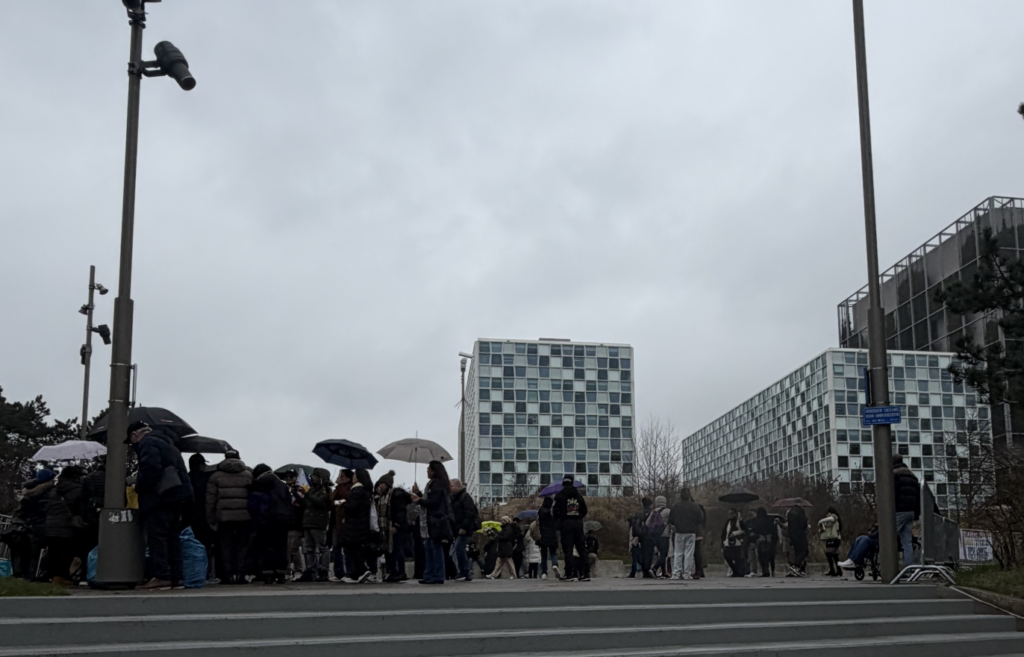
CAGAYAN DE ORO CITY — For most Filipinos, international justice exists somewhere between abstraction and irrelevance, a distant system built for other countries’ crises, other people’s dictators. The confirmation of charges hearings against former President Rodrigo Duterte last month at the International Criminal Court changed that, at least for those paying attention.
From Cagayan de Oro to The Hague, some in Mindanao — the geopolitical heartland of the former president — found themselves navigating unfamiliar legal terrain: What a “confirmation hearing” actually means, why it differs from a full trial, what the Rome Statute requires a prosecution to prove, and why a defense counsel’s opening gambit matters less than the evidentiary record that follows.
For a country where due process is often a casualty of the very institutions sworn to uphold it, the proceedings were, in the words of one local, something Filipinos simply don’t get to see at home.
“The ICC was created specifically to run after impunity,” noted human rights lawyer Dexter Lopoz, whose brother Rex Jasper Lopoz was murdered during the drug war. The intense trolling surrounding the case, he added, only proved that a fair trial in domestic courts remains impossible, underscoring precisely why an international forum exists in the first place.
Evidence Versus Rhetoric
The hearings delivered a masterclass in opposing legal strategies: one grounded in evidence, the other in theater.
ICC Deputy Prosecutor Mame Mandiaye Niang anchored the prosecution’s opening on a foundational principle: “Those in power are not above the law.” Niang argued that Duterte wielded “ultimate influence and authority” over a systematic campaign of killings, characterizing documented cases as “merely a fraction of the overall criminality” of the drug war. One of victims’ counsels, Joel Butuyan, followed with a pointed warning: Failing to confirm the charges would allow Duterte to return to the Philippines as a “conquering hero” who continues “gospeling impunity.”
Pat Jared Pangantihon, a climate justice advocate in Northern Mindanao, said he was struck by the prosecution’s “dispassionate and unambiguous method,” a presentation style rarely encountered in Philippine legal culture, where proceedings are often more combative than methodical.
“The playing of the video clips where Duterte openly admits to having a hand in the extrajudicial killings blatantly shows a person who sees himself above and beyond the law,” Pangantihon said.
Misreading the Room
If the prosecution offered a lesson in international criminal procedure, the defense offered a lesson in what doesn’t work before an ICC pre-trial chamber.
Lead defense counsel Nicholas Kaufman dismissed Duterte’s public kill orders as mere “hyperbole, bluster, and rhetoric” and painted the former president as a frugal leader who grew up subsisting on “dried fish and boiled rice,” arguing his harsh language was a protective measure for the poor, not a murder directive.
The strategy landed poorly with Mindanao observers who understood the ICC’s evidentiary standards well enough to recognize that rhetorical appeals don’t substitute for legal arguments.
Antonio Montalvan, a Kagay-anon pundit in self-exile due to online harassment, put it bluntly: “Kaufman wasn’t talking in a courtroom. It was like he was rabble-rousing a DDS rally in Duterte Street.”
Rev. Felixberto Calang, Iglesia Filipina Independiente Bishop and Co-Convenor of Sow the Seeds of Peace in Mindanao, was quick to dismantle the rags-to-riches framing: “Is there an impoverished governor in the country? I know of none.” It’s a pointed reference to Duterte’s father, who served as a provincial governor.
Beyond the Courtroom
For many observers, the proceedings represented more than legal spectacle. They offered a framework – one largely absent from Philippine institutional life — for understanding what accountability for mass atrocity is supposed to look like.
Charlito “Kaloy” Manlupig, a Cagayan de Oro-based humanitarian worker, criticized the defense’s performance as falling “short of what the public is entitled to expect in proceedings of this magnitude,” a comment that itself reflected a new standard of expectation the hearings were quietly installing.
Jessiemer Loi Algarme, station manager at Juander Radyo, said he would be “happier if this is confirmed after the pre-trial and proceeds to a full trial so that justice is fully served,” demonstrating a grasp of ICC procedural stages that would have been unusual knowledge for most Filipinos just months ago.
Fr. Raymond Ambray, convenor of the Save Our Schools Network, tied the hearings to the fourth anniversary of the killing of the “New Bataan 5,” volunteer teachers and community workers slain in Davao de Oro. “For Indigenous peoples, the ICC proceedings signify that state power is not beyond accountability,” Ambray said. “The struggle against impunity continues.”
Not everyone felt the proceedings spoke to their lives. Lourderico Pedimonte, a local motorela (tricycle) driver, expressed a fatalism familiar to many at the margins: “Even if I take an interest in the ICC hearings, it still won’t help our situation. The ruling classes — the bosses — don’t want that.”
His skepticism is not without basis. But for those who watched closely, the hearings offered something the Philippine justice system has long struggled to provide: a demonstration that the law, at its best, does not bend to power. Whether that lesson takes root is another question entirely.
Honey Pisos, president of the Cagayan de Oro Press Club, may have offered the most apt summary of where responsible observers should stand: “My position is anchored on respect for due process and the rule of law. What matters most is that proceedings are conducted fairly, transparently, and in accordance with international legal standards.” (Rights Report Philippines)
Leonardo Vicente “Cong” Corrales is a journalist based in Cagayan de Oro City. He was a writing fellow for Vera Files and served as deputy director of the multimedia desk at the Philippine Center for Investigative Journalism.