Most Filipinos have never heard of No Peace Without Justice. But for nearly a decade, this Rome-based advocacy group quietly helped build one of the most consequential human rights cases in Southeast Asian history: the International Criminal Court prosecution of a sitting head of state for crimes against humanity.
WHEN Rodrigo Duterte was still just the mayor of Davao City, he already had a reputation for ordering people killed. When he became president of the Philippines in 2016 and announced a national “war on drugs,” one organization in Europe was paying close attention — and taking notes.
Most Filipinos have never heard of No Peace Without Justice. But for nearly a decade, this Rome-based advocacy group quietly helped build one of the most consequential human rights cases in Southeast Asian history: the International Criminal Court prosecution of a sitting head of state for crimes against humanity.
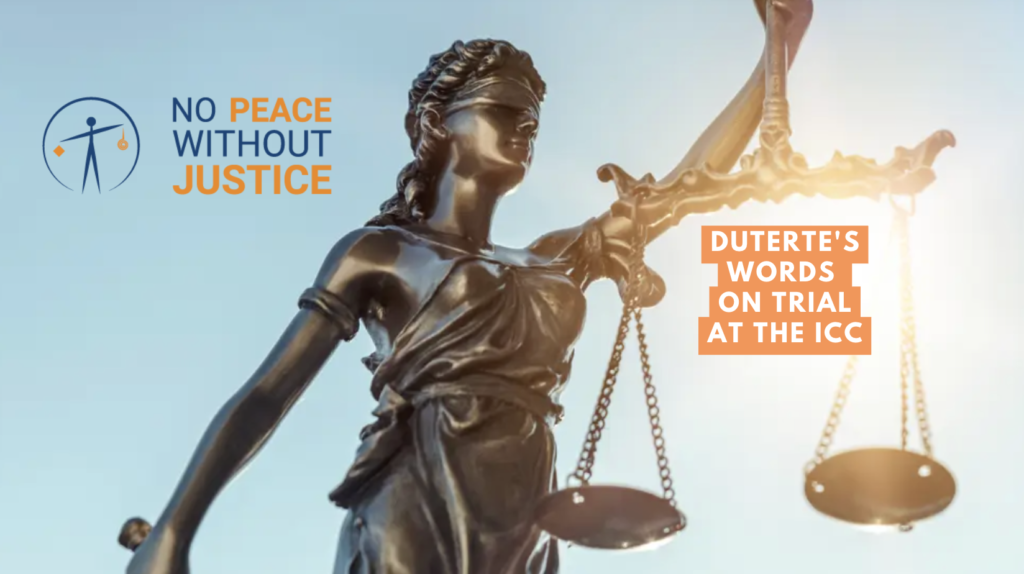
It started early. Even before Duterte’s body count had fully registered with the international community, NPWJ’s legal team was already analyzing his public speeches under the Rome Statute, the treaty that governs the ICC. The central question they asked — and answered — was whether a leader’s public words could, on their own, constitute criminal liability for the murders that followed.
In November 2016, just months into Duterte’s presidency, NPWJ legal director Alison Smith presented the group’s findings at the ICC’s Assembly of States Parties in The Hague. The side event’s title was blunt: “International Criminal Liability for Spoken Word Alone.” Smith’s conclusion was equally direct: the killings accompanying Duterte’s drug war most likely constituted crimes against humanity. Then-ICC Prosecutor Fatou Bensouda said she would be watching.
In March 2017, NPWJ co-sponsored a United Nations forum in Vienna where Vice President Leni Robredo delivered a historic speech denouncing the drug war — one of the first major political figures to do so publicly on an international stage. The late Commission on Human Rights chairman Chito Gascon was also there.
But the work didn’t stop at press events and conference rooms. Over the following years, NPWJ conducted 15 training and mentoring sessions — seven in person, eight online — to help Filipino human rights workers document abuses in ways that could hold up before an international court. It helped the Commission on Human Rights build an analysis unit from scratch. It trained civil society groups on witness interviews, evidence handling, and how to construct an airtight legal case. It connected Filipino activists directly to ICC investigators.
I can speak to this personally. In 2018, NPWJ facilitated several hours of my conversations with ICC investigators. It also helped arrange a meeting between ICC staff and a key witness — the third member of the so-called Davao Death Squad.
This was painstaking, unglamorous work, made harder by the COVID-19 pandemic and by a Duterte administration that systematically dismantled the country’s human rights institutions. The democratic space for civil society in the Philippines shrank to nearly nothing. NPWJ stayed anyway.
Then came a crisis closer to home. NPWJ was hit with accusations that were later found to be unsubstantiated, leading to the arrest of its secretary-general and the freezing of its operating funds — funds meant for advocacy work in Libya, Afghanistan, Amazonia, and elsewhere. It was a gut punch to an organization already stretched thin. The timing was especially bitter: just as the Philippines was finally opening up to ICC scrutiny, one of the case’s most steadfast allies was fighting for its own survival.
The Belgian court ultimately released the secretary-general without charges. NPWJ reorganized, formed a new board, and — perhaps most tellingly — still found time to issue a statement welcoming Senator Leila de Lima’s release from years of what many consider politically motivated detention. The promise to pursue the Philippine case remained firm.
I am now a member of that new board, alongside president Tara Reynor O’Grady and fellow members Alison Smith, Carmelo Palma, and Marco Perduca. I join with full awareness of what this organization has risked — and what it still intends to do.
Looking back, NPWJ’s early insistence that “spoken words alone” could trigger international criminal liability turns out to have been prophetic. At the ICC’s Confirmation of Charges Hearing in The Hague last February, prosecutors made exactly that argument: that Duterte’s public declarations — his repeated encouragement to shoot, kill, neutralize — were not jokes or hyperbole, but incitement. That the words of the most powerful person in the country carry a weight and a lethality that ordinary speech does not. That when a president tells his people “I will kill you,” some of them end up dead in the street.
Duterte’s supporters have long called his bloodiest statements a form of expression, dark humor, the bluster of a strongman. NPWJ spent nine years quietly, methodically dismantling that defense — one training session, one documented case, one ICC briefing at a time.
Words matter. Violent words kill. And the people who proved it are still at it. (Rights Report Philippines)
Albert E. Alejo, SJ, is a faculty member at the Pontifical Gregorian University in Rome and a member of the Board of Directors of No Peace Without Justice.