
A 12-hour running gunfight should leave plenty of evidence: spent casings, trampled paths, bloodstains, bullet holes in trees or structures. These should have been documented by now. What are they hiding in Toboso?
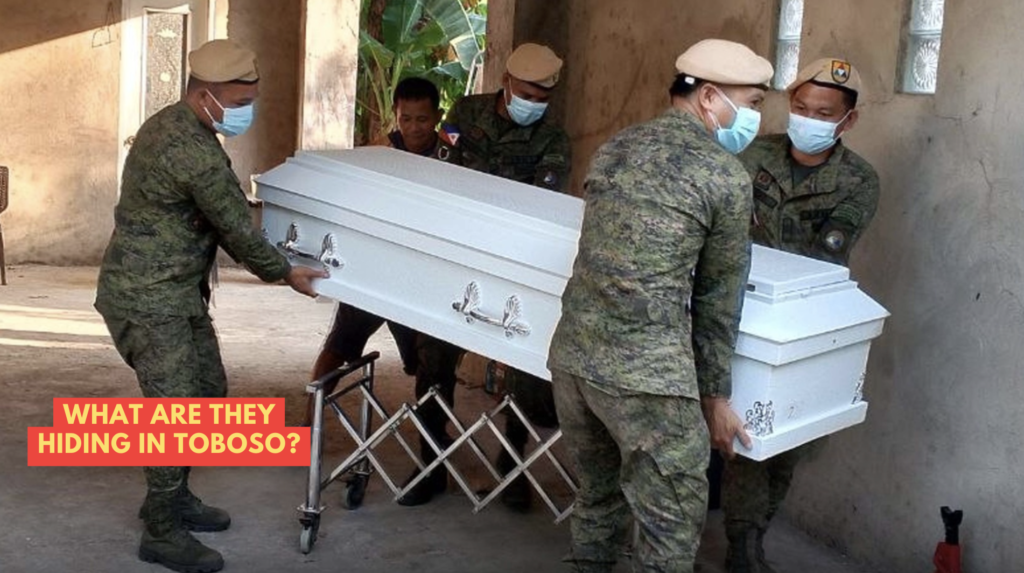
Five days after 19 people were killed in alleged firefights between the Philippine military and the New People’s Army, debate rages over whether the killings violated international humanitarian law. The military insists all the deceased were combatants, even though not all have been identified and at least one was a journalist.
Still, many questions remain unasked — and so unanswered — on details that should have been available days ago.
The military says the casualties were rebels, asking pointedly: if they were civilians, why were they in the encounter area, armed and engaging soldiers in a firefight?
Unfortunately, while the Armed Forces of the Philippines could have presented photos and other forensic evidence to back up those claims, they have chosen to ask questions instead of offering proof.
None of the news reports or official statements claimed the encounter area was an NPA camp. Since residents had to be evacuated, it appears the area is a civilian, residential one. The military initially said the rebels were in a “temporary encampment,” and reports citing the military say the “series of clashes” — which lasted 12 hours — moved from Sitio Sinugmawan in Barangay Salamanca to Sitio Plaringding, where the bodies were recovered.
If the encounter area was in fact a residential zone, then civilians had every right to be there, regardless of whether they were students from Manila or Filipino-Americans visiting the country. In a Facebook post by Toboso Mayor Richard Jaojoco about the initial evacuation, one commenter wrote that they could not leave because there was no one to guide them out — suggesting not all residents were able to escape before or during the fighting.
READ: Negros Burns, Again: Death of 19 in Army Raid Raises Hard, Familiar Questions
Another question that needed asking — and should have been easy to answer — is how residents evacuated. Did they leave on their own, as sometimes happens when fighting breaks out, or were they guided out? Did the military clear the area when the clashes started? That question matters because, if so, the AFP’s logic seems to be: the casualties must be rebels, because soldiers had already cleared out the civilians.
The AFP says it was a 12-hour firefight that stretched three kilometers from start to finish. Nineteen rebels were killed, according to the AFP, but only one soldier was injured — initially reported as having two gunshot wounds, one to each arm. He was hospitalized and later said to be in stable condition.
A question that should have been asked and answered by now — since some bodies have already been claimed by relatives — is where the gunshot wounds were and how many there were. How did those 19 people die? Were paraffin tests done to check whether the victims tested positive for gunpowder residue? A positive result, while not acceptable in other contexts, would offer far better proof than any intelligence report that those killed were combatants, not civilians.
Another question that should also be answerable by now is how many guns were actually found. A Philippine News Agency report dated April 21 — two days after the encounter — citing the Philippine Army’s 79th Infantry Battalion, says “[an] assault rifle, two rifle grenades, a hand grenade, bandoliers, 20 hammocks, backpacks, food supplies, and other personal items” were found. A Panay News report, also on April 21, says nine firearms were recovered from the encounter site — and notes that some bodies were found in fishponds. The following day, on April 22, the Philippine Daily Inquirer reported: “The Army said troops recovered 24 firearms from the scene, including seven M16 rifles, three Garand rifles, three M14 rifles, a carbine rifle, an M203 grenade launcher, six .45-caliber pistols, and three .357 Magnum revolvers.”
READ: ‘Negros 19’ Deaths Need to Be Investigated. But Who Is Credible Enough to Do it?
Neither the rifle grenades nor the hand grenade mentioned in the first report appeared in that second account.
If 19 people died and only half as many guns were found in early reports, what proves all 19 were combatants? Or if 24 firearms were eventually seized — after an initial report of nine, or just one, depending on which account you trust — and only 19 were killed, who carried the extra weapons? Where were those guns taken from, and why does the count keep changing? The bodies and whatever weapons were found beside them should have been secured once the encounter ended. The facts, at this point, should not still be in dispute.
Where were the guns — and the grenades — found in relation to the bodies? Were the deceased holding them? Which hand held which weapon? Were the fingerprints of the dead among those found on the guns and grenades? The answers to these questions would do more to establish participation in the fighting than witness accounts that could be challenged — or discredited — in court.
A 12-hour running gunfight should leave plenty of evidence: spent casings, trampled paths, bloodstains, bullet holes in trees or structures. These should have been documented by now, but there are no reports of any independent investigator having returned to the encounter area.
What proof exists that the guns recovered were actually fired? Each firearm leaves a unique mark on the bullets it discharges. Spent rounds would confirm the guns were used — and where they were found would show where they were fired. This matters because, while the bodies were reportedly recovered in one area, some claims suggest that not all of the deceased were in that location before the alleged encounter.
READ: Why the Laws of War Matter in Places Like Negros — and Why They Are Routinely Ignored
One could argue that because it was a running gun battle, there simply was no time to gather pieces of evidence. But the AFP has photographed those killed in other encounters. Why not here?
Calls for a thorough investigation have grown louder. The Commission on Human Rights has said it will conduct one — but that raises another question: why is the CHR the only body investigating?
People can argue endlessly about the beliefs and backgrounds of the deceased, or even their right to be where they were. But the core question stands: What evidence actually backs up the military’s claims? Or will this come down, once again, to the reliance on eyewitness testimony that often fail? (Rights Report Philippines)