CONTEXT CHECK: Both sides in the Philippines’ communist insurgency have formally committed to follow the rules of war. In Negros Occidental and elsewhere, they have repeatedly broken them.
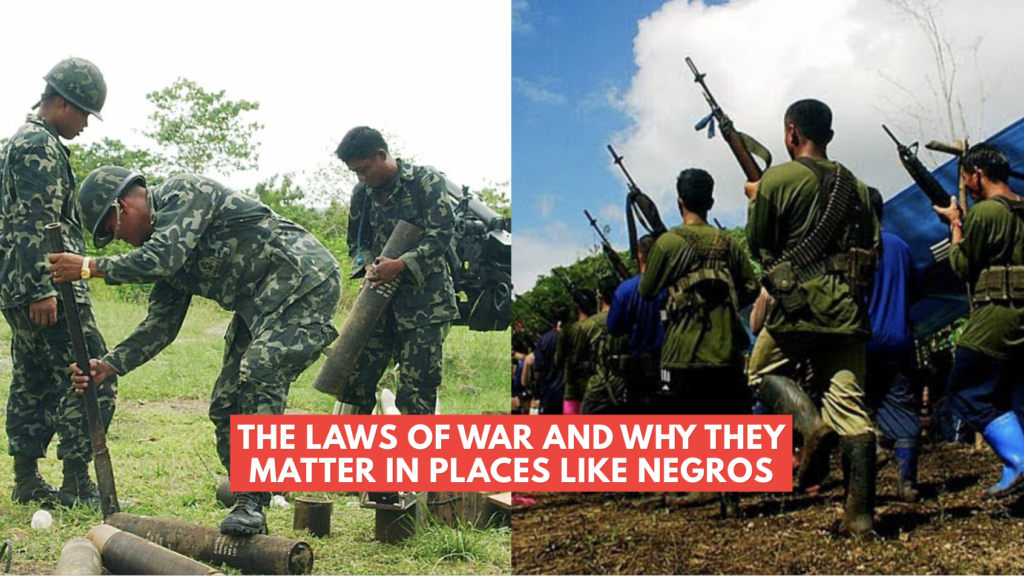
WHEN human rights and activist groups such the International Coalition for Human Rights in the Philippines called for an investigation into the April 19 killings in Toboso, they framed their demand around potential violations of international humanitarian law (IHL). That phrase appeared in statements from the U.P. Office of the Student Regent, the Student Christian Movement of the Philippines, San Carlos Bishop Gerardo Alminaza, and several other groups and individuals since the alleged “massacre” by state forces of 19 individuals.
In a country with the longest-running communist insurgency in the world, it is not surprising that IHL comes up quite often. It is violated with even greater regularity.
What IHL Actually Says
International Humanitarian Law is the set of rules that governs what combatants may and may not do during armed conflict. The foundation is the four Geneva Conventions of 1949 and their Additional Protocols, all of which the Philippines has signed and ratified.
The most important provision for a conflict like the one in Negros — a domestic war between a government and a rebel group — is Common Article 3, which appears in all four treaties. As the ICRC explains, it requires all parties — government forces and armed groups alike — to treat humanely anyone not actively participating in hostilities. It expressly bans murder, torture, mutilation, hostage-taking, and executing anyone without a fair trial. It binds both the Armed Forces of the Philippines (AFP) and the NPA.
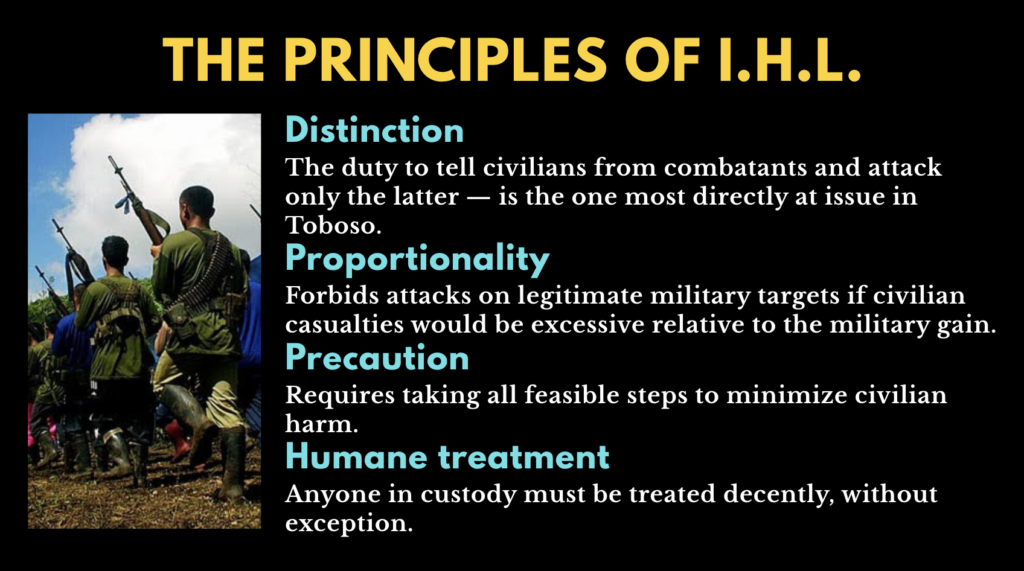
Four principles flow from these obligations. Distinction — the duty to tell civilians from combatants and attack only the latter — is the one most directly at issue in Toboso. Proportionality forbids attacks on legitimate military targets if civilian casualties would be excessive relative to the military gain. Precaution requires taking all feasible steps to minimize civilian harm. Humane treatment means anyone in custody must be treated decently, without exception.
These are not guidelines. They are binding legal obligations — and nowhere in the Philippines do they matter more than in Negros Occidental, where decades of counter-insurgency operations have repeatedly blurred the line between armed combatants and the farming communities around them.
Who Is a Legitimate Target?
This is the core legal question raised by the Toboso operation, and it is worth spelling out clearly.
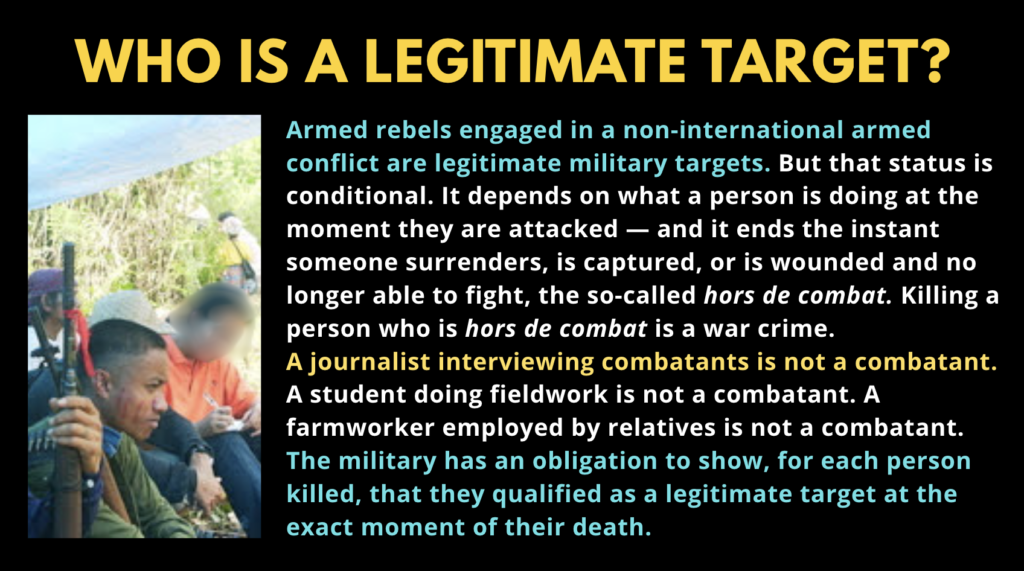
Under IHL, armed rebels engaged in a non-international armed conflict are legitimate military targets. But that status is conditional. It depends on what a person is doing at the moment they are attacked — and it ends the instant someone surrenders, is captured, or is wounded and no longer able to fight. The Latin term for this is hors de combat, “out of the fight,” and killing a person who is hors de combat is a war crime under Common Article 3.
Soliman M. Santos Jr., a retired Regional Trial Court judge from Naga City and a longtime IHL lawyer who sits on the editorial board of the International Review of the Red Cross, made this distinction plain in a 2017 Inquirer column: “It cannot be presumed a priori that ‘no armed NPA will surrender to authorities,’ because it has in fact happened. And any lethal self-defense can be justified only in the face of armed resistance.”
That matters in Toboso. A journalist researching farming communities in Sitio Plaringding was not presenting armed resistance. A student doing fieldwork was not a combatant. A farmworker employed by relatives was not a combatant. If any of the 19 dead were killed while not actively fighting — or after the fighting had stopped — then RA 9851, the Philippines’ domestic war crimes law, was potentially violated. The military has an obligation to show, for each person killed, that they qualified as a legitimate target at the exact moment of their death.
What Philippine Law Says
The Philippines has put IHL obligations into domestic law more thoroughly than almost any of its Southeast Asian neighbors. Republic Act 9851, signed in December 2009, defines and penalizes war crimes, genocide, and crimes against humanity, creates special courts to try them, and establishes that Philippine courts have jurisdiction regardless of where the offenses occur. The ICRC itself has described the law as a significant step in domestic IHL enforcement — though it has also identified awareness and implementation as persistent challenges among prosecutors and investigators.
As Karapatan Secretary General Cristina Palabay has pointed out, the Philippines has signed and ratified more IHL treaties than any other country in Southeast Asia — and still produces a steady stream of credible violation reports year after year. The law is more robust than the practice.
What the Communists Formally Promised
One of the least-told dimensions of this conflict is that the rebel side didn’t simply find itself bound by IHL from the outside. It actively sought those obligations.
In August 1991, the National Democratic Front of the Philippines, the political wing of the Communist Party of the Philippines, first declared adherence to Common Article 3 and Protocol II of the Geneva Conventions. Then, on July 5, 1996, it went further — formally depositing a Declaration of Undertaking with the Federal Council of the Swiss Government, the official custodian of the Geneva Conventions, committing to apply the full Conventions and Protocol I to its armed conflict with the Philippine government. The Swiss Federal Council acknowledged receipt and forwarded the declaration to the ICRC.
The declaration is a remarkable document. The NDFP asserted that the NPA had been “deployed in accordance with the civilized rules of warfare” even before the formal declaration, and explicitly accepted the principle of command responsibility — meaning NDFP officers bear legal responsibility for ensuring their forces follow IHL and for holding violators within their own ranks accountable.
The declaration also spelled out exactly who the NPA may legitimately attack: units of the AFP, the Philippine National Police, paramilitary forces, and intelligence agents. Not civilians. Not community workers. Not journalists.
Two years later, in 1998, both parties put a shared framework on paper. CARHRIHL — the Comprehensive Agreement on Respect for Human Rights and International Humanitarian Law — was signed by the government and the NDFP. It established a Joint Monitoring Committee to receive complaints from either side. Both parties explicitly acknowledged that “the prolonged armed conflict in the Philippines necessitates the application of the principles of human rights and principles of international humanitarian law.” The agreement’s stated purpose was to find “principled ways and means of rendering justice to all the victims” of rights violations.
The NPA’s Record
The NDFP’s formal IHL commitments did not stop the NPA from running “people’s courts” that execute civilians labeled as informants or traitors, a practice Human Rights Watch has documented and condemned going back decades. In 2011, after the NPA admitted to multiple civilian killings in Mindanao and Negros Occidental, HRW deputy Asia director Elaine Pearson was blunt: “For four decades the New People’s Army has offered excuses for cold-blooded killings of civilians. Recent attacks show that there has been no real departure from this illegal practice.”
UN Special Rapporteur on extrajudicial executions Philip Alston, who investigated the Philippines during his tenure from 2004 to 2010, found the NPA’s court system to be “either deeply flawed or simply a sham.” Pearson’s verdict: “The NPA’s ‘revolutionary justice’ is not just — it is simply old-fashioned murder.”
The problem has not gone away. HRW documented in 2022 that the NPA in Negros executed three people after “people’s court” proceedings — one man shot as he stepped out of his own house. Common Article 3 prohibits summary executions and requires fair trial standards before any punishment is imposed. The NPA accepted those standards when it signed its 1996 Declaration and again when it signed CARHRIHL. Neither commitment has prevented these killings.
HRW has consistently applied this standard symmetrically. In its Universal Periodic Review submission to the United Nations, it stated plainly that “Philippine security forces, the NPA and various Moro armed groups continue to be implicated in serious violations of international humanitarian law, including unlawful killings and attacks on civilians.” Both sides are named. Both sides are accountable.
In Negros alone, the NPA has claimed responsibility for more than 30 civilian killings since 2025, with each victim labeled an informant. The Commission on Human Rights has concluded that targeting civilians based on rebel designations violates both RA 9851 and the principle of distinction — the very principle the NDFP formally committed to in 1996. Santos, writing in Rappler in 2023, put the challenge directly: “Continue fighting if you have to. But do so according to the rules of war.”
The AFP’s Record
The AFP’s record is no better — and by volume of documented incidents, human rights groups say it is considerably worse.
The ICHRP has alleged over 22,000 people affected by AFP bombings in civilian areas between July 2022 and November 2023. HRW has found that AFP personnel and paramilitary members have been implicated in hundreds of extrajudicial killings and enforced disappearances going back to at least 2001. The U.S. State Department’s 2024 human rights report confirmed that extrajudicial killings by security forces remain a serious problem and that impunity persists.
In Negros specifically: Karapatan documented that the 79th Infantry Battalion — the same unit involved in the April 19 Toboso operation — killed farmer Jose Caramihan while he tended his rice field in Escalante in February 2024, then falsely listed him as an NPA casualty. That same operation involved attack helicopters and firepower that forced 300 families from nine villages.
In June 2023, Karapatan and ICHRP reported that Roly and Emelda Fausto and their sons Ben, 15, and Ravin, 12, had been red-tagged and harassed by soldiers of the 94th Infantry Battalion before they were killed in their Himamaylan City home. The military denied responsibility. No one has been convicted.
In February 2024, Karapatan reported that five fighters described as hors de combat were allegedly summarily executed by soldiers in Bilar, Bohol. In Iloilo, the group alsodocumented six people killed in a separate firefight bore marks of torture inconsistent with combat wounds. Karapatan also alleged that the military reportedly required families in that incident to sign away their right to legal action, an apparent attempt to foreclose accountability.
None of these cases resulted in prosecution under RA 9851. The law has been on the books since 2009. It has almost never been used.
The Gap Between Promise and Practice
The JMC that CARHRIHL established to handle complaints has not been the accountability mechanism it was designed to be. The AFP has publicly declared CARHRIHL “no longer in existence,” a claim the NDFP contests. A Kyoto Review analysis of the peace process found that in one 22-month period during the administration of President Gloria Macapagal-Arroyo, the Joint Secretariat received more than 600 complaints against both sides – and the committee met on almost none of them. (That backlog grew over time.) The late CPP founder Jose Maria Sison himself acknowledged that the result was that victims were “being denied justice.”
Santos, in a 2024 interview, urged both sides to move past military gains toward what he called “a principled and peaceful resolution of the armed conflict.” In an essay on the conflict’s human toll published on Dateline Ibalon, he put it more personally: “The leaders of both sides owe it to their fallen rebels and fallen soldiers to be as sincere and as serious in peace negotiations as their fallen rebels and fallen soldiers were in the performance of their tasks and duties.”
Why Toboso Sits in This History
The April 19 operation began before dawn and unfolded across multiple sub-villages over 12 hours. Seven of the eight firefights the Army tallied happened during pursuit operations at Sitio Plaringding — three kilometers from the initial contact site. That is where journalist R.J. Nichole Ledesma was killed. Human Rights Advocates Negros says he was not involved in any firefight. The question, under IHL, is whether he was actively participating in hostilities at the moment he was killed — or a civilian protected under the very obligations both the government and the Communists have signed.
Nobody can answer that without an investigation. That is exactly what IHL requires. Both parties have formally said they agree. But as the history of this decades-long conflict shows, neither has shown they mean it. (Rights Report Philippines)