CONTEXT CHECK: Layers of markups and taxes that push prices as high as 355%, a gutted generics law, kickbacks to doctors, and decades of regulatory failure have made the Philippines one of the most expensive pharmaceutical markets in Asia.
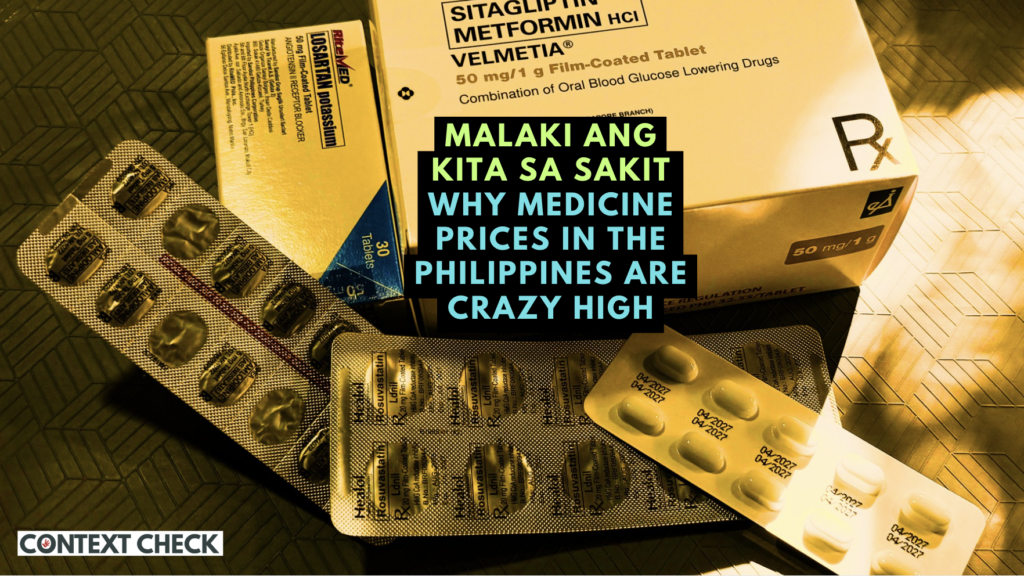
BY THE time a medicine reaches a Filipino patient, its price has been inflated by as many as five separate markups totaling as much as 273% above what the manufacturer originally charged — before a 12% value-added tax is added on top.
That is the central finding of a recent data released by Ibon Foundation, the Manila-based economic research organization, which traced the full price journey of imported medicines in the Philippines. The data shows a supply chain in which drug retailers — not manufacturers or distributors — pocket the biggest share.
According to Ibon, a typical imported medicine collects the following additions before reaching the patient: a 4.5–12.5% markup between a foreign pharmaceutical company’s head office and its Philippine subsidiary; a 20% charge covering import tariffs, freight and insurance, quality control testing fees, corporate taxes, and transport; a 5–13% distributor or wholesaler markup; a further 5–13% from the retailer; and finally, a 12% VAT.
For locally manufactured drugs, which still depend almost entirely on imported raw ingredients, the situation is worse. Ibon says distributors add as much as 355% to those products, with retailers adding another 117%. Drug retailers in the Philippines, the data shows, are the richest link in the entire supply chain.
A Long-Running Crisis
None of this is new. A 2005 study using WHO and Health Action International methodology found that branded medicines in the Philippines sell at roughly 15 times more than the international reference prices, with generics at six times those benchmarks. A peer-reviewed study published in 2020 in the International Journal of Environmental Research and Public Health found things had gotten worse: branded medicines had climbed to more than 30 times the international reference price, and generics to about 10 times.
The numbers become more concrete when you look at specific drugs. Global price comparisons show Filipinos paying 355% above the global median for Zestril (lisinopril), a standard blood pressure drug. In Thailand, the same medicine costs 58% below the global median. For Lipitor (atorvastatin), a common cholesterol drug, the Philippines is 39% above the global median — while India sits 85% below it. Branded medicines in the Philippines run 5 to 30 times more expensive than the same manufacturer’s products in India and Pakistan.
Medical inflation in the Philippines reached 19.3% in 2024, according to a Willis Towers Watson survey of 348 health insurers across 75 countries, the second-highest rate in Asia Pacific. Healthcare costs were projected to rise another 18.3% in 2025, outpacing Malaysia at 16.4%, Thailand at 14.2%, India at 13.2%, Singapore at 12%, and Vietnam at 11.2%.
Filipinos spent a total of P615 billion out of pocket on healthcare in 2024 — 42.7% of the country’s total healthcare costs — according to a House bill filed in 2025. More than P251 billion of that went directly to medicines bought at pharmacies. A 2019 Pulse Asia survey cited in House Bill 05956 found that 99% of Filipinos do not buy all their prescribed medicines because they simply cannot afford to.
Why Retailers Get Away With It
The most direct answer is market power. Mercury Drug Corporation, founded in 1945 and privately held by the Que Azcona family, operates more than 1,200 stores and holds roughly 60% of the pharmacy retail market — a share one government minister called a “near monopoly” as far back as 2001. A 2008 Health Action International study found Mercury Drug accounted for roughly 80% of total drug retailer sales at the time, a dominance the market has never effectively challenged since.
Wholesale is just as concentrated. As of the mid-2010s, Zuellig Pharma and its affiliate Metro Drug together controlled roughly 80–85% of pharmaceutical wholesale distribution channels in the Philippines — a concentration that made them, and Zuellig in particular, the dominant gatekeeper between manufacturers and the retail pharmacy market. Zuellig remains the country’s market leader in pharmaceutical distribution today. The practical result: even when the government secures lower prices for medicines, those savings disappear as the drugs pass through Zuellig’s distribution network and then through the retail chain, each adding its own cut.
Second, price controls are structurally weak. The DOH’s Drug Price Reference Index sets price ceilings for public hospitals and clinics — but private pharmacies, where most Filipinos buy their medicines, operate on market pricing. The government can dictate what a public hospital pays for amoxicillin. It cannot effectively do the same for Mercury Drug.
Third, competition law has not been meaningfully applied to the pharmaceutical retail sector. The Philippine Competition Act of 2015 exists specifically to address the kind of market concentration that enables price-setting by a dominant player. The Philippine Competition Commission has not used it here.
Fourth, 40–60% of the cost of a drug in the Philippines goes into advertising and retailing, not manufacturing. A medicine here is as much a marketing product as a health product — and marketing costs, unlike production costs, are not capped by any law.
The market’s five dominant chains — Mercury Drug with 1,200-plus stores; Watsons with 800-plus outlets through a partnership with SM Prime Holdings; The Generics Pharmacy with over 2,000 franchise outlets; and Southstar Drug and Rose Pharmacy, both under Robinsons Retail, with Southstar estimated at $132.6 million in annual revenue — have also moved into private-label house brands. These products carry lower marketing costs but higher margins, which widens the gap between what a drug costs to source and what a patient pays at the counter.
What Happened to the Generics Law
Republic Act 6675, the Generics Act of 1988, was supposed to be Asia’s first powerful drug price reduction law. It required all prescriptions to use generic names, directed every drug manufacturer to produce generic versions of their products, and told all government health agencies to buy and dispense medicines under generic names only.
It failed — largely from within.
The law had a critical loophole baked in from the start: it allowed doctors to write both the generic name and the brand name on a prescription. That one provision gutted the whole point. A doctor who writes “atorvastatin (Lipitor)” has technically complied with the Generics Act. The patient still walks out paying branded prices.
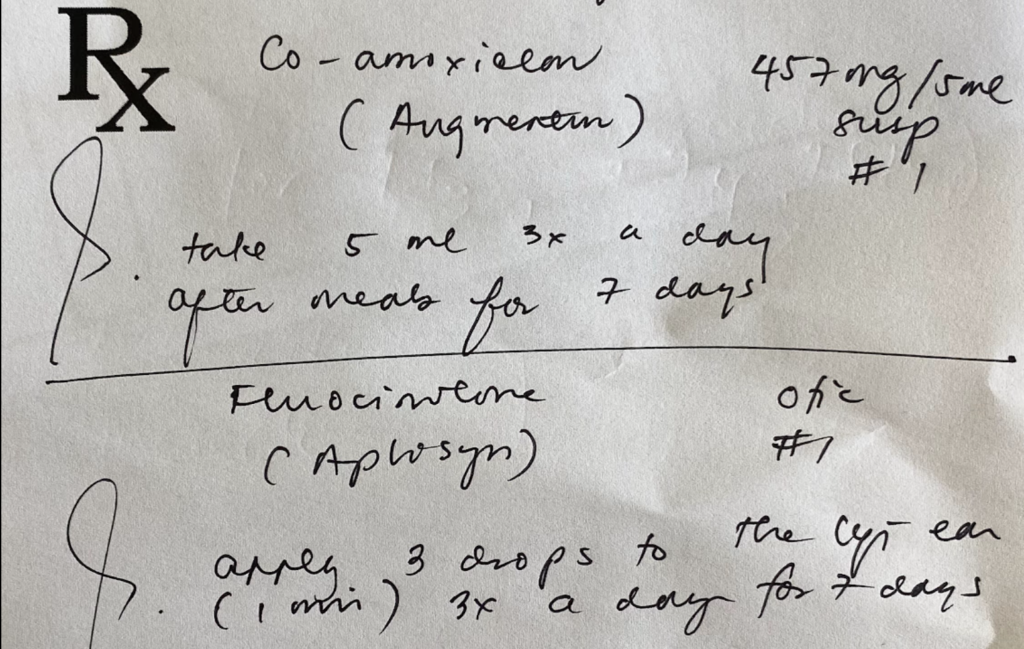
Former DOH Undersecretary Alex Padilla said it once plainly: the law had “failed” to weaken branded medicine’s grip on the market. “Doctors still prescribe branded medicines and they cannot be punished for that because there’s a loophole in the law,” he said. Two decades after the law passed, the DOH’s own data showed that true generics — medicines sold only under their chemical name, with no brand attached — held just 4% of the Philippine pharmaceutical market. In the United States, generics account for approximately 90% of all prescriptions dispensed
A 2014 Philippine Institute for Development Studies survey found that only 7% of respondents could correctly define a generic drug, and 48% believed generics were less effective than branded medicines. There is no scientific basis for that belief. But pharmaceutical companies had spent decades and enormous sums making sure people believed it anyway.
In September 2024, Agri Party-list Rep. Wilbert Lee filed a House resolution calling for Congress to review both the Generics Act and the Cheaper Medicines Act of 2008. After 36 years, the law’s basic promise — affordable medicine, identified by its chemical name — remains largely unkept.
Doctor-Pharma Collusion
Collusion between doctors and the pharmaceutical industry is documented. And it is widespread enough that the Philippine Senate launched a formal investigation into it in 2024.
In April of that year, Sen. Jinggoy Estrada disclosed in a Senate privilege speech that Bell-Kenz Pharma — a company founded and run by physicians — was alleged to have offered rebates of up to P2 million, luxury cars, foreign travel, and other incentives to doctors who prescribed its products. The company, he said, operated through a multi-level marketing scheme for prescription drugs..
Sen. JV Ejercito filed Senate Resolution No. 1011 seeking a formal inquiry. He cited Dr. Sylvia Claudio, a former University of the Philippines medicine professor, who described how pharmaceutical influence works in practice: ballpoint pens and notepads at the small end, restaurant dinners and foreign trips at the other, and continuing medical education programs funded entirely by the companies whose drugs doctors are expected to prescribe in return. The DOH and Food and Drug Administration announced an investigation. Health Secretary Teodoro Herbosa reminded health professionals publicly that accepting gifts in exchange for prescriptions was “unethical.”
None of this was a revelation. The Health Action International report of 2008 had already named physician influence as a core structural reason for high drug prices in the Philippines. The same problem was being investigated by a Senate committee 16 years later.
What makes it so hard to fix is the absence of a law that actually criminalizes it. The Philippines has no equivalent of the U.S. Anti-Kickback Statute, which makes it a federal crime to offer or accept any payment — money, gifts, or services — intended to influence a healthcare provider’s prescribing decisions. Estrada called for Philippine legislation modeled on it. As of this writing, none exists.
The Legal and Human Rights Case
This is not just a market problem or a regulatory gap. Under both Philippine law and binding international commitments, it is a failure of government duty — and one for which both the state and the companies involved can, and should, be held accountable.
The 1987 Philippine Constitution is clear: “The State shall protect and promote the right to health of the people.” Article XIII goes further, directing government to make “essential goods, health and other social services available to all the people at affordable cost,” with explicit priority for “the underprivileged, sick, elderly, disabled, women, and children.”
The Universal Health Care Act of 2019 reaffirmed those obligations. A 2023 World Bank assessment cited in a pending House bill found that “significant inequalities persist in access to quality health services, with lower-income and rural populations disproportionately underserved.” That is not a policy aspiration falling short. It is a constitutional obligation being violated.
At the international level, the Philippines is a signatory to the International Covenant on Economic, Social and Cultural Rights, whose Article 12 protects the right to “the highest attainable standard of health.” The UN committee that interprets the covenant has said this requires governments to ensure medicines are available in sufficient quantities, economically accessible, and of good quality. It also requires governments to actively “control the marketing of medical equipment and medicines by third parties” and to prevent privatization of the health sector from threatening the affordability and quality of care. On both counts, the Philippine government failed.
On the corporate side, the UN Guiding Principles on Business and Human Rights, unanimously endorsed by the UN Human Rights Council in 2011 and developed by Special Representative John Ruggie, set the international baseline for what companies owe the public. The framework has three parts: governments must protect people from human rights abuses by businesses; companies must not violate human rights, even when governments fail to stop them; and people harmed must have real access to remedy. Known as the “Protect, Respect, and Remedy” framework, the Ruggie Principles require companies to carry out human rights due diligence — meaning they must not just follow national law but proactively identify and manage harm they cause to people.
The 2008 Human Rights Guidelines for Pharmaceutical Companies, submitted to the UN General Assembly by then-Special Rapporteur on the Right to Health Paul Hunt, are more specific. They require drug companies to be transparent about their pricing; to refrain from lobbying against policies that would make medicines more affordable; to stop the practice of making cosmetic changes to existing drugs just to extend a patent and block cheaper generics; and to market medicines ethically. These are not aspirational guidelines. They represent, as the Health and Human Rights Journal concludes, a binding normative baseline — a floor below which no pharmaceutical company operating anywhere in the world should fall.
Measured against that floor, the conduct documented in the Philippine pharmaceutical market — inflated supply chain markups, anti-competitive retail concentration, kickback-driven prescriptions, and decades of lobbying that diluted reform legislation — is not just bad business practice. It is a pattern of corporate behavior that, under international human rights standards, should expose companies to legal liability.
Advocates have pointed to Dutch courts’ willingness to hold private companies to a social duty of care — as demonstrated in the 2021 Shell climate liability ruling — as a legal avenue that could and should be tested against pharmaceutical companies in the Netherlands and in Philippine courts. A Dutch nonprofit has filed exactly such a case, but no liability finding has yet been reached.
Is It, at Its Core, Greed?
It is. But calling it greed and leaving it there lets the system off the hook.
Greed is the motive. The system is what makes the motive unstoppable. And in the Philippines, that system — the retail concentration, the captured supply chain, the doctors on commission, the laws with loopholes, the regulators without teeth — has been built up over decades and protected by the very companies that profit from it.
Foreign pharmaceutical companies charge more in the Philippines than in India or Pakistan for the same products simply because they can. There is no national insurance system powerful enough to push back. There is no aggressive use of the legal tools — like compulsory licensing — that would force lower prices in the name of public health.
University of the Philippines professor Orville Solon identified “interlocking interests” between manufacturers, distributors, and retailers that give the industry “greater potential for vertical control” over what Filipinos pay for medicine. Ibon’s Sonny Africa was more direct: the structure will not change as long as the government allows foreign companies to dominate a largely unregulated market.
That tolerance is not an oversight. Multinational drug companies with Philippine operations — a roster that has historically included GlaxoSmithKline, Pfizer, AstraZeneca, Novartis, and Roche, among others — collectively accounted for about 82% of total foreign pharmaceutical sales in the country, with growth rates that outpaced the national GDP, according to this 2009 GMA News investigative report.
At least 10 of them ranked among the Philippines’ top 1,000 corporations at peak concentration. Companies with that economic weight shape policy environments. That is not a conspiracy. It is how power works.
The result is a country in which getting sick can push a family into debt, in which a 36-year-old law promising cheaper medicines has never been properly enforced, which forced the Senate to call an inquiry to address a doctor-kickback culture that researchers first named in published reports in 2008. And one in which, as the PSA data cited in the Senate inquiry confirms, over P251 billion of Filipino household spending in a single year went directly to medicines bought at pharmacies — a figure that represents not just economic pain but a human rights failure playing out, tablet by tablet, at a drugstore counter.
What Needs to Be Done
The reform agenda is not a mystery. Researchers, legislators, international health organizations, and constitutional scholars have spelled it out, repeatedly, for decades. What has been missing is political will and legal enforcement. Here is what a serious response looks like:
Close the prescription loophole. Amend the Generics Act to require that prescriptions be written by generic name only — no brand names allowed on the prescription slip. Doctors who refuse must face enforceable sanctions through the Professional Regulation Commission. No country that has successfully shifted its market toward generics has done so without mandating generic-only prescribing.
Extend price controls to private retail. The DOH’s Drug Price Reference Index governs only public procurement. Maximum retail prices — already authorized under RA 9502 but applied to only a narrow list of drugs — must cover all essential medicines in private outlets, with regular updates and mandatory posting at every pharmacy counter. The law already gives the secretary of health this authority. It needs to be used.
Pass an anti-kickback law. The Philippines needs criminal legislation modeled on the U.S. Anti-Kickback Statute that prohibits pharmaceutical companies from offering, and doctors from accepting, any form of payment — cash, gifts, travel, or commissions — in exchange for prescribing decisions. Professional reprimands are not enough. Criminal penalties are.
Apply competition law to pharmaceutical retail. The Philippine Competition Commission must investigate the documented market concentration in both distribution and retail. A single company controlling 60% of pharmacy retail is a textbook competition law problem. The Competition Act of 2015 was written for exactly this situation.
Remove VAT from all essential medicines. The BIR’s Memorandum Circular No. 93-2024 already exempts 15 medicines from VAT. That list must be expanded to cover every medicine on the WHO Essential Medicines List and the Philippine National Drug Formulary. Taxing medicines that the poor cannot otherwise afford is, in plain terms, a tax on being sick.
Build domestic pharmaceutical manufacturing. The Board of Investments has already named pharmaceuticals a priority industry, but roughly 98% of active pharmaceutical ingredients remain imported. Public investment in local ingredient manufacturing — modeled on what India did through its national pharmaceutical policy — would reduce import costs, break the supply chain’s price dynamics, and give government more leverage over what medicines ultimately cost.
Use compulsory licensing. The Cheaper Medicines Act of 2008 already allows the government to override drug patents in cases of public health necessity. This provision has been invoked rarely, if ever — a sharp contrast with Thailand and India, which have used it repeatedly, with direct and measurable results in lower prices. For maintenance drugs — blood pressure medications, diabetes drugs, cholesterol treatments — that millions of Filipinos need every single day, the public health case for invoking it is not just arguable. It is obvious.
Strengthen PhilHealth’s bargaining power. A national insurer that covers most of the population should be negotiating drug prices from a position of enormous leverage. PhilHealth is not. Its outpatient medicine benefit coverage is limited, leaving most drug costs as direct out-of-pocket expenses. Expanding PhilHealth’s drug formulary and giving it a statutory mandate to negotiate prices — as Taiwan’s National Health Insurance does — would change the balance of power in the pharmaceutical market more fundamentally than any other single reform.
Enforce the Business and Human Rights framework. The Philippine government should adopt a National Action Plan on Business and Human Rights covering the pharmaceutical sector, as the UN Guiding Principles envision. This would require all pharmaceutical companies operating in the Philippines to publish human rights due diligence reports covering their pricing practices, distribution arrangements, and marketing conduct — and would create a legal basis for going to court against companies that fall below the standard of care that international law requires. The tools for this already exist. What is needed is a government willing to pick them up and use them.
The problem is not complicated. It is old, entrenched, and protected. Greed organized into institutions, backed by lobbying, tolerated by the state, and paid for — every day, at every pharmacy counter in the country — by the people who can least afford it. (Rights Report Philippines)
Sources: Ibon Foundation;Health Action International; MDPI / International Journal of Environmental Research and Public Health; DOH Drug Price Reference Index; Willis Towers Watson 2025 Global Medical Trends Survey; Philippine House of Representatives / HB 05956;Pacific Prime global drug price data; UN OHCHR — Human Rights Guidelines for Pharmaceutical Companies; Health and Human Rights Journal — Ruggie Principles / Access to Medicines; Health and Human Rights Journal — Pharmaceutical Accountability; CESCR General Comment No. 14;Philippine 1987 Constitution;RA 9502 Implementing Rules; Board of Investments / Business Inquirer;Italian Trade Agency — Philippine Pharmaceuticals Sector Guide
This report is based on publicly available documents and reports. Rights Report Philippines endeavored to fact-check and verify every claim and statistic in this report but if you spot factual errors, let us know and we will promptly correct them.