
The investigative outfit Whale Hunting, on the heels of significant reporting by Philippine news outlets, reveals a sophisticated international image operation built around the son of a kleptocrat — and the corruption it was designed to obscure.
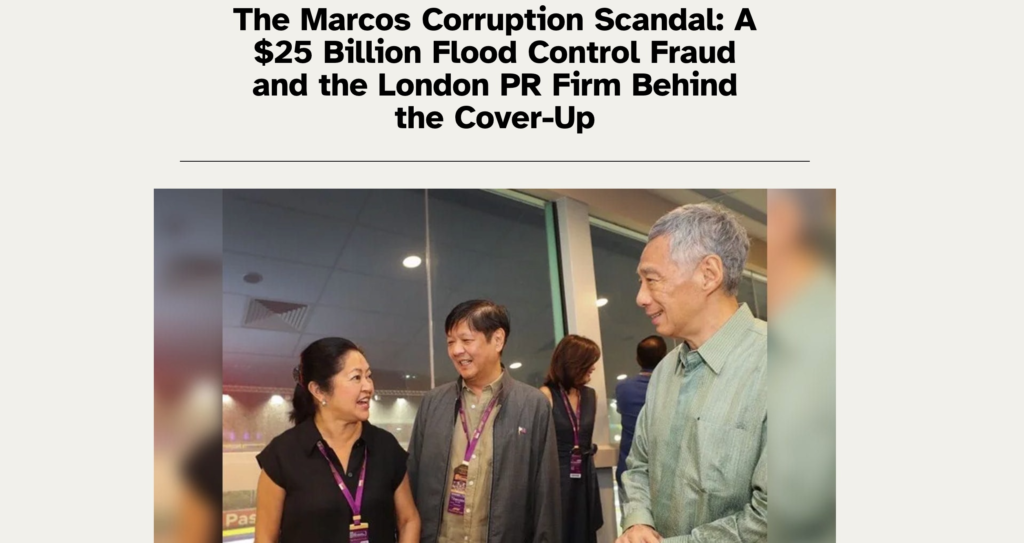
ONE month before Ferdinand Marcos Jr. won the Philippine presidency in 2022, a London political communications firm sent him a confidential proposal. The fee was $144,000 a month. The job, according to a document obtained by the investigative outlet Whale Hunting, was to manage the international narrative around a candidate whose family name carried the weight of one of the most documented cases of state plunder in modern history.
The firm, Project Associates — since rebranded as Panterra Global — promised to arrange private dinners with Western diplomats, place favorable coverage in international media, and prepare spokespeople with a handbook for deflecting questions about the Marcos family record. Ferdinand Marcos Sr. looted an estimated $10 billion from the Philippine treasury during his 14-year dictatorship before being driven from power by popular uprising in 1986. He died in exile in Hawaii in 1989 without facing trial. His wife Imelda was convicted of corruption in 2018.
Project Associates had previously subcontracted the parent company of Cambridge Analytica to run influence operations in the Middle East. Rappler, which tracked extensively the domestic side of the Marcos rebranding, reported in 2020 that Marcos had approached Cambridge Analytica directly to reshape the family’s image on social media. The broader campaign flooded platforms with content portraying the martial law years as a golden age.
Project Associates was the international complement to that operation — tasked with making Marcos palatable to Western audiences who still associated the family name with Swiss bank accounts and mass human rights abuses.
The strategy held, at least initially. Marcos won the largest presidential victory in Philippine history. Foreign governments treated his administration as a credible partner.
In August 2025, Manila’s poorest districts went underwater. The drainage systems that had been paid for — part of what investigators would later describe as a scheme diverting roughly 1.45 trillion pesos ($25 billion) through ghost and substandard infrastructure projects — did not exist in the ground. A health worker named Christina Padora waded through waist-high floodwater to check on vaccines, grabbed a metal pole connected to a live wire, and was electrocuted. She was one of dozens who died. Over 100,000 people took to the streets.
The corruption that killed them had already been partly mapped by Philippine journalists, most notably Rappler and the Philippine Center for Investigative Journalism (PCIJ). In July 2025 — in his State of the Nation Address, delivered as the scandal was cresting — Marcos rebuked corrupt officials on live television, declaring in Filipino: “You should be ashamed.” But his speech preceded the August deaths. By the time the protests broke out, the address had already been given. The accountability it promised had not arrived.
PCIJ hadreported that Marcos Jr.’s son, Sandro, and his first cousin Martin Romualdez — then the Speaker of the House — were the country’s largest individual recipients of discretionary public works funds, describing them as the “pork barrel kings.” Rappler’s own property investigation had already surfaced a multimillion-peso mansion in Sotogrande, Spain linked to Romualdez, and had traced Malaysian shareholders to the same offshore structure.
Much of what the Whale Hunting report adds is a corporate paper trail from Singapore connecting the Spanish villa to a businessman whose company previously paid illegal surcharges to Saddam Hussein’s government under the UN Oil-for-Food Programme.
Romualdez was formally named the “purported mastermind” of a $960 million kickback scheme by the Office of the Ombudsman and barred from leaving the country. His assets were frozen. In a video posted in late April, he rejected the designation. “I will not be the fall guy,” he said, adding that the national budget originates not with the Speaker but with the President.
While anti-money laundering authorities have frozen assets linked to 724 individuals and 537 entities, not one freeze order has touched Marcos, his wife, or his son. The institutions conducting the investigation report to the administration they are supposed to be investigating.
That is the deeper story the PR campaign was always designed to obscure — and why the prior work of Rappler and the PCIJ, produced at professional and sometimes personal risk inside the Philippines, remains the foundation on which international accountability reporting must build. When Western governments treat a rebranding exercise as evidence of reform, and when international media repeats that framing without scrutiny, they become part of the system that makes the looting possible.
The people who died in August did not drown because of bad weather. They drowned because money meant to protect them was moved through shell companies to a villa on the Costa del Sol. Naming that clearly — tracing the money, publishing the records, refusing the managed narrative — is not just a journalism problem. It is what human rights accountability, in practice, looks like. (Rights Report Philippines)