

The Philippines cannot fully realize the benefits of workplace AI without setting up the needed policies, such as protecting workers, writes Carl Javier.
LIKE clockwork, almost every week there is some kind of report about the “AI jobs apocalypse” or some multinational company announcing massive layoffs because “AI can do the work.” How many of us have heard, “You won’t be replaced by AI, but you’ll be replaced by a person who uses AI?”
We might be doubtful of these big claims, for good reason. After all, there are companies like Klarna, the Swedish fintech company, that tried to pivot to AI by laying off hundreds of employees, only to rehire or reassign them. There are companies like Block, the US financial services firm, that fired workers as part of its “shift to AI.”
But some argue that companies like these are merely riding the AI hype while “AI-washing” – that is, getting rid of workers and blaming it on AI. In fact, generative AI has no significant effects – at least not yet – on job openings or total jobs, as studies like this have shown.
This might make us think that maybe all of this is overblown, that the hype machine is in overdrive to push up the valuations of major tech companies – the so-called hyperscalers. Maybe, but there are signals nonetheless that should concern us.
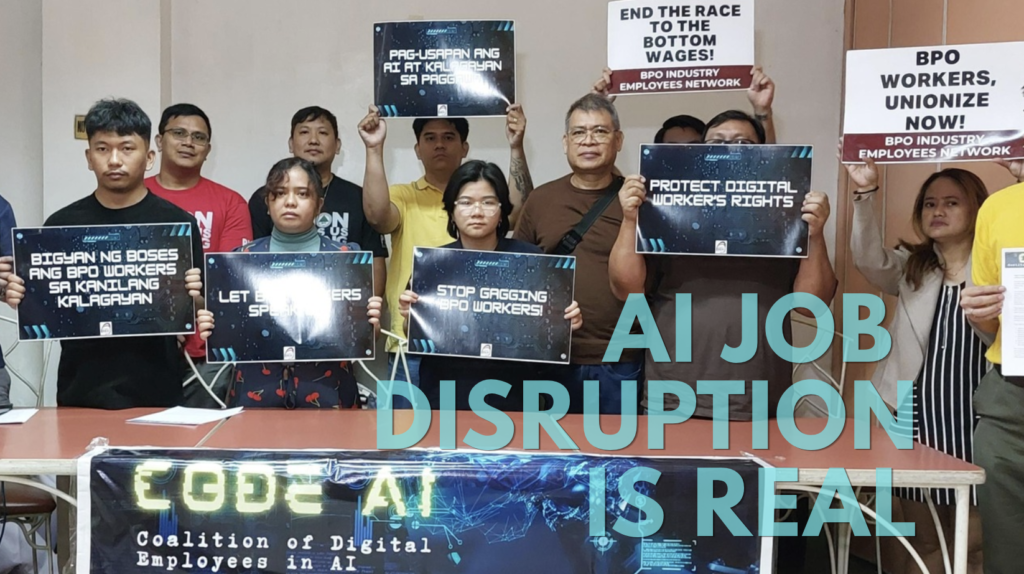
There is an observed shift in the job market, especially with the decline in entry-level jobs. This can be attributed to AI tools capable of doing entry-level work on one hand and, on the other, to employers deciding not to hire as they wait to see if AI will keep improving. Mylene Cabalona of BIEN Pilipinas (BPO Industry Employees Network) talks about BPOs laying off workers already. Things can get worse, she says. More anecdotal stories reveal virtual assistants losing work and local BPO teams being made to train their AI replacements.
So with all these conflicting narratives and all of the fear around AI displacing jobs, how should we be thinking about this situation now? What can we expect as AI adoption continues, and what can we do to advocate for a human-centered future?
AI Is Going to Change Work
There will continue to be grand pronouncements about a future where there will be no jobs. That’s par for the course with the AI online discourse of 2026. There are more thoughtful ways to consider these changes, though.
First, we can look at some of the studies. The World Economic Forum (WEF) projects that 60% of the global workforce will require training to keep up with the changes due to AI. The International Monetary Fund (IMF) identifies over 30% of jobs as having tasks that could be replaced or augmented with AI.
The 60% retraining or upskilling and the 30% job exposure do not necessarily mean that all those jobs will disappear. As companies continue to adopt AI systems, they discover the parts of work that can easily be replaced and those that will continue to need human intervention, either in the short term or even forever.
AI researcher Dominic Ligot writes in his paper, “Labor Futures Under Artificial Intelligence,” that “AI does not affect jobs directly; it affects tasks, and the translation of task-level change into employment outcomes is mediated by firms, workers, and policy institutions.” In other words, unlike certain mechanical or repetitive labor, knowledge jobs that are most directly affected by AI are not merely repeated actions but, rather, bundles of tasks and decisions that knowledge workers execute.
What the IMF, Anthropic researchers, and others identify is that tasks within these jobs are exposed to AI. For example, a virtual assistant might need to prepare a brief for their client’s meeting. This might be broken up into tasks like researching who the client is meeting, checking past interactions, and looking at the different kinds of projects the meeting subject’s company has undertaken recently. All this research would lead to writing the brief and even possibly giving the client a five-minute briefing and guide questions right before the meeting. Each of those is now a task that AI language models might be able to accomplish. An AI agent might just as easily be able to do all of those tasks.
The question becomes: beyond those tasks, are there essential aspects of the job that AI is not capable of doing? If within a job all of the executable tasks can be done by AI, then it is very likely that the job will be replaced by AI.
However, if there are key aspects of the job that cannot be done by AI, or the bundles of tasks would need to be managed or orchestrated by a human, then rather than being replaced, the worker’s role becomes complementary to AI processes. In an ideal world, this would translate to handoffs where AI does the tasks that are repetitive and less enjoyable, while the human can focus on more meaningful tasks or go higher up in the value chain.
In practice though, developments are far from ideal. But it’s not too late to change course.
Challenges and Bottlenecks
The conversation is often about how we need to catch up, how AI adoption needs to happen, and how it needs to happen fast. While it is incumbent on government, sectors, and individuals to respond properly to this disruptive technology, we should all be approaching this from a thoughtful and measured perspective.
For example, we cannot rush headlong into AI systems if we do not yet have the data centers to run them. For those data centers to run at a level that can be impactful, we need to first address our challenges in energy infrastructure and the cost of generating power. We also need better data, better cybersecurity, and overall better digital infrastructure.
While there are projected benefits if we are able to transition to an AI-powered economy, we will not be able to realize any of these benefits if we do not find a way to put all of the right pieces into place. In the meantime, we will continue to be battered by the negative effects and challenges.
Even as we see all these bottlenecks, we are also already observing impacts that increase vulnerability and precarity for workers.
For example, alongside the high AI exposure of BPO jobs, the US government is trying to pass legislation that would discourage outsourcing work.
Right now, it is prospective and current employees in the workforce who are attempting to endure the shocks brought on by shift to AI. They are told that they need to upskill, reskill, “be better than the AI,” so that they can keep their jobs. Paul Quintos, a professor at the UP National College of Public Administration and Governance, writes about how AI systems are used to justify the devaluing of human labor. His research shows that firms benefit from AI adoption while wages stay flat or fall significantly.
Upcoming research from Juan Gabriel Felix and Florabea Charis Iñon discusses precarity in the form of lower base pay and increased employee surveillance. Alongside this, they cite eroding worker dignity and the feeling that workers are becoming obsolete as they train the systems that will replace them. While that last thought sounds like something from a dystopian science-fiction novel, it is, unfortunately, a sentiment that has surfaced across multiple sources.
The Future Isn’t Written Yet
Ligot writes, “The future is not technologically predetermined.” This is an important thought for us to hold on to, especially as we are bombarded by the AI hype machine about the inevitability of AI replacing human jobs and even perhaps eliminating the job market wholesale.
One reason that Big Tech advances the inevitability narrative of AI is so that we cannot see other options and we accept that the technology will do what it does. But it is important for us to remind ourselves that none of this is inevitable, that we do have human agency and the power to determine for ourselves – whether on the individual, community, company, or societal levels – how AI adoption unfolds.
It is difficult to advocate for ourselves, especially in cases of job precarity. That’s why we need to band together to push for human-centered AI adoption. We need to see that there is sufficient time for us to act.
One of the narratives around AI is that there is not enough time and that if we do not take extreme steps, we will all be left behind. However, even Yann LeCun, one of the biggest names in AI, tells us to tune out alarmist tech narratives and heed economists instead. This aligns with the views of Arvind Narayanan and Sayash Kapoor, AI researchers and co-authors of “AI Snake Oil,” that we need to think of AI as a “normal technology.” By this, they mean that, like every other technology before it, no matter how transformative, societies will take time to adopt or “metabolize” it.
If we can free ourselves from the fear, the hype, and the oppressive labor practices that are being enacted under the guise of AI adoption and efficiency, then we might be able to chart a future where AI empowers instead of replaces us.
Good AI Policy Is Key
There are already attempts at AI policy, whether in the form of the National AI Strategy (NAIS PH) or the many bills currently filed in Congress. While the former continues to be developed, individual departments and government agencies are already releasing and enacting policies. The latter, with bills filed in both the House and the Senate, are a signal that legislators understand that policy is essential if we are to thrive in a world transformed by AI.
Among the many possible approaches to AI policy, a few specific ideas stand out as useful first steps.
We need, as soon as possible, policies for fair transition. There will inevitably be job losses, whether because certain roles become obsolete or because workers have not yet had the chance to reskill. Employers and the government need to establish safety nets for displaced workers as well as opportunities for retraining and upskilling for the most vulnerable. Again, given the high exposure of BPO jobs, this is of utmost importance.
Another set of policies that needs to be advanced is one that addresses the retraining, upskilling, and reskilling demands identified by the WEF. The nature of many jobs will change even if AI technologies only keep getting incrementally better. The efficiency gains AI offers will benefit firms, and we must empower a workforce that will be ready for all those changes. One example would be understanding what kind of tasks might be needed in the future that AI cannot handle, enabling targeted training in complementary skills. Another would be better training in coordinating and managing AI systems and teams that mix human and AI roles.
Alongside preparing our current workforce, we need to create policies that equip educational institutions to prepare young people for a future that we are still trying to imagine. Based on participation in AI policy and governance forums, what emerges as the essential things people will need to have if we cannot yet guess what jobs and the market will look like are creativity, imagination, critical thinking, collaboration, and entrepreneurship. Building education around these qualities would require a fundamental shift in how schools are structured.
We should look at policies that will build a business landscape where we can thrive. It is increasingly clear that while BPO is an important and substantial part of our economy, our continued reliance on the sector is a real vulnerability. The question then becomes: instead of selling services to foreign markets, how does the Philippines build businesses that can compete globally in an AI-powered economy?
Policy initiatives would need to include incentives and support for startups and micro, small, and medium enterprises (MSMEs), as well as large-scale investments in digital infrastructure. Beyond specific policies, there’s a need for a large-scale reimagining of our role in the world so that we are no longer left in such a precarious position.
All of this can look overwhelming. It can feel like we have so much ground to cover. But it’s not too late.
We have to be realistic about where we are now. We have to acknowledge the real threat that AI poses alongside the real opportunities it offers us. We can still make decisions and advance policies that will make lives better. Workers can band together to advocate for their rights. Firms and the government can build policies to protect workers. Education and training need to be designed to prepare everyone for whatever the future might look like. Policymakers need to imagine an AI-powered Philippines as one that supports and empowers its people. (Rights Report Philippines)