
A radio news director in Cagayan de Oro published screenshots of a private chat with a city official to document why a promised interview was canceled. Now she faces up to six years in prison.
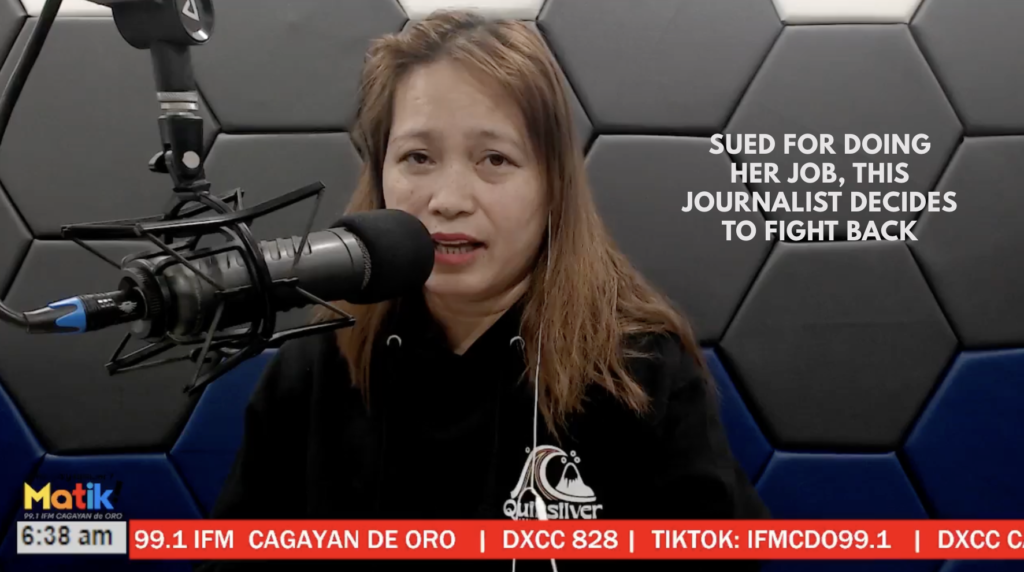
CAGAYAN DE ORO CITY — When a city official abruptly canceled a scheduled radio interview about delayed student scholarship payments, Menzie Montes did what journalists do: she published the evidence.
Montes, news director of RMN-Cagayan de Oro and known for her on-air exposés, had been negotiating through Facebook Messenger with Richel Petalcurin-Dahay, acting head of the city’s Education and Development Office, to arrange an on-air interview about complaints from scholars whose tuition payments and living stipends had gone unpaid. When Petalcurin-Dahay backed out — saying her office would only engage with students who could be identified by name, not anonymous ones — Montes posted a summary for her listeners and attached screenshots of their entire conversation.
That decision has since cost her a subpoena.
On April 23, the Office of the City Prosecutor directed Montes to file a counter-affidavit in response to a complaint accusing her of violating the Cybercrime Prevention Act of 2012 and the Data Privacy Act. Petalcurin-Dahay, who filed the complaint, argued that publishing the private exchange violated her right to privacy and breached journalistic ethics.
Montes says she was doing her job. Her colleagues say the charges are designed to make sure she thinks twice before doing it again.
Designed for Hackers, Used VS Reporters
The Cybercrime Prevention Act, signed in 2012 by then-President Benigno Aquino III, was introduced primarily to prosecute hackers, identity thieves, and purveyors of online child pornography. But its criminal libel provision — which carries a penalty of six months and one day to six years in prison, and fines ranging from 200,000 to one million pesos — quickly became a tool of a different kind.
Journalists and rights groups have documented how the law has been used not to protect the public from cybercriminals, but to silence reporting that embarrasses the powerful. The most prominent example is Rappler CEO Maria Ressa, who was convicted under the law’s cyberlibel provision in 2020 alongside former writer Reynaldo Santos Jr., for a 2012 article about a businessman’s alleged ties to a former chief justice. The article was published four months before the law was even enacted, a detail that drew widespread condemnation and raised serious questions about retroactive prosecution.
The International Commission of Jurists called that conviction a miscarriage of justice, saying it put the Philippines in breach of its obligations under the International Covenant on Civil and Political Rights, the foundational treaty governing the right to free expression in international law. The Philippines ratified that treaty in October 1986.
The case against Ressa did not slow the complaints. From mid-2022 to April 2024, the Center for Media Freedom and Responsibility and the National Union of Journalists of the Philippines recorded 135 incidents of attacks and threats against media workers, a number that exceeded the tally from the first 22 months of the Duterte administration. Eight journalists were charged with libel or cyberlibel during that period alone.
The Legal Architecture
Philippine law, on its face, protects journalists robustly. Article III, Section 4 of the 1987 Constitution states plainly that “no law shall be passed abridging the freedom of speech, of expression, or of the press.” The Supreme Court has repeatedly described press freedom as a “preferred right” — a phrase it uses to signal that free expression carries special weight when balanced against competing interests, and one it has applied consistently across decades of jurisprudence.
Internationally, the Philippines is also bound by Article 19 of the International Covenant on Civil and Political Rights, which protects the right to seek, receive, and share information and ideas through any medium. The United Nations Human Rights Committee’s General Comment 34, adopted in September 2011, reinforced that governments cannot use criminal defamation laws to shield public officials from legitimate scrutiny. Officials who open themselves to public debate, the comment states, must accept a higher degree of criticism than private citizens.
That standard has direct bearing on the case in Cagayan de Oro. Petalcurin-Dahay is a public servant overseeing a government program that affects students’ ability to pay tuition and rent. The conversation Montes published was about that program and initiated by the official herself.
Yet the charges Montes faces — cybercrime and data privacy violations — could put her in prison for years.
A Pattern That Repeats
In January 2024, UN Special Rapporteur on freedom of opinion and expression Irene Khan visited the Philippines and urged repeal of the Cybercrime Prevention Act, saying its cyberlibel provision was “fundamentally at odds with international standards.” In her exit statement, Khan said the law — originally designed to address online predators and hackers — had been “used to deadly effect against journalists, chilling freedom of expression.”
She was not the first to say so. In an earlier case, the UN Human Rights Committee determined that the Philippines had violated Article 19 of the ICCPR when it imprisoned Davao radio journalist Alexander Adonis on criminal libel charges in 2007. The committee called on the government to decriminalize libel entirely. The government did not.
The pattern described by Khan and rights groups is visible in the Montes case, local media rights advocates say. In 2024, a fictitious Facebook account publicly disclosed the private personal information of Montes and a colleague. The leaked documents apparently originated from the Cagayan de Oro City Housing and Urban Development Department. Media rights groups at the time noted that the anonymous perpetrators seemed to be sending a message: journalists who benefit from any government program — such as housing assistance — should not criticize the government that runs them.
“Public servants should not be too onion-skinned when facing issues involving public interest,” the NUJP Cagayan de Oro chapter said in a statement this week. “They are accountable to the people for their actions, decisions, and use of public resources.”
Montes Fights Back
Montes is mounting her defense through a legal agreement between the Cagayan de Oro Press Club and La Viña, Zarate and Associates, a law firm that has worked with local journalists facing legal threats. The arrangement was established during the tenure of former press club president Froilan Gallardo.
“As of now, I will avail of the MOA of Cagayan de Oro Press Club,” Montes said. “I did not ask for help from our company.”
The press club has not yet issued a public statement on the matter.
Lawyer Carlos Zarate of the law firm said defending Montes was, at its core, a defense of the constitutional right to report. “Filipino journalists most often operate under political and legal pressure,” he said, “and cybercrime laws can be weaponized to silence critical voices.”
Franck Rosete, chairman of the NUJP-CDO chapter, said the complaint should have been settled through the Kapisanan ng mga Brodkaster ng Pilipinas, the national broadcasters’ association, before it ever reached the prosecutor’s office. There was nothing wrong done by Montes, considering it was a work-related conversation and it was a matter of public interest,” he told Rights Report Philippines.
The broadcasters’ association was informed of the dispute before Petalcurin-Dahay filed the complaint, according to Montes. The association has not issued a statement.
The next step is Montes’ counter-affidavit, which her lawyers are now preparing. She remains on the job. (Rights Report Philippines)