
NEWS ANALYSIS: The Communist Party’s admission that nine of the 19 killed were not its combatants shifts the burden squarely onto the Armed Forces of the Philippines — and onto whatever investigation is still credible enough to find the truth.
FOR days now, the Philippine military has insisted that every one of the 19 people killed in a pre-dawn operation in Toboso, Negros Occidental, was an armed communist rebel. That claim just got significantly harder to sustain after the Communist Party of the Philippines (CPP) named its own dead.
In a statement signed by CPP spokesman Marco Valbuena, the party listed 10 members of a New People’s Army squad — by name, rank, and hometown — who it said fought and died in Barangay Salamanca on April 19. Then it listed nine more people and called them civilians killed alongside those fighters: a student, a journalist, two children, two Filipino-Americans, a farmer, and two peasant organizers.
The CPP is not a disinterested party, and its account should not be taken at face value any more than the AFP’s should. But the party’s willingness to publicly claim its own fighters — while separately, and specifically, disowning the nine others — creates a new evidentiary problem for the government. If the NPA itself draws a line between its combatants and the rest, the burden now falls on the AFP to explain, with evidence, why it does not.
So far, it has not even tried.
READ: 19 Dead Bodies and the Army’s Claims That Don’t Add Up
Instead, military officials have offered body counts, seized firearms, and statements that amount to this: if you were there, you were a target. That position has no basis in international humanitarian law, and the government knows it. What it does not seem to have — or is unwilling to produce — is the pre-operation intelligence that would answer the only question that matters: did the 79th Infantry Battalion know that noncombatants were present in that camp before it opened fire at 3:58 in the morning?
That question will not be answered by the AFP. At this point, it may not be answered credibly by anyone — unless an investigation genuinely independent of the military, the NPA, and the government is convened immediately.
Who Were the Dead?
The CPP’s list of civilian dead includes a cross-section that no single narrative — military or otherwise — can easily contain.
Alyssa Alano served as the education and research councilor of the UP Diliman University Student Council. Her colleagues said she had been living among farming communities in Negros to study conditions of land grabbing and militarization firsthand. The CPP identified her alongside RJ Nichole Ledesma, 30, who had led Paghimutad-Negros, an alternative media outlet focused on human rights reporting, since 2020, and who colleagues said had gone to Toboso to do field work on the effects of renewable energy projects on peasant livelihoods. Fr. Melvin Fajardo of Human Rights Advocates Negros said Ledesma was unarmed and conducting journalism when he was killed.
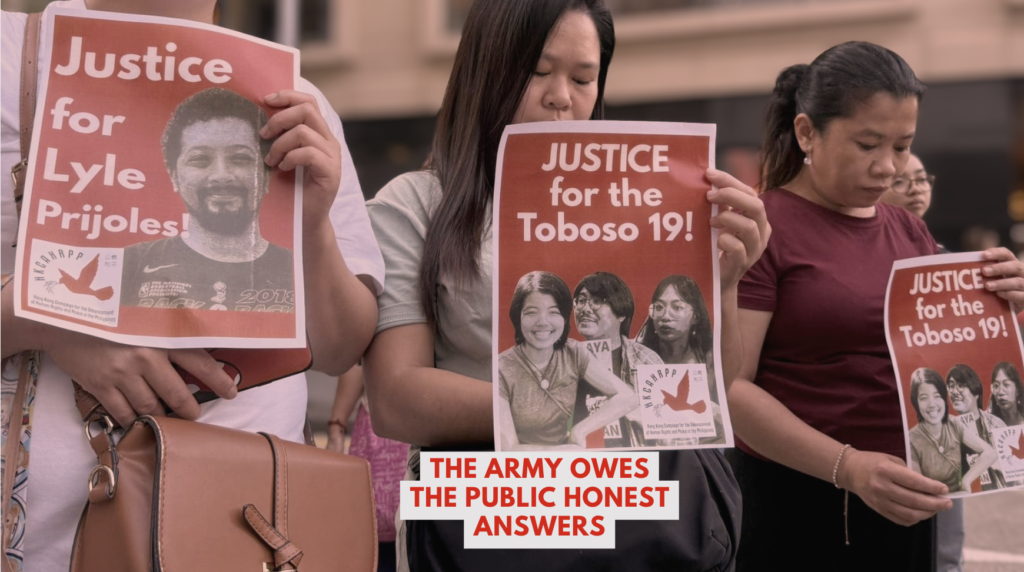
Two Filipino-Americans were also among the dead: Lyle Prijoles, 40, of San Francisco, a country council member of the International Coalition for Human Rights in the Philippines, and Kai Sorem, 26, of Steilacoom, Washington, a founding officer of Anakbayan South Seattle.
The CPP also named Maureen Keil Santuyo, 24, a member of the National Network of Agrarian Reform Advocates; Errol Wendel, 24, of Unyon ng mga Manggagawa sa Agrikultura; and Roel Sabillo, 19, a local resident the NPA said was working at his uncle’s property at the time. Peasant organizations Kilusang Magbubukid ng Pilipinas and Tanggol Magsasaka separately identified Santuyo and Wendel as community advocates.
Then there are the two whose presence may say more about where the killing happened than any weapons inventory ever could. Jemina Gumadlas was 15 years old, a resident of Sitio Plarending in Barangay Salamanca — the same barangay where the encounter took place. Dexter Patajo was 17, from Sitio Buklog, Barangay Lalong, Calatrava. Both are on the CPP’s list of civilian dead, not among its fighters.
The presence of children — not merely legal minors, but a 15-year-old girl and a 17-year-old boy from the immediate locality — at a site the AFP describes as an NPA armed encampment is not a peripheral detail. It points, powerfully, to the civilian character of the location itself. Communities where families live, where children are present at 4 in the morning because it is their home, are not military objectives.
These children’s deaths bring into sharp relief two separate but reinforcing bodies of law: the ICRC’s Customary IHL Rule 135, which requires that children caught in armed conflict be given special protection, and the UN Convention on the Rights of the Child, which the Philippines ratified in 1990 and which prohibits the direct targeting of children in any circumstance.
Neither the AFP nor the PNP’s special identification task group has publicly addressed why two children from the area died in the operation, how they came to be at the site, or whether the 79th Infantry Battalion had any intelligence about their presence before it moved in.
As of Wednesday, only six of the 19 had been positively identified by police and claimed by their families. There is still no full, official list of names.
What the Army Says Happened
In its official statement, the AFP said the operation was launched on the strength of civilian reports about armed elements in the area, that running firefights continued throughout the day as the NPA tried to escape, and that 19 members of the armed group were killed along with the seizure of 24 firearms. AFP Chief Gen. Romeo Brawner Jr., speaking to reporters in Cebu, praised the operation and offered his theory of combatant status: “Once you start fighting, firing against government forces, then you are a combatant and of course you can be a casualty.”
Defense Secretary Gilberto Teodoro Jr. went further. Asked by reporters about Alano’s death, he did not address the specific circumstances of her killing. He said instead that anyone found at an encounter site alongside armed groups could face prosecution for aiding and abetting, regardless of combatant status. “Whether or not NPA ‘yun, nandun sa enkwentro, you shouldn’t be there in the first place when you know that they are armed terrorists,” he said.
That framing — that physical proximity to fighters equals criminal liability — has no support in international humanitarian law and directly contradicts the legal framework the AFP itself claims to have followed. The National Union of Peoples’ Lawyers (NUPL) responded: “Their presence in Toboso was a conscious act of solidarity with communities facing land grabbing, systemic neglect, and the grinding poverty that decades of counterinsurgency have done nothing to address.”
READ: Negros Burns, Again: Death of 19 in Army Raid Raises Hard, Familiar Questions
Did the AFP Know Civilians Were Present?
This is the question the AFP has not answered — and shows no sign of wanting to.
The AFP’s statement describes an intelligence-driven operation launched on civilian tip-offs about armed elements in the area. It says nothing about whether that same intelligence flagged the presence of non-combatants alongside those elements.
The ICRC’s Customary IHL Rules 15 through 21 on precautions in attack require forces to do everything feasible to verify that targets are military objectives before striking. Whether that standard was met in Toboso is precisely what no official inquiry has established. The presence of two children from the local community suggests, at minimum, that the question was never seriously asked.
The CPP’s statement raises two additional specific claims that compound the credibility problem for the military. First, it says the AFP initially reported recovering only seven firearms from the site, then revised the figure to 20, and later to 24 — changes it says were made to shore up the claim that all 19 were armed. The AFP has not publicly addressed the reported discrepancy. Second, the CPP alleges that drone footage from the AFP’s own aerial cameras has surfaced on social media showing Fabillar — Ka Tapang — alive and apparently unable to fight, which the party says indicates he was summarily executed rather than killed in combat. Rights Report Philippines has not independently verified the video’s authenticity, contents, or even existence.
Karapatan secretary general Cristina Palabay framed the stakes plainly: “Whether they are civilians or combatants, the sheer number of those killed triggers significant questions on the conduct of the operations, including use of proportionate force, the steps taken to minimize casualties, and compliance with international humanitarian law and human rights. The possibility that the military committed a massacre, including in the context of an armed confrontation, should be investigated.”
NUPL put it even more pointedly: “If IHL core principles — distinction, proportionality, and precaution — were observed, how is it that 19 people are dead, over 650 residents displaced? What does proportionality mean when a firefight ends with no reported military casualties and 19 dead civilians and alleged combatants alike?”
READ: Why the Laws of War Matter in Places Like Negros — and Why They Are Routinely Ignored
The Investigation Problem
The Commission on Human Rights, expressing grave concern, said through its Negros Island regional office that it has launched an independent investigation. The CHR noted conflicting accounts of the identities of the dead and stated that any determination of combatant status must rest on verifiable evidence and due process — and that under IHL, doubt resolves in favor of civilian status.
That is the right standard. Whether the CHR can actually enforce it is another matter entirely.
The CPP’s statement cited a direct precedent: the commission’s promised investigation into the June 2023 Fausto family massacre in Himamaylan City, also in Negros Occidental, in which a farmer, his wife, and their two sons — aged 15 and 12 — were shot dead in their home, allegedly by soldiers from the AFP’s 94th Infantry Battalion. As of June 2024, a full year after that killing, not a single case had been filed and the CHR’s own Bacolod head acknowledged the commission had produced nothing substantive. The Toboso operation involved a different AFP unit, but the same island, the same pattern of contested identities, and the same commission now pledging to investigate.
The AFP’s credibility on Toboso has been damaged enough — by its shifting firearm count, its silence on direct questions, and its senior officials’ legally indefensible statements about who qualifies as a target — that any probe it participates in or controls will struggle to be believed. The deaths of two children deepen that problem. A 15-year-old girl and a 17-year-old boy were killed in a military operation, and no official body has yet asked in any formal setting how that happened or whether it could have been prevented. That silence is itself an argument for a process that neither the AFP nor the government can quietly outlast.
What this moment arguably requires is something the Philippines has rarely managed to produce in cases like this: a genuinely independent investigative body with subpoena-equivalent access, forensic resources, and enough institutional distance from both the military and the CPP-NPA to be credible when it reports. The ICRC will likely conduct its own inquiry, as it typically does when potential IHL violations are alleged, but that process is confidential by design and its findings will not be made public.
READ: ‘Negros 19’ Deaths Need to Be Investigated. But Who Is Credible Enough to Do it?
San Carlos Bishop Gerardo Alminaza, in a pastoral letter issued April 20, called the clash a wake-up call, an invitation to return to root causes rather than fixate on the body count. Negros Occidental Gov. Eugenio Jose Lacson, while careful not to contradict the military, said the incident saddened him: “When incidents like this happen, it really saddens me because it is Filipinos fighting fellow Filipinos.”
Eight days after the shooting stopped, the CPP’s partial concession — that yes, its fighters were there, and no, the others were not theirs — has done more to clarify the Toboso picture than anything the government has said. That the most coherent accounting of the dead has come from one of the warring parties, rather than from the state, is itself an indictment. It is also the clearest possible reason why the investigation that follows must be fully independent, fully resourced, and fully public — starting with an honest answer to the question of what two children from the neighborhood were doing among the dead. (Rights Report Philippines)