
OPINION: A Philippine advocacy group says Southeast Asia is already sitting on the answer to its energy crisis. The problem is it keeps shipping that answer overseas — and the 48th ASEAN Summit in Cebu just made the stakes clearer.
By Carlos Conde
WHAT does a meeting of Southeast Asia’s leaders in Cebu have to do with the solar panels going up on rooftops across Metro Manila and other urban areas in the Philippines — especially in poorer neighborhoods? More than you might think. Both are about the same problem: a country sitting on some of the richest energy resources on earth that still cannot keep its own electricity affordable.
Last Saturday, with the heat index hitting dangerous levels across much of the country, many Filipinos did what they have been quietly doing for months. They switched on whatever solar panels they had — registered or not — and hoped for the best.
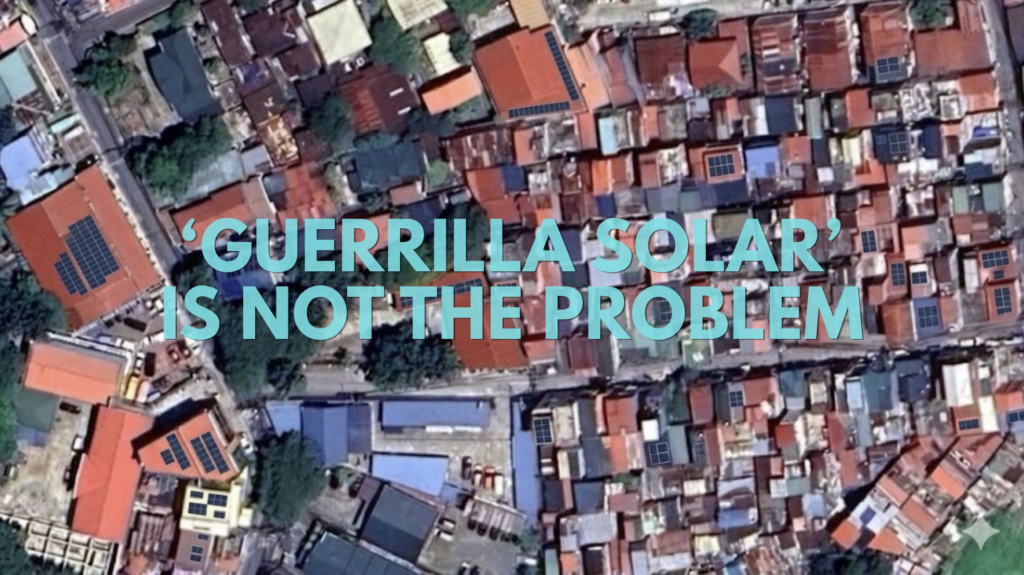
About one in three rooftop solar systems in the Manila area is unregistered, according to satellite data analyzed by a local research group. On social media, particularly Facebook, one can find plenty of videos teaching DIY installations of these systems, often at a fraction of the cost of those done by established companies. The government calls them “guerrilla” installations. But to the families who put them up, they are just a way to survive a summer of electricity bills that have risen sharply since the energy crisis began.
Now Meralco, the country’s largest power distributor, is pushing the Senate to crack down on these unregistered setups. Some see it as a legitimate safety concern. Others see a utility protecting its income at the expense of struggling households. A columnist in the Philippine Daily Inquirer put the tension plainly: the Philippines already has the second-highest electricity rates in Southeast Asia, yet families that try to generate their own power risk being penalized for it.
This is where Cebu comes in.
On Friday, the leaders of Southeast Asia’s 10 nations wrapped up the 48th ASEAN Summit, which was dominated by a regional energy crisis set off by months of fighting near the Strait of Hormuz — the narrow sea passage through which much of the world’s oil flows. A ceasefire, mediated by Pakistan, is now in place, but fuel costs have yet to fully settle. The disruption exposed just how vulnerable Southeast Asia is to energy shocks it has no control over.
The leaders left Cebu with pledges to build a regional power grid, fast-track an oil-sharing agreement among member countries, and push harder on renewable energy. They noted — but did not commit to — a proposal to study a shared oil reserve. Rappler summed it up: agreement in spirit, nothing concrete yet.
But a new report published in March says the region is missing the bigger point entirely.
The report comes from the Legal Rights and Natural Resources Center, a Filipino NGO that advocates for communities affected by mining. Its title is “From Peripheries to the Core.” Its argument, stated plainly: Southeast Asia already has everything it needs to power its own clean energy future. No new mines required. The problem is not a lack of resources. The problem is who controls those resources — and where the money goes.
Here is the basic arithmetic. The Philippines and its neighbors produce roughly 65 percent of the world’s nickel — the metal inside electric vehicle batteries and solar storage systems. By the group’s own calculations, Southeast Asia could mine enough nickel to cover its entire clean energy needs in about three weeks of production.
Three weeks.
The rest of the year’s output goes overseas. And the country that dug it up buys the finished products — solar panels, batteries — back at full price.
The Philippines imports 98 percent of its oil from the Middle East. When that supply is disrupted, electricity prices go up. The metals that could fix that dependence — nickel, copper, cobalt — are sitting in the mountains of Surigao, Palawan, and Mindanao. They just get shipped out first.
Most of it goes to China. About 90 percent of Philippine nickel exports end up there, where the ore gets refined, turned into battery materials, and eventually sold back into the global market as finished technology. The Philippines earns a small cut from the digging. Everyone else earns from everything that comes after.
Indonesia tried to stop this by banning raw nickel exports in 2020, forcing foreign companies to build processing plants inside the country. It worked, partly. Indonesia now produces nearly two-thirds of the world’s nickel. But about 90 percent of those processing plants are owned by Chinese companies and run mostly on coal. Indonesia got more of the production. A different set of foreign investors still owns it.
The LRC report calls this swapping one dependence for another.
Meanwhile, a global power struggle over these same metals is heating up. Both the United States and China are racing to lock up supplies of the minerals needed for clean energy and advanced technology. The International Energy Agency projects demand will be six times higher by 2040.
In February, the Philippines signed a deal with the United States on critical minerals, with officials saying it would help make the country a processing hub. The agreement is non-binding. It commits no money. The Manila Times, in an editorial, warned it could simply make the Philippines a raw material source for Washington instead of Beijing — the same story, different buyer.
The human cost of all this is most visible in the communities where the mining actually happens. Global Witness documented last year that nearly half of active mining permits in the Philippines overlap with ecologically sensitive areas. In Caraga, Mindanao, nickel permits cover roughly 84 percent of indigenous ancestral lands and biodiversity areas. In Palawan, a 50-year ban on new mining was declared in 2025, but 11 existing mining firms can still operate and renew their contracts.
Climate Rights International spent months in 2025 interviewing 57 residents and workers near nickel mines in Surigao del Sur and Dinagat Island for its report Broken Promises. It found that mining had destroyed fishing and farming livelihoods, contaminated drinking water, and left communities more exposed to flooding — and that the Philippines is now the most dangerous country in Asia to be a land or environmental defender.
READ: How Abusive Nickel Mining in the Philippines Destroys the Environment — and People’s Lives
The LRC report calls these communities “sacrifice zones.” They give up their land, their water, and their safety. The metals get sold cheaply overseas. And the communities left behind cannot afford the clean energy products those metals eventually become.
The report’s proposed fix is a regional one. Instead of each ASEAN country making separate deals with the U.S. or China, it argues the 10 member nations should work together — sharing resources, processing capacity, and technology among themselves, and building enough of their own clean energy supply chain to serve the region’s needs first. It calls for a shared ASEAN minerals framework, a regional energy trading arrangement, and consistent rules on taxes and royalties across member states.
The LRC says this is not just about fairness. It is about survival. A Southeast Asia that processes its own minerals and manufactures its own clean energy technology would be far less vulnerable to the kind of disruption that hit this year.
Whether ASEAN can actually pull this off is an open question. The bloc is not known for moving fast or imposing common rules on its members. That was visible in Cebu on Friday — big commitments in language, little detail on execution.
Which brings the story back to those rooftops in Metro Manila.
The real tension in the Meralco dispute is not about safety standards. It is about who gets to control where electricity comes from. Meralco’s business depends on households buying power from the grid. Rooftop solar — especially the unregistered kind — cuts into that.
For the families who put those panels up without asking, none of that is the point. The point is a bill they cannot pay and a heat index that will not let them turn the air conditioning off.
“Southeast Asia does not need to open new mines and processing facilities to produce the metals that it needs to fully transition” to clean energy, the LRC report says. The region already has enough. It just needs to stop giving it away.
When Filipino families put solar panels on their roofs without permission, they are not undermining the energy system. They are doing, on a household scale, exactly what the LRC report is asking governments to do at a regional one: taking control of the energy that is rightfully theirs. (Rights Report Philippines)