
If you are an ASEAN member, you can kill thousands of your own citizens, disappear activists, label journalists as terrorists, and beat protesters in the streets. The bloc’s human rights commission was designed to look away, writes Carlos Conde.
By Carlos Conde
Second of Two Parts
IN THE summer of 2019, I was in a meeting room at the United Nations Human Rights Council in Geneva during the informal consultations on a modest resolution about the ongoing drug war in the Philippines. Iceland had introduced the measure; it asked only that the UN human rights office prepare a report on the situation in the Philippines. What I witnessed next I have not forgotten.
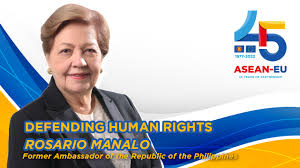
Rosario Manalo, a former top Philippine diplomat who had served as Manila’s representative to ASEAN’s human rights commission (and mother of the current foreign affairs Secretary Enrique Manalo), rose and launched into a tirade. She berated Iceland for sponsoring the resolution, accused that government of hypocrisy and interference in Philippine affairs, and turned on the Filipino human rights defenders seated in the same room — people who had traveled to Geneva because every domestic and regional avenue had been closed to them — and called them treacherous for supporting the resolution.
The resolution passed anyway, 18 votes to 14. But the moment stayed with me — not because of its shock value, but because of what it revealed about the system Manalo had spent her career helping to build.
The ASEAN human rights commission she helped shape has been silent on the drug war, silent on red-tagging, silent on journalist killings, silent on enforced disappearances, and silent on the 19 people killed in Toboso nineteen days before this summit opened. That silence did not happen by default. It was designed into the institution from its first day — and people like Manalo made sure the design held.
Built to Fail
The ASEAN Intergovernmental Commission on Human Rights was inaugurated in October 2009 amid considerable fanfare, offered as evidence that the bloc was finally serious about rights. What it actually produced was a body that cannot receive individual complaints, cannot conduct independent investigations, cannot compel testimony, and cannot issue binding recommendations. It operates by consensus, meaning any single member state can veto any collective action. Each representative is nominated by and answerable to their own government. The commission, in the most technical sense, is a human rights body. In any functional sense, it is not.
Its structural constraints, established from the day it was created, made meaningful action impossible before the first blow was ever struck.
Manalo’s role in cementing this deserves examination in full. While serving as the Philippines’ representative to the AICHR in 2012, she supported the adoption of the ASEAN Human Rights Declaration, a document widely criticized by rights groups for subordinating international human rights standards to regional and national sovereignty preferences, effectively building a way for member governments to dictate their own framework when it comes to dealing with human rights concerns. She then promoted that declaration’s exceptionalism at national and regional forums, advocating for the bloc to develop its own human rights conventions in an effort to insulate members from universal standards.
After Geneva, she went on to chair Myanmar’s government-appointed International Commission of Enquiry on Rakhine State. At the August 2018 press conference announcing the commission’s members — before its work had even begun — Manalo offered the Myanmar government her personal reassurance: “There will be no blaming of anybody, no finger-pointing of anybody saying you’re accountable.”
The commission delivered on that promise. It found “no evidence of gang rape” by Myanmar’s security forces — a conclusion that directly contradicted the UN’s own findings and Human Rights Watch’s documented evidence of widespread sexual violence against Rohingya women and girls. Critics, including the International Commission of Jurists, concluded that the body could not deliver justice or accountability. It had been designed, from its chairwoman’s first public statement, not to.
Manalo was subsequently nominated for a fourth term on the UN Committee on the Elimination of Discrimination against Women (CEDAW). She was elected. The system rewarded her record — not despite it, but consistent with a regional culture in which loyalty to governments consistently outranks loyalty to the people those governments have harmed. (HRW’s Phil Robertson, reacting to Manalo’s election, called her an “unfit candidate” to lead the UN’s women’s rights body.)
That sequence — from AICHR, to Geneva, to Myanmar, to CEDAW — is a precise distillation of what the ASEAN human rights architecture produces in practice: a forum designed to provide the appearance of scrutiny while protecting governments from its consequences.
The Doctrine of Looking Away
The institutional machinery Manalo helped shape rests on a foundation older than the AICHR itself. The foundational doctrine of ASEAN cooperation is non-interference — enshrined in the 1976 Treaty of Amity and Cooperation and reinforced at every turn since. Under it, member states agree never to act, criticize, or even comment on one another’s domestic affairs. Consensus is required for any collective action, meaning a single member can veto any statement on anything.
There is a version of this principle that makes sense. Smaller states with a history of foreign domination have genuine reasons to guard their sovereignty. The principle was designed, in part, to prevent the so-called great-power meddling that destabilized Southeast Asia through much of the 20th century. These are not arguments to be dismissed.
But the principle has been stretched, decade by decade, into an instrument of impunity. It has evolved from a protection against foreign interference into a shield behind which governments commit atrocities knowing their neighbors will never call them out.
When Duterte’s government killed people at a rate that the UN human rights office said may constitute crimes against humanity, the ASEAN response was to nod, look at the floor, and change the subject. When red-tagging sent activists to their deaths under Marcos, the AICHR produced no statement, conducted no review, initiated nothing. When journalists were shot and their killers walked free, ASEAN issued no comment.
There is also a layer of hypocrisy worth naming plainly. ASEAN is not a neutral bloc on drug policy. Its founding charter commits the organization to creating a drug-free region. Several member states — Thailand, Malaysia, Indonesia, Singapore — have their own harsh anti-drug policies, including the death penalty for drug offenses. When Duterte spoke of his drug war to ASEAN partners, he was not speaking to skeptics. He was speaking to governments that shared his basic premise: that the drug problem warranted extreme measures, and that those measures were a domestic matter. The regional drug-control architecture created ideological cover for mass killing.
To be fair, ASEAN is not entirely without voices of conscience. The ASEAN Parliamentarians for Human Rights, a body of current and former legislators from across the region, has been consistently vocal. After Duterte’s own congressional admissions in 2024 confirmed what rights organizations had documented for years, APHR members called for ICC cooperation and accountability. After Toboso, APHR was the only ASEAN-affiliated body to issue a condemnation. These parliamentarians deserve credit.
But APHR is not ASEAN. It is a civil society body whose statements carry no binding weight and are routinely ignored by the governments they are supposed to hold to account.
What the Silence Has Cost
Duterte has now been committed to trial at the International Criminal Court, arrested in March 2025 on charges of crimes against humanity, with all counts confirmed by ICC judges on April 23, 2026, just two weeks before this summit. There is finally, for some of what happened, the prospect of individual accountability.
But the ICC succeeded despite ASEAN, not because of it. The court’s jurisdiction was preserved only because the crimes occurred before Manila’s withdrawal from the Rome Statute took effect. And even now, ASEAN as a body has said nothing. Its member states have watched a former head of government committed to trial for crimes against humanity, and responded with silence.
That silence has consequences beyond the Philippines. Myanmar watched. Cambodia watched. Every government in the region tempted to resolve its problems through extrajudicial violence has watched ASEAN’s non-response and drawn the same conclusion: if you are an ASEAN member, you can kill thousands of your own citizens — tens of thousands by some estimates — disappear activists, label journalists as terrorists, and beat protesters in the streets. As long as you call it domestic law enforcement, your neighbors will write the appropriate paragraphs in the chairman’s statement and move on to the South China Sea.
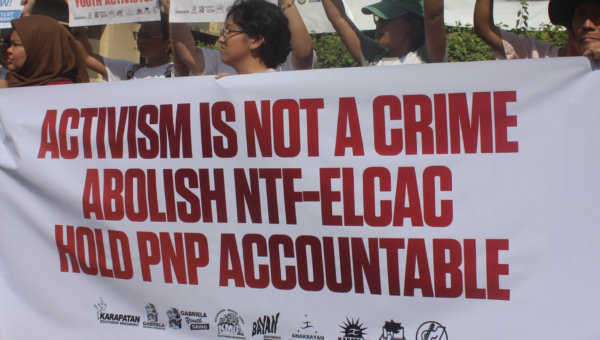
This week, the Philippines is hosting the summit, chairing the meetings, and pushing through a charter amendment in its own name. It is also, simultaneously, a country where drug killings continue with near-total impunity, where red-tagging sends people to early graves, where eight journalists have been murdered in three years, and where the government maintains lists of internal targets that human rights organizations consider a license for extrajudicial violence.
What Meaningful Action Would Look Like
It would not require abandoning regional solidarity. It would not require one state humiliating another. What it would require is an honest application of the ASEAN Human Rights Declaration — adopted in 2012, and signed by the Philippines — which commits member states to the promotion and protection of human rights in the region.
That declaration is not legally binding and contains its own sovereignty carve-outs. But it exists. ASEAN states could use it to raise human rights concerns in bilateral consultations, to refer specific situations to the AICHR for monitoring, to press member governments privately and collectively for accountability. They have, consistently, done none of these things.
The AICHR chair, Malaysia’s Edmund Bon, has put forward the most ambitious proposal in the commission’s history: a five-year plan explicitly aimed at pushing for legally binding human rights instruments across the region. This is a direct challenge to the consensus-and-veto model that has rendered the AICHR toothless since its founding. If it advances, it would be the most meaningful structural reform the commission has ever attempted.
But advancing it requires member states to ratify what amounts to a surrender of the veto power each of them currently holds over the commission’s every action — a veto that protects not just the Philippines but Thailand, Cambodia, Vietnam, and every other member state that has used the non-interference doctrine as a shield. The incentive to preserve that veto is structural and powerful. The Philippines, as this year’s chair, could use its platform to build the political will to overcome it. There is, from Cebu, no sign it intends to.
***
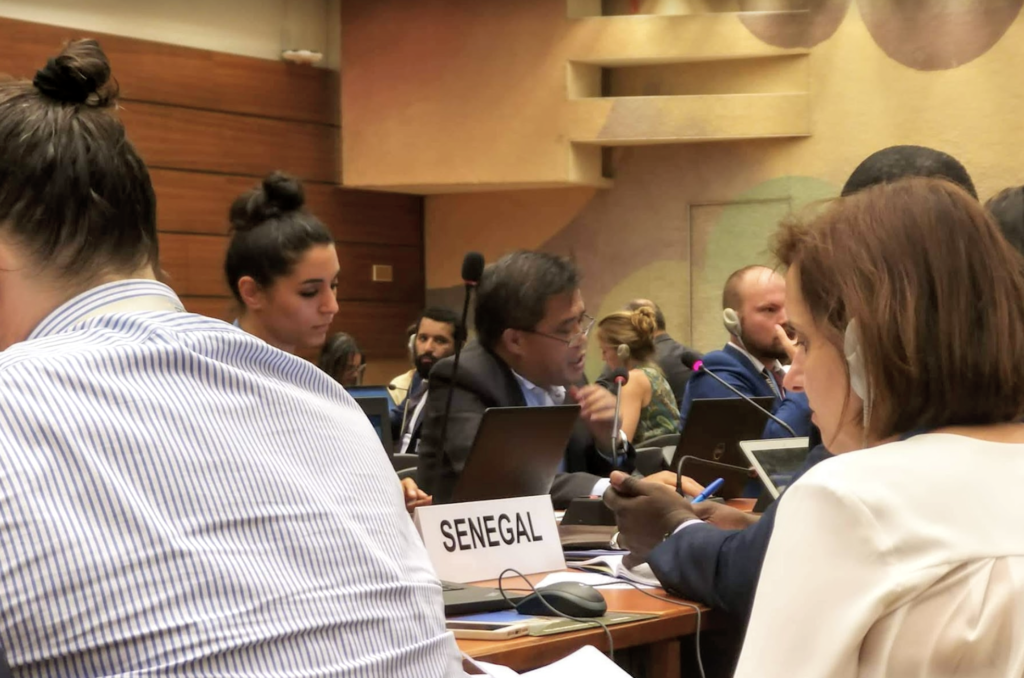
What I remember most from that meeting room in Geneva is not Manalo’s words. It is the faces of the Filipino rights defenders seated near her — people who had traveled to Geneva because every domestic and regional avenue had been closed to them, who were being called treacherous for doing so, and who went home to the Philippines and continued their work anyway, at genuine personal risk, in the faith that accountability was still possible somewhere.
Some of them are still doing that work today. Others or their colleagues have been killed, disappeared, or driven into silence — in some cases by the very apparatus this piece describes.
Tens of thousands of dead Filipinos — by some counts far more — did not change ASEAN’s silence. A former president committed to trial in The Hague has not changed it. Disappeared activists have not changed it. Shot journalists have not changed it. Nineteen people killed in Toboso nineteen days before this summit opened have not changed it.
The families of all of these people have never been given a reason. They have only been given, over and over again, the same empty paragraphs in the chairman’s statement, and then watched the leaders board their planes home.
That silence is ASEAN’s truest statement on human rights in the Philippines. It has been consistent from the beginning. And this week in Cebu, the only question is how many more names it will take before someone in that summit room decides they have had enough of it. (Rights Report Philippines)
Carlos Conde was a researcher at Human Rights Watch until late last year. He now edits Rights Report Philippines.