
Allowing an unjust law to crush a propagandist today only sharpens the blade that will inevitably be used against legitimate journalists tomorrow, Cong Corrales argues.
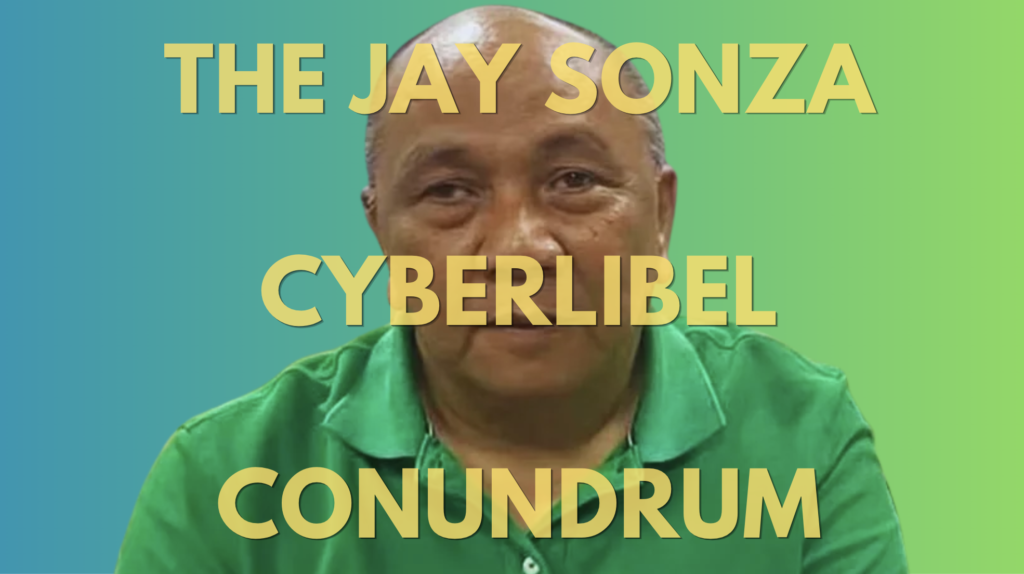
FOLLOWING my recent commentary on the deafening silence of media groups regarding the arrest of Jay Sonza, I received quite a predictable pushback from some colleagues in the media industry.
** IMPORTANT EDITOR’S NOTE AT THE END OF THIS COMMENTARY **
Their counterarguments were familiar and, frankly, exhausting in their lack of imagination: He is no longer a journalist. He is a propagandist. We shouldn’t use the decriminalization campaign to shield someone who spreads disinformation. He isn’t even a member of the union.
It is fascinating how intelligent people can miss the point so thoroughly.
In the fight for constitutional rights, missing the point by an inch is the same as missing it by a mile.
Let me dismantle the first and most dangerous misconception: the idea that opposing Sonza’s arrest under the Cybercrime Prevention Act is somehow an endorsement of his actions or a defense of disinformation.
It is neither.
My core argument against cyberlibel has never been that the accused are innocent angels waiting in line for canonization at the Vatican.
My argument is that criminal prosecution and jail time are fundamentally disproportionate, dangerous remedies for speech.
Let me say it with feeling: the cyberlibel law is a blunt instrument for those in power.
It does not pause to ask if the speech in question was a legitimate investigative report or a fabricated medical record; it simply crushes the accused with the coercive machinery of the state.
We have seen this before, and not so long ago.
In June 2020, Maria Ressa, who would win the Nobel Peace Prize the following year, was convicted of cyberlibel under this same law — albeit a different provision — together with former Rappler researcher Reynaldo Santos Jr.
The charge did not come from the government directly. It was filed by a private businessman, Wilfredo Keng, who alleged that a 2012 Rappler investigative report linking him to illegal drugs and human trafficking had damaged his reputation. The article had been published months before the Cybercrime Prevention Act even existed.
Prosecutors argued that a minor correction made to the article in 2014 — fixing a typographical error — counted as a fresh act of publication, stretching the law backwards across years to reach a story written before it was even a crime.
Now the same law has been used against Jay Sonza, a man at the opposite end of the journalistic spectrum from Ressa. One is celebrated as a defender of truth. The other is accused of spreading it in fabricated form. But the law does not care. It made no distinction then, and it makes no distinction now.
And that is precisely what a blunt instrument does: it does not cut cleanly. It lands on whoever is in range — a Nobel laureate under one administration, an alleged disinformation peddler under the next. The blade does not choose its targets. The hand that wields it does.
This is why we must oppose the law’s application universally.
Allowing an unjust law to crush a propagandist today only sharpens the blade that will inevitably be used against legitimate journalists tomorrow.
Then comes the staggeringly elitist and insular argument: that Sonza is not a “real” journalist anymore, therefore, he is outside our jurisdiction of concern.
Since when did the Constitution require a press card?
Freedom of speech and expression is a universal, constitutionally guaranteed right.
It is not a VIP privilege reserved exclusively for those who meet an arbitrary standard of journalistic practice, or those who sit in the right circles.
If a media watchdog only barks when its own friends are bitten, it is not a human rights advocate – it is a fraternity.
Finally, there is the claim that defending someone like Sonza “diverts” the campaign to decriminalize libel. This is perhaps the most intellectually dishonest argument of all.
Let me disabuse my critics of a convenient delusion: this is not, and never has been, a defense of Jay Sonza the man or his brand of digital garbage.
Defending the principle precisely when it is uncomfortable does not divert the campaign — it is the ultimate proof of it.
It proves that our outrage against cyberlibel is rooted in an unwavering moral obligation rather than selective convenience. When advocacy groups only protest the weaponization of the law when it hits their allies, they reduce a principled campaign for free expression into mere partisan posturing.
If you abandon the argument against cyberlibel the moment you find the accused repugnant, you have abandoned the argument entirely.
Once more, for the people in the back, beside the broombox: An unjust law applied to an adversary is still an unjust law. If we cannot see that, then our fight for press freedom not only missed the mark by an inch – we have missed it by a mile. (Rights Report Philippines)
EDITOR’S NOTE
Since Cong Corrales’ first commentary on this subject was published, a closer review of court records and news reporting has surfaced factual distinctions that readers should be aware of. What began as a routine fact-check by Rights Report Philippines has turned into something more unsettling: a window into how the machinery of the Cybercrime Prevention Act actually operates in practice — and how even the courts struggle to keep its moving parts straight.
The arrest charge is not cyberlibel
The warrant that put Jay Sonza in handcuffs on April 30 was issued by Pasay RTC Branch 118 for unlawful use of means of publication and unlawful utterances under Article 154 of the Revised Penal Code, in relation to Section 6 of RA 10175, the Cybercrime Prevention Act. Article 154 is not a libel provision. It covers the knowing publication of false information that could damage state interests or endanger public order. It requires no identifiable victim, no proof of damaged reputation — only a government willing to argue that a publication disturbed public order. This is a broader and more elastic standard than cyberlibel, which at minimum requires a specific person claiming injury.
Nearly all media coverage described the arrest as being for cyberlibel — a characterization traceable to the NBI’s own press release, which headlined it as being over “cybercrime charges” without specifying which provision triggered the warrant. Even NBI Director Melvin Matibag, in a radio interview, described the warrant as having been issued for cyberlibel under Article 353 of the Revised Penal Code — the libel provision — when the actual warrant cited Article 154, a different offense entirely. The confusion did not originate with reporters. It was present in the government’s own communications from the start.
The warrant itself was riddled with errors
It gets worse. According to Sonza’s lawyer Atty. Mark Tolentino, the warrant cited “Article 154 as amended by Republic Act No. 10591” — but RA 10591 is the Comprehensive Firearms and Ammunition Regulation Act, a gun law that has nothing to do with speech or publication. The correct amending law is RA 10951. The warrant also classified the offense as non-bailable, which is legally wrong for a charge of this nature.
When the court explained what went wrong, it did not say the judge had consciously mislabeled the charge. The court said the non-bailable designation did not come from the judge at all, but from the Philippine National Police’s e-warrant system, which generated it automatically. The judge signed the output without catching the error. The wrong Republic Act citation — RA 10591, a gun law — was a separate defect that Tolentino identified and that the court did not specifically address in its explanation. Tolentino’s earlier suggestion that the judge may have confused the Article 154 case with the pending cyberlibel case was speculation he offered before the court gave its own account, and should be read as such. The court apologized. Sonza himself accepted the apology upon his release.
What the court’s explanation actually reveals is, if anything, more alarming than a judge confusing two cases. A semi-automated system processed a warrant, attached a designation from the wrong law, and nobody in the chain — not the e-warrant platform, not the reviewing prosecutor, not the judge — caught it before the NBI knocked on a 71-year-old man’s door at night. Sonza experienced breathing difficulty at the time of his arrest and reported asthma attacks while in detention. He spent five days in NBI detention before being released on P10,000 bail — an amount so small it underscores how minor the charge actually is.
The Branch 111 cyberlibel case: stated but unconfirmed
Sonza does face a separate cyberlibel case, reportedly pending before Pasay RTC Branch 111. But much of the coverage surrounding the arrest has treated that case as established fact. It should not be. Every reference to Branch 111 in public reporting traces to a single source — statements by Tolentino himself. The NBI, the Department of Justice, and the Presidential Communications Office have not independently confirmed that a separate cyberlibel Information has been filed and raffled to that branch. No case number has been published. No court order from Branch 111 has appeared in any reporting.
This does not mean the case doesn’t exist. The NBI recommended both a cyberlibel complaint and an Article 154 complaint to the DOJ in February, and if the DOJ found probable cause on both — as it apparently did — two separate Informations would have been filed and raffled to different branches. That is procedurally plausible. But plausible is not confirmed, and we should not have treated it as such.
What Tolentino has said about the Branch 111 case is nonetheless worth noting: that because the alleged offended party is the President, the President himself — not the NBI — should be the complainant, and that the NBI’s lack of legal standing is grounds for dismissal of both cases. Under Philippine law, libel is a private offense. No public reporting has established whether the President or his office appears anywhere in the charging documents for either case.
Beyond Jay Sonza
This oped’s central argument — that an unjust law applied to an adversary is still an unjust law — stands. But the factual record now reveals something that makes the argument more urgent, not less.
A man was arrested, held in detention over a holiday weekend, and denied bail — not because of a deliberate judicial decision but because a warrant was processed by an automated system that cited the wrong law, produced the wrong bail classification, and was signed without anyone in the chain catching either error. The law underpinning that warrant, Article 154 of the Revised Penal Code as elevated by the Cybercrime Prevention Act, requires no identifiable victim and no proof of harm to any individual — only the government’s assertion that a publication was false and damaging to public order. It is, in the precise sense the author of this commentary intended, a blunt instrument.
When a law is broad enough that its own enforcers cannot agree on which provision applies, elastic enough that an automated system can pull the wrong clause without anyone noticing, and carries enough institutional weight that a man spends five days in detention before a clerical error is corrected — the danger the author describes is not hypothetical. It is the documented record of what happened to one man in Quezon City on the night of April 30.
The Editor
Rights Report Philippines