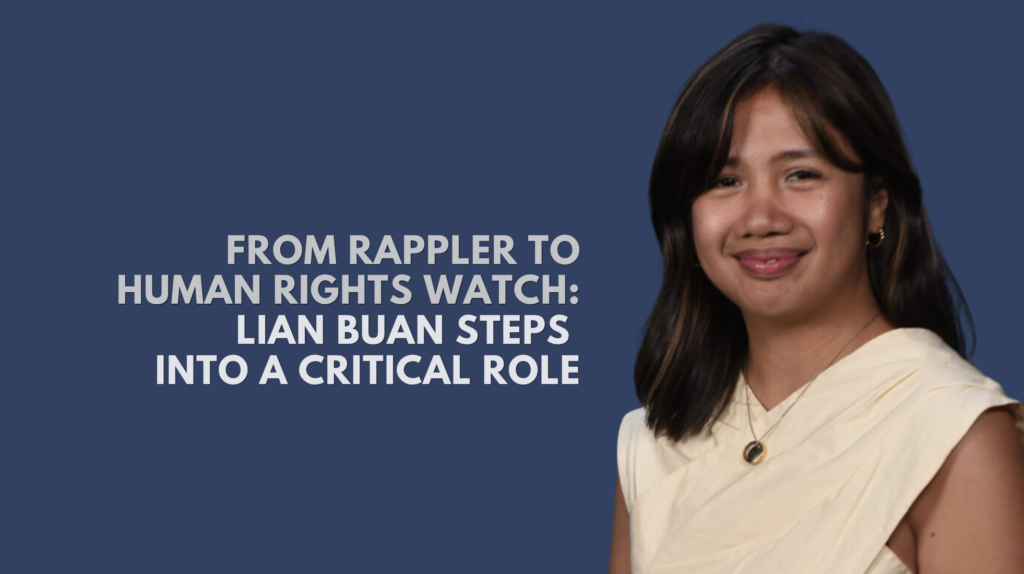
MANILA — Lian Buan, a senior investigative reporter at Rappler, is joining Human Rights Watch as its new Philippines researcher, an appointment set to be formally announced soon. She will be only the second Filipino in HRW’s history to hold the position, after Carlos Conde, who left in July 2025 following nearly 14 years in the role.
Buan has spent nearly 15 years covering the Philippine justice system from the inside out — high-level corruption, judicial politics, and the killing, abduction, and persecution of activists and indigenous leaders. She helped lead Rappler’s justice and human rights cluster, which in 2024 pursued one of her most consequential investigations: a seven-month Freedom of Information deep dive showing that most of the drug war “showcase cases” had been closed without criminal prosecution.
She also covered the International Criminal Court proceedings against Duterte from The Hague itself, where on April 23, 2026, pre-trial judges unanimously confirmed all three counts of crimes against humanity against him and committed him to trial. She was in the courtroom for the confirmation of charges hearings in February 2026 — and was direct about what it cost her. “It’s easy to romanticize an assignment like The Hague,” shewrote on returning. “It’s a prestigious assignment, sure, but I can tell you I felt no prestige having my morality, my values, and my humanity as a Filipino be put on a public trial like that.”
Her academic credentials match the work. She holds a Master of Laws in Human Rights from Birkbeck College, University of London, earned as a Chevening scholar — a program that draws roughly 50,000 applicants a year globally, with a 2 to 3 percent acceptance rate. She has been named a panelist at the Jaime V. Ongpin Journalism Seminar three times — in 2020, 2021, and 2025 — and was runner-up for the International Women’s Media Foundation’s 2026 Elizabeth Neuffer Fellowship, given annually to women journalists covering human rights and social justice.
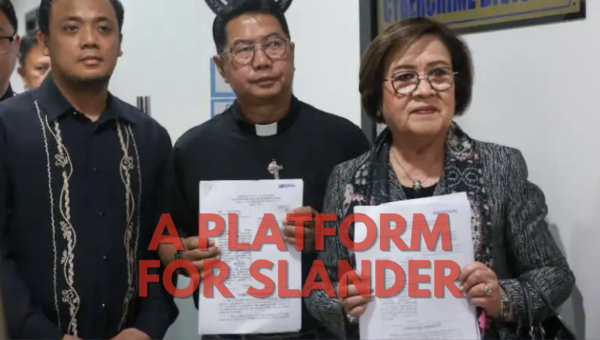
Buan covered this beat without the protection of distance, and paid for it. In May 2022, HRW itself reported that a Marcos spokesperson repeatedly ignored her questions at a press conference about an outstanding contempt order against the incoming president in the United States. Earlier that same campaign season, Marcos security personnel physically blocked and shoved her at a rally. An anonymous social media account simultaneously red-tagged her — baselessly accusing her of being a high-ranking official of communist organizations. The National Union of Journalists of the Philippines warned the labeling “has implications on her safety, especially while covering the election campaign.”
None of this was random. An NUJP study found that 60 percent of red-tagging cases against Filipino journalists were state-sponsored. The Committee to Protect Journalists documented the Duterte government’s three-pronged approach: verbal assaults, coordinated social media attacks, and threats to media licenses or commercial interests — all aimed at discouraging critical coverage of the drug war. CPJ’s Asia coordinator Beh Lih Yi has noted that even under Marcos, “journalists in the Philippines still routinely face harassment, legal threats, arbitrary detention and even murder in retaliation for their work.”
Buan went through all of that inside one of Asia’s most targeted newsrooms. She worked at Rappler alongside Nobel Peace Prize laureate Maria Ressa and a team that included some of the country’s finest human rights reporters — among them Jodesz Gavilan, Rambo Talabong, and Jairo Bolledo.
The Philippines is not short of human rights problems. The government has rejected calls from UN experts to disband the National Task Force on Ending the Local Armed Conflict, the agency most associated with red-tagging activists and journalists as communist sympathizers. Extrajudicial killings continue. And with the ICC having now confirmed Duterte’s trial on crimes against humanity charges, the country’s human rights record is being examined as never before at the international level.
The HRW Philippines researcher writes country reports that inform UN proceedings, briefs foreign governments and diplomats, and advocates before international human rights bodies. It is work that requires legal precision, institutional credibility, and the trust of communities that have every reason to be suspicious of outsiders.
Buan brings all of it: a law degree in human rights, 15 years reporting on the justice system, firsthand experience at The Hague, and the record of someone who kept working while being targeted by the same machinery she will now document. Her predecessor Carlos Conde — a veteran journalist and former New York Times Manila correspondent who spent nearly 14 years in the role — built it into one of HRW’s most respected country desks. HRW’s work on the Duterte drug war, for example, played a crucial role in the ICC investigation that followed. (From HRW, Conde went on to establish Rights Report Philippines, where he is the editor.)
Human Rights Watch is one of the world’s most influential independent human rights organizations, founded in 1978 as Helsinki Watch to monitor the Soviet Union’s compliance with the Helsinki Accords. It took its current name in 1988 after expanding to cover abuses across Asia, Africa, and the Americas, and today monitors human rights conditions in close to 100 countries. Headquartered in New York and accepting no government funding, it operates on a model of rigorous on-the-ground fact-finding, public reporting, and direct advocacy with governments, international bodies, and the United Nations. Its annualWorld Report is one of the most closely watched assessments of global human rights conditions. HRW shared the Nobel Peace Prize in 1997 as a founding member of the International Campaign to Ban Landmines, and played a central role in drafting the Rome Statute that established the International Criminal Court — the same court that is now trying Rodrigo Duterte. (Rights Report Philippines)