

Residents heard the first shots before sunrise. By afternoon, 19 people were dead — and a small community in Negros Occidental was left trying to understand what happened. Marchel P. Espina reports.
By Marchel P. Espina
Rights Report Philippines
TOBOSO, NEGROS OCCIDENTAL — Hours before the clash that resulted in the deaths of 19 people – 10 of them rebel fighters and 9 civilians, including 2 children – soldiers from the Philippine Army were already converging in Barangay Plarending, waiting for a group led by the communist New People’s Army to enter what, essentially, was a kill zone.
As early as 4 a.m. that day Sunday, April 19, residents of Plarending heard faint gunfire coming from the neighboring Sinugmawan, a southern sitio more than two kilometers away from Plarending. But they had no idea who was firing the weapons and at whom.

About an hour later, soldiers started to arrive in Plarending and positioned themselves, according to residents interviewed by Rights Report Philippines. “Una sila di plastar (They were the first ones here),” said Plarending resident John Kenneth Pancho, 26, in Cebuano. “Tuyok ang lugar (They surrounded the area).”
By 11 a.m., according to Pancho and other residents, loud bursts of gunfire rang across Plarending as the soldiers engaged with a group that turned out to be led by the NPA, which had with them individuals the Communist Party of the Philippines later declared were civilians.
Pancho said the Army must have known that the group would retreat to Plarending from Sinugmawan during the alleged gunbattle. “Gin-unahan sang Army na diri madalagan. Tinuod, diri man nagdalagan (The Army anticipated they would run here. True enough, they did run here),” he said. A different group of soldiers were left stationed around Sinugmawan and its environs as more descended on Plarending.
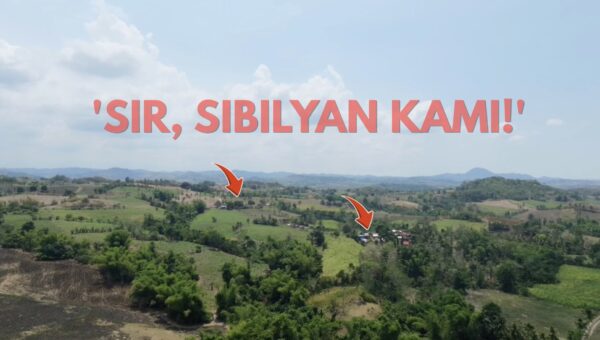
Plarending is a remote upland sitio marked by rugged terrain, with scattered houses and elevated forested areas. The area is accessible mainly through a narrow dirt path and is more than a 30-minute walk from the main road.
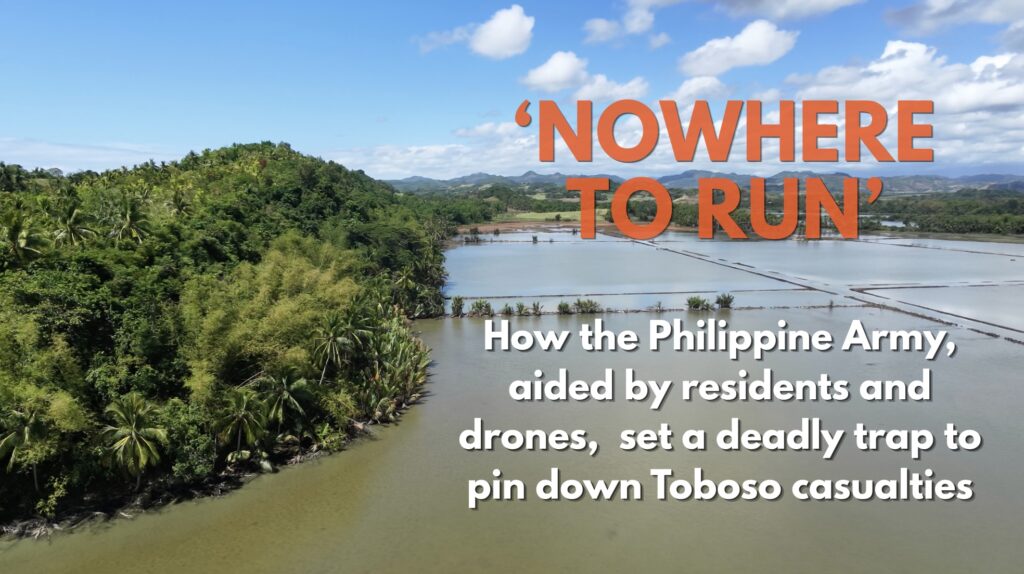
‘Nowhere to Run’
According to one resident, “Na trap sila kay ginpalibutan sang Army, daghan man Army. Amo to nag-encounter sila, na trap…waay sila daganan. (They were trapped because they were surrounded by the Army, a lot of Army. That’s why there was an encounter. They were trapped… They had nowhere to run).”
Barangay Salamanca chairman Romeo Sultan said there are three exit points from Sitio Sinugmawan, where the initial firefight erupted: Barangay San Jose in Toboso, Sitio Plarending, and Barangay Udtongan in neighboring Escalante City.
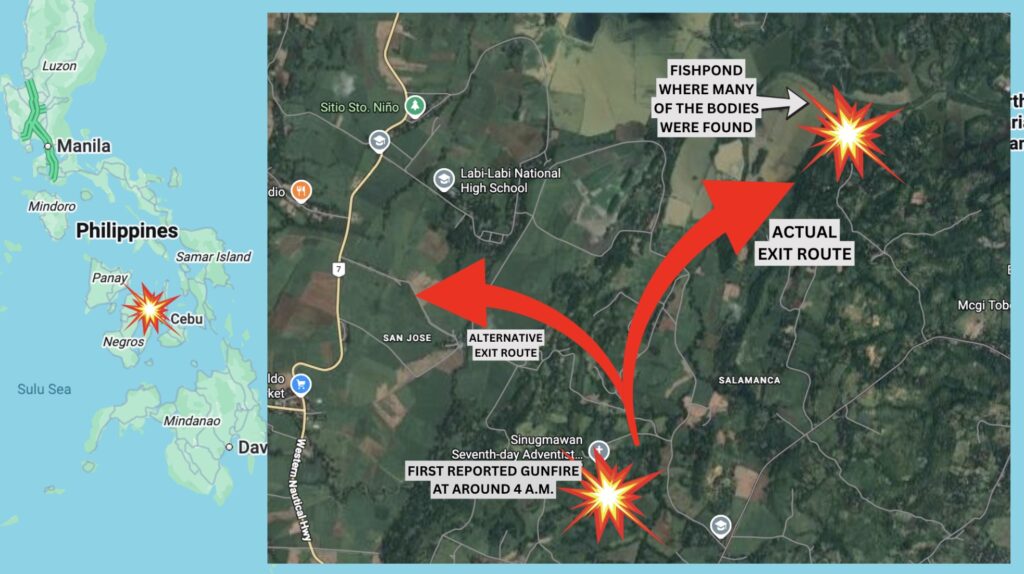
He said the rebels would have been trapped if they escaped through San Jose because it leads directly to the national highway.
He said they could instead pass through Plarending, where a river leads to Udtongan. According to Sultan, they could swim across during high tide (it was high tide that hour of the day). Plarending is more than an hour’s walk from Sinugmawan.
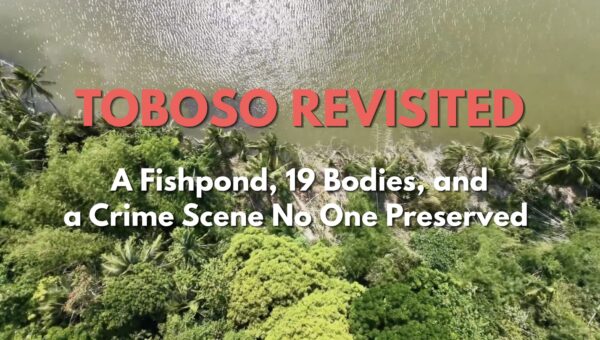
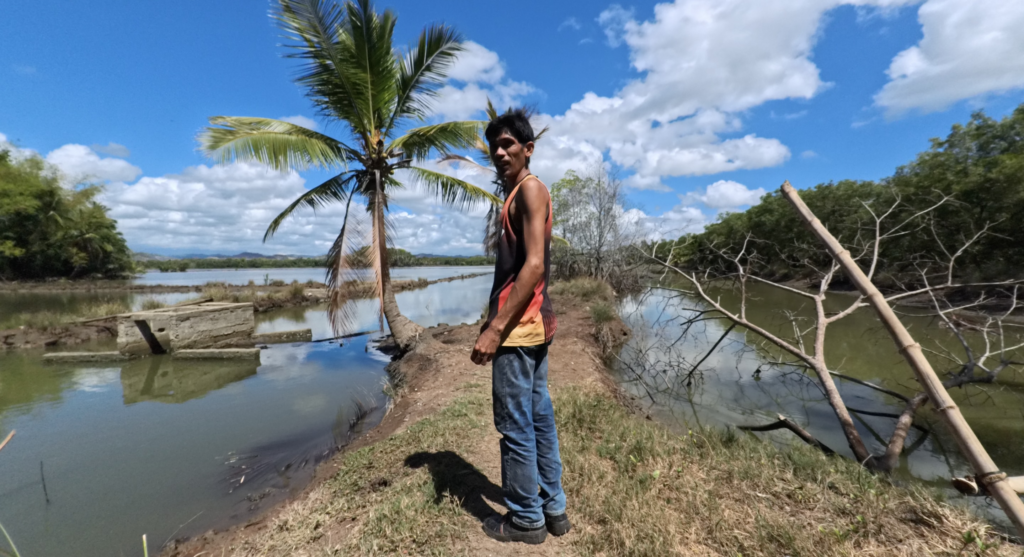
But the firefight ended at the fishpond. One side of the fishpond is bordered by elevated forested terrain, which provided a tactical vantage point over the kill zone. Sultan said the fishpond could be seen from this position. “Walang tao, walang bahay. Sila lang doon (There are no people and no houses there. They were the only ones there),” he said in Filipino.
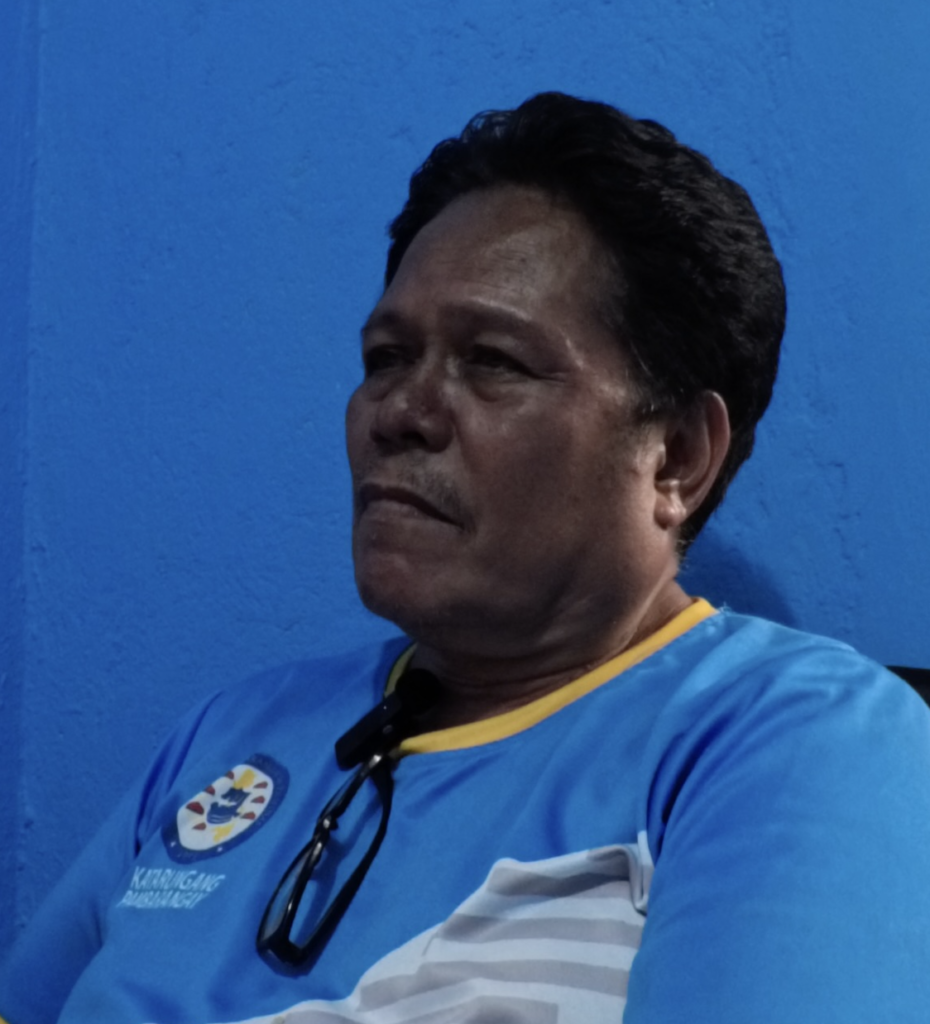
Asked how the Army was able to track the rebel group’s position, Sultan said they were followed and that it was the residents of Sinugmawan who pointed to the direction they were taking.
“Maraming tao nagsabi kung saan dumaan. Mga tao nagsabi (Many residents told them where they (the NPA group) passed. It was the people who told them),” the barangay leader said.
“Pag putukan, ang iba nag-forward na, kasi alam nila saan dumaan (When the gunfight started, the others moved forward because they already knew where the NPA group went),” he added.
“Ang alam ko, pinasubaybayan kung saan sila pumunta (All I know is that they were tracked to where they went),” Sultan said.
Army spokesperson Col. Louie Dema-ala, in an interview with local media on April 23, confirmed this account, saying it was the community that reported the presence of the NPA-led group to the authorities.
Bursts of Gunfire
“Kuyawan (afraid),” Pancho said when asked how he felt after hearing the gunshots. He immediately dropped to the floor to avoid being hit by stray bullets. Thirty minutes later, he said he and his sibling rushed to the evacuation site, a school, near the Salamanca barangay hall, about two kilometers from their house.
His house was the last one before the sprawling fishpond where some of the bodies were recovered.
Another Plarending resident, Riza Viajedor, 33, said they also saw Army soldiers in the area early that morning. They were terrified when they heard the loud bursts of gunfire, she said.
Their house is a 30-minute walk from the fishpond where many of the bodies were recovered. They were not able to evacuate immediately because they were caught in the middle of the firefight and were told to stay inside and wait for further instructions.
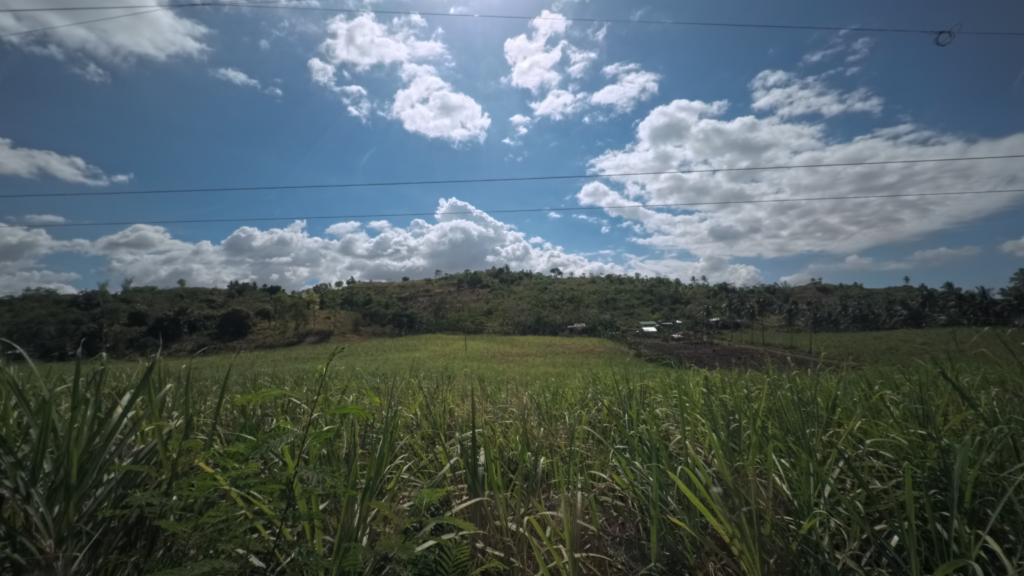
Viajedor recalled running to the house of their neighbor, barangay councilor Danilo Dalugdog, because they were terrified by the gunfire. Most residents in their area, she said, were only able to evacuate at around 4 p.m., after the shooting stopped.
She said five members of their family immediately rushed to the barangay hall. Her five-year-old niece was terrified. “Nagsuka ang bata sa kulba (She vomited out of fear),” Viajedor added.
Dalugdog said he was inside his house when the gunfire started and helped his neighbors evacuate because they were terrified by what was happening.
The community remained shaken by the incident, he said.
Randy Toto, 38, who moved to Plarending from Talisay City only four months ago, said some residents were not able to evacuate immediately because they were trapped when the shooting started. The Army told them to stay inside their homes to avoid being hit by stray bullets.
He said he and his wife had just arrived home from selling shrimp when they heard the gunshots that morning.
“Kusog ang lupok. Dugay ang balusanay sang lupok. May dako pa gid nga lupok, ambot kung granada (The gunshots were loud. The exchange of fire went on for a long time. There was also a huge explosion. I don’t know if it was a grenade),” he said in Hiligaynon.
He said it was their neighbor, a barangay councilor, who told them to evacuate.
Toto, along with his wife, two children ages 4 and 1, and his 60-year-old mother-in-law, whom he fetched from a nearby house, fled on his motorcycle. They had to scooch over so all of them could fit on the motorcycle, he said.
His family remained traumatized by what happened. He recalled seeing soldiers behind his house as they moved toward the fleeing rebels.
Church Service
Meanwhile, some residents were oblivious to the gunfight as they were inside a Christian church attending a Sunday service from 9 a.m. to noon.
Primitivo Mahilum, a barangay councilor who was inside the church when the firefight started, said they did not hear any gunshots or explosions while inside. He said he only learned about the encounter after a fellow councilor informed him.
He said they were told to remain inside the church until the situation settled.
Mahilum said that had his fellow councilor not informed him, they would not have known what was happening outside because it was also loud inside the church during the praise and worship service, with drums being played. It was difficult to hear anything from outside, he said.
Drone Sighting
When pressed on whether the soldiers used drones in tracking the location of the NPA group, Sultan firmly denied knowing anything about it.
But this was contradicted by the accounts of several residents interviewed by Rights Report Philippines, who asked not to be identified.
One resident said he actually saw a drone hovering overhead, although he could not say categorically that it belonged to the Army.
Another resident said he heard many people at the evacuation center talking about seeing a drone that day, although he himself did not see any.
Four more residents said they saw a drone that day, with one of them describing it as “high-tech.”
Rights groups and the NPA have been calling for the release of the alleged drone footage, which they claimed showed rebel leader Roger Fabillar alive and reportedly no longer in a position to fight back.
“This indicates that he was summarily killed by the fascists, instead of being taken in as prisoner of war,” the Communist Party of the Philippines said in a statement released on April 27.
The Army denied the existence of any drone footage.
‘Legitimate’ Encounter
Negros Occidental Governor Eugenio Jose Lacson, in an interview with local media on May 8, said he believed the incident in Toboso was a “legitimate encounter.”
“I think we should also realize that the Army could not have done that without information from the community, so clearly the community helped guide the Philippine Army to run after their target…we do not question the Philippine Army,” Lacson, who also chairs the Regional Peace and Order Council-Negros Island Region, said.
He added: “We should appreciate the Philippine Army who are out there every day sacrificing their lives for us to be free and live peacefully.”
The NPA earlier claimed that only 10 of the 19 killed were combatants, including their leader, Roger Fabillar, also known by the aliases Arnel Tapang, Jhong, Nono, and Domeng, who carried a 1 million peso bounty. The group said the remaining nine were civilians and noncombatants.
Army spokesperson Col. Louie Dema-ala, in the same interview with local media on April 23, stressed that the Philippine Army followed the rules of engagement and respected international humanitarian law. He maintained that those killed were combatants and that high-powered firearms were found or recovered. (Rights Report Philippines)
Editor’s Note:
Why We Call Them Civilians
Immediately after the Toboso incident was reported, the Philippine military claimed that all the fatalities were combatants of the New People’s Army because they were there, they were armed, and they were fighting back. But it has not presented evidence to back up their claim other than pictures of bodies with bandoliers.
Meanwhile, the Communist Party of the Philippines admitted that 10 of the casualties were indeed NPA fighters but the other nine were not. Since then, reports and testimonies from friends and colleagues of several of the fatalities surfaced, indicating that they were civilians. The lives as civilians of these victims prior to the Toboso carnage, shown through their body of work and personal histories, are verifiable.
Among them were RJ Nichole Ledesma, a community journalist from Bacolod City; Alyssa Alano, a University of the Philippines Diliman student councilor; Maureen Keil Santuyo, a member of the National Network of Agrarian Reform Advocates-Youth; Errol Wendel, a member of the Unyon ng mga Manggagawa sa Agrikultura; Lyle Prijoles of the International Coalition for Human Rights in the Philippines from San Francisco, California; and Kai Sorem from Seattle, Washington.
Also among the listed casualties were Roel Sabillo, a farmer and resident of Barangay Tabunac, Toboso; a 15-year-old girl from Sitio Plarending, Barangay Salamanca, Toboso; and a 17-year-old teenager from Sitio Buklog, Barangay Lalong, Calatrava, Negros Occidental.
Unless there’s hard evidence and independent corroboration that these individuals were NPA members who actively participated in combat that day, Rights Report Philippines will continue referring to them as civilians.