
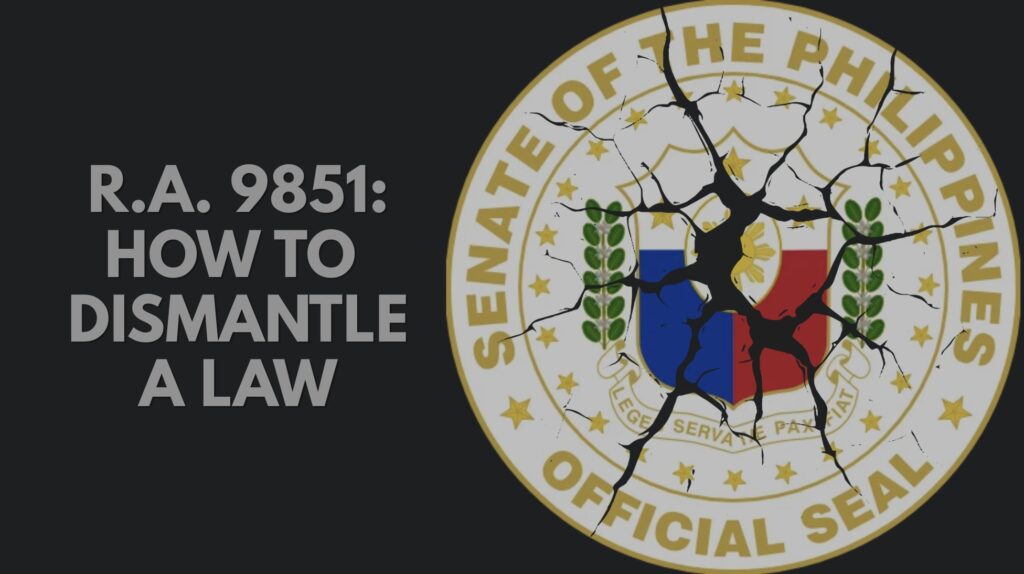
ANALYSIS: The fate of the Philippines’ most powerful accountability statute – the law on crimes against humanity – is not an irony. It is a diagnosis of the rot in our political culture, Carlos Conde writes.
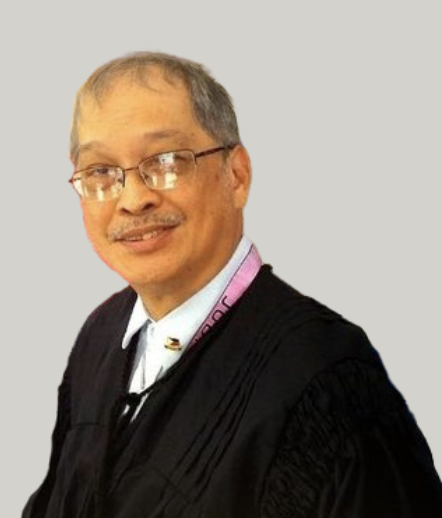
SOLIMAN M. Santos Jr. spent years of his life drafting the Philippine law against crimes against humanity. Between 2002 and 2006, he prepared three versions of what became Republic Act 9851, the country’s most powerful domestic statute against crimes against humanity.
He worked with the Philippine Red Cross to push it through Congress, and watched the International Committee of the Red Cross lobby the executive and the military to finally let it pass. When President Gloria Macapagal-Arroyo signed RA 9851 into law on December 11, 2009, Santos, at a public briefing at the UP College of Law months later, called it long overdue.
Fifteen years later, Santos watched the politicians who championed that law deploy it as a shield against accountability, then as a tool of circumvention, then ignore it entirely. In an email to Rights Report Philippines, he blamed “the lawyer traditional politicians (trapos) who are good in misapplying or circumventing the law in general.” He called it the “utilitarian approach to the law for vested interests.”
This week, some of the people responsible were in full view.
On May 11, Senator Ronald “Bato” dela Rosa, who has an active International Criminal Court arrest warrant for his role in Rodrigo Duterte’s drug war, returned from months in hiding and cast his vote for the leadership change that made Alan Peter Cayetano the new Senate president. National Bureau of Investigation agents moved to detain him. He fled through a stairwell into the Senate chamber, where allied senators placed him in protective custody. Two days later, after gunfire broke out on the Senate grounds, he slipped out in the early hours of May 14.
Cayetano confirmed the escape at a press conference that afternoon and declared it no escape at all. “But again, the use of the word escape is wrong because there’s no warrant,” he told reporters in a mix of English and Tagalog. “There’s no warrant, so he’s free to go.”
In fact, there is a law that says otherwise. And the senators now arguing against its application are, in several cases, the same people who helped write it.
How the Law Was Built
Santos, now a retired Regional Trial Court judge in Naga City, provided Rights Report Philippines with a 2010 backgrounder that traces the IHL bill’s origins to an assessment he conducted for the Philippine National Red Cross IHL National Committee in 2002. Despite ratifying the 1949 Geneva Conventions and their protocols, the Philippines had passed almost no legislation to make those obligations enforceable in its own courts.
Santos modeled the draft bill after the Rome Statute. In an email exchange, he told Rights Report Philippines that the ICRC “was crucial in helping shepherd it through Congress which passed it in 2009.” In his backgrounder, he described the bill as taking “the bargain of ‘buy one, take two'” — using the Rome Statute’s framework to cover not only war crimes but genocide and crimes against humanity within a single domestic statute.
His rationale was rooted in the country’s immediate reality. “That we have been in this for that long on two major fronts of armed conflict,” he said at the UP briefing, referring to the decades-long insurgencies in Mindanao and the conflict with communist insurgents, “may be said to be the ultimate rationale for RA No. 9851, which in fact is long overdue.”
The bill’s passage was obstructed primarily by the military establishment, which feared it would expose commanders to suits and complicate counterinsurgency operations. What finally cleared those obstacles was a convergence of public pressure in 2007 — the Melo Commission’s findings, UN Special Rapporteur Philip Alston’s mission, and the Supreme Court’s own summit on extrajudicial killings. At the time, extrajudicial killings against activists and journalists were already rampant, which was why the UN got involved.
ICRC’s engagement with the executive and security sector that year, Santos wrote, “ultimately bore fruit.” The bill had by then become a priority bill.
The bill’s Senate authors included Senator Jinggoy Estrada, Senator Loren Legarda, and Senator Francis Escudero, whom Santos’s backgrounder credits for “‘shepherding’ the bill to the Bicameral Conference Committee.” Senator Pia Cayetano voted for it on Third Reading on May 26, 2009.
When RA 9851 was signed, Santos held up the Maguindanao Massacre — committed just weeks before, in November 2009 — as the benchmark. Under the new law, he said at the UP briefing, what had been charged as multiple murder could now be prosecuted as a crime against humanity.
How It Was Dismantled
Then came the dismantling. And it was not sudden – it happened across administrations, executed each time by someone with detailed knowledge of the institution being set aside.
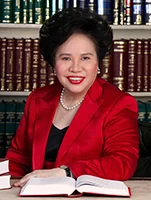
Miriam Defensor Santiago co-authored the Senate bill. In 2011, she became the first Filipino — and the first Asian from a developing country — elected as an ICC judge. By the 2016 presidential campaign, she was publicly dismissing as hyperbole Duterte’s admissions that he had killed people, calling him her “best friend.” She died in September 2016. Harry Roque lobbied for the bills that became RA 9851, then pushed as a party-list representative in 2016 for amendments to bring the Philippines into fuller Rome Statute compliance. He then became Duterte’s spokesperson and defended the country’s withdrawal from the court he had once championed.
Alan Peter Cayetano’s arc is the most documented. In August 2011, he was among the 17 senators who voted to ratify the Rome Statute. In March 2018, as Duterte’s Foreign Affairs Secretary, he filed the Philippines’ withdrawal from that same treaty with the United Nations. The Supreme Court case upholding that withdrawal bears his name: Pangilinan v. Cayetano. In that ruling, the court leaned on RA 9851 to argue the withdrawal was not consequential — the domestic law was sufficient. Cayetano is now the Senate president using that same logic to argue the ICC’s warrants have no force here.
His sister Pia voted for RA 9851 in 2009. She voted for her brother’s Senate presidency on May 11.
Estrada, the law’s principal author, voted for the coup this week and was the senator who informed Cayetano on Thursday that dela Rosa had left the building. Legarda, another principal author, switched from the former majority bloc to vote for the leadership change. Escudero, who steered the bill through Congress, was among the eight members of Cayetano’s core minority bloc who backed the coup.
Everything Is Transactional
What Santos calls a utilitarian approach to law is the operating logic of Philippine politics at its most concentrated. Laws are authored when authorship confers political capital — when civil society, for instance, is watching or when international pressure is high. They are circumvented when the calculus shifts — when allies face prosecution, when political survival requires flexibility. Or, as we’ve witnessed the past week, when the law’s application would hurt the very people who wrote it.
RA 9851 is not an exception to this pattern. It is its clearest expression, because the law in question is not a subsidy formula or a franchise provision. It is the statute criminalizing the worst things a government or its leaders can do to their own people. That the same legislators who defined those crimes are now arguing the definitions do not apply exposes something beyond hypocrisy. It shows that in Philippine politics, accountability structures are built not as constraints on power but as credentials — tools for claiming moral authority that can be quietly set aside when authority is no longer what is needed.

This is what makes the events of this week something more than a political crisis. Dela Rosa arrived in Cayetano’s car to cast his vote. The Senate was then used as sanctuary from a warrant arising from killings that RA 9851 was specifically designed to prosecute. The DOJ stated plainly the day before Cayetano spoke that Philippine law permits surrender of suspects to international courts without a separate local warrant. None of it mattered. The law is only as effective as the people responsible for enforcing it — and this week, those people staged the coup.
What the Law Can Still Do
Santos anticipated some of this. In his application notes, he asks why no RA 9851 case has ever been filed against AFP or PNP personnel, given that every conviction so far has involved rebel group members. The answer his question implies is the same answer this week makes explicit: the law has never been used against the state because the state controls whether it is used.
Rights groups can still act within that constraint. Crimes under RA 9851 do not prescribe. Evidence built now can anchor future cases indefinitely. The command responsibility doctrine reaches superiors who knew of killings and failed to stop them. Filing drug war deaths as crimes against humanity under Section 6 — which, as the UP Law Center notes, largely replicates the Rome Statute’s own definition — would place individual killings within the systematic pattern the ICC has already confirmed. In October 2023, Burmese refugees demonstrated the law’s extraterritorial reach by filing proceedings at the Department of Justice against Myanmar junta members for atrocities committed entirely outside the Philippines. One protection remains beyond litigation. RA 9851 bars official capacity as a defense but retains the sitting president’s constitutional immunity during their tenure.
Santos built the law to survive political bad faith. He gave it no statute of limitations, no implementing rules requirement, no dependence on the goodwill of whoever held office. What he could not build into the statute was a Senate that would enforce it — or a political culture in which the people who pass laws believe themselves bound by them. What happened this week was not a failure of RA 9851. It was a demonstration of the one thing no law can fix on its own. (Rights Report Philippines)