“The world recognizes in Frenchie Mae a journalist imprisoned for doing her job — and in that recognition lies the most damning vindication of her work and cause as a people’s journalist.” – National Union of Peoples’ Lawyers
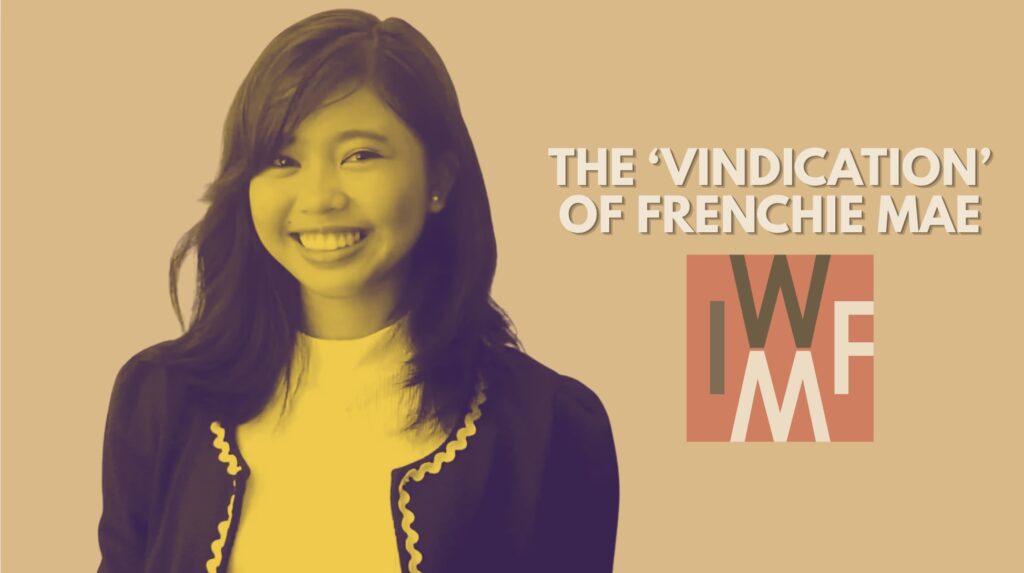
ON THE morning of February 7, 2020, Frenchie Mae Cumpio was dragged from her bedroom and made to lie on a kitchen floor while police and soldiers moved through the house. “All we saw were boots,” she would latertestify in court. She has not been free since.
More than six years later, Cumpio, the executive director of the independent news outlet Eastern Vista, was named Wednesday as a recipient of one of journalism’s most significant honors. The International Women’s Media Foundation announced the award as part of its 37th annual Courage in Journalism Awards, giving her the 2026 Wallis Annenberg Justice for Women Journalists Award, reserved each year for a journalist who is unjustly imprisoned. She received the news from a jail cell in Tacloban.
Cumpio is one of five people collectively known as the “Tacloban 5” arrested in that pre-dawn raid. The military maintained she was a key officer of the Communist Party of the Philippines, and that each of the five individuals were linked to militant groups serving as fronts for the CPP and its armed wing, the New People’s Army. All five have denied the accusations. Two were eventually released on bail. Three, including Cumpio, remain behind bars.
The original charges against her — illegal possession of firearms and explosives — were the basis of her detention for the first year and eight months. Then, in 2021, prosecutors filed a separate and additional charge: terrorism financing, based on money found during the raid.
It is that later charge on which a Tacloban regional trial court convicted her and co-accused Marielle Domequil in January, sentencing both to up to 18 years in prison. The court simultaneously acquitted them on the original firearms and explosives charges — the very accusation that had put them in a cell in the first place.
The National Union of Peoples’ Lawyers (NUPL), which has served as legal counsel for both women since their arrest, did not mince words. “Whatever the local court may have ruled,” the group said in a statement, “the world recognizes in Frenchie Mae a journalist imprisoned for doing her job — and in that recognition lies the most damning vindication of her work and cause as a people’s journalist.”
The National Union of Journalists of the Philippines, which has campaigned for Cumpio’s release, said the IWMF’s recognition affirmed the importance of community journalism in amplifying marginalized voices, and reiterated its call to reverse the charges against Cumpio, Domequil, and their colleague Alexander Abinguna, a human rights worker who also remains detained.
READ: Court Upholds Cumpio, Domequil Terror-Financing Conviction
One Among Thousands
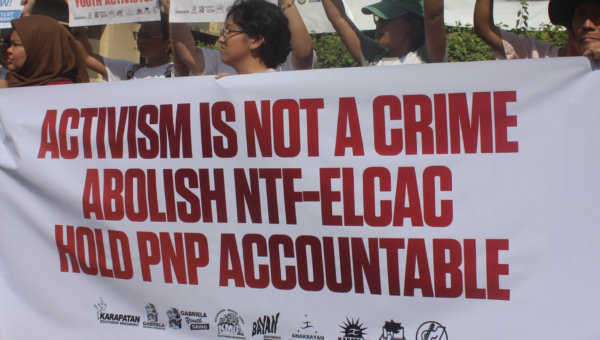
Cumpio’s case did not arise in a vacuum. It is a single thread in a pattern that has claimed farmers, lawyers, teachers, church workers, indigenous leaders, and journalists across the Philippines for decades — one that accelerated sharply when former President Rodrigo Duterte formally ended peace talks with the communists in November 2017 and then, a year later, signed Executive Order 70, establishing the National Task Force to End Local Communist Armed Conflict, or NTF-ELCAC. The task force institutionalized what critics describe as the state’s primary instrument of repression against dissent: the practice of publicly branding individuals as communist terrorists — without due process, without evidence, and with consequences that can range from harassment to killing.
Red-tagging did not begin with Duterte, nor with the NTF-ELCAC. It is a practice with roots stretching back to the earliest years of the Philippine government’s war against the Communist Party of the Philippines and its armed wing, the New People’s Army — a Maoist insurgency that began in 1968 when Jose Maria Sison reestablished the CPP under a Maoist line, and that has outlasted every administration that has tried to defeat it.
At the core of the counter-insurgency doctrine is a specific theory of how the insurgency sustains itself: that the NPA does not survive through armed recruitment alone, but by drawing fighters and supporters from the world of legal, above-ground organizations — NGOs, student publications, church groups, farmers’ alliances, indigenous peoples’ networks, labor unions. The International Crisis Group has documented how the CPP’s use of such “front organizations” — “groups that organize for and channel funds to their comrades underground – has made leftist activists targets of military and paramilitary retaliation.” The strategic logic follows directly: cutting off the NPA’s access to these organizations is treated as inseparable from fighting it in the field.
READ: Frenchie Mae Cumpio and the Wider War on Dissent
Red-Tagging as Instrument
Red-tagging is the instrument of that strategy. Publicly branding an organization as a communist front — on a tarpaulin, at a press conference, in a social media post — is how the military signals that it has identified a link in the chain. The tactic has been applied broadly enough that it now covers virtually any form of organized dissent. Union organizers, human rights lawyers, campus journalists, environmental advocates, and disaster relief workers have all been branded at one point or another. Critics — including the Philippine government’s own Commission on Human Rights — argue that the doctrine has no limiting principle: once the state decides that documenting suffering is functionally equivalent to recruiting for those who fight because of it, the act of journalism itself becomes grounds for suspicion.
Cumpio was reporting on exactly the kinds of grievances the military considers dangerous: killings of farmers, land dispossession, the human cost of militarization in Eastern Visayas. That her outlet, Eastern Vista, was affiliated with Altermidya, a network of community-based media organizations, gave the military the organizational link it needed to frame her not as a journalist covering abuses, but as an operative sustaining them.
A landmark 2025 inquiry by the Commission on Human Rights — the government’s own rights body — documented red-tagging as a systematic violation that silences dissent, endangers lives, and corrodes the civic space that journalists, lawyers, and ordinary citizens depend on. The inquiry gathered testimonies from across Luzon, Visayas, and Mindanao. Its finding was unambiguous: red-tagging is not a harmless label. It kills.
The CHR found no sector spared. Farmers advocating for land reform, indigenous peoples opposing mining on their ancestral lands, students, teachers, priests, and community organizers — all had been branded. Journalists whose coverage displeased the military were listed explicitly as targets, a fact the CHR described as a direct attack on press freedom.
When the Tacloban court convicted Cumpio in January, the NTF-ELCAC publicly celebrated the verdict as a “decisive legal victory against terrorism.” Human rights organizations said that celebration confirmed what they had long argued: the charges were never about evidence.
Most victims of red-tagging never reach international headlines. A farmer killed in a military operation in Negros, an indigenous leader disappeared after being named at an NTF-ELCAC press conference — their cases move through the system, if at all, without the attention that forces governments to respond. Cumpio’s case is different, and the reason is structural: her identity as a journalist meant that global press freedom organizations — the Committee to Protect Journalists, Reporters Without Borders, the International Federation of Journalists — mobilized immediately after her arrest and have not stopped. That network has kept her name alive in international forums in a way that thousands of other red-tagging victims, equally deserving of attention, simply do not have access to.
READ: Philippines’ Terrorism-Financing Machine Is Breaking Down in Court. But the Damage Keeps Spreading.
The Record on What Drove the Targeting
A question has hovered over the case from the beginning: was Cumpio targeted because of her journalism, or because of her association with progressive organizations? The documented record points clearly to the former.
Prior to her arrest, Cumpio covered alleged abuses of power perpetrated by the military. Eastern Vista had reported on military attacks on farming communities, on the killings of peasants in Eastern Visayas, and on the expansion of Duterte’s counterinsurgency operations into civilian life. The UN Special Rapporteur on freedom of expression, Irene Khan, denounced the charges explicitly.
The military’s framing of her as a CPP operative drew on her affiliation with Eastern Vista, which it labeled a communist front. But a Court of Appeals ruling found no evidence linking Cumpio or Domequil to the CPP or its armed wing, and cautioned explicitly that “measures to counter terrorism must not be done without due process, and at the expense of individuals, groups, and civil society organizations that are engaged in the promotion and defense of human rights.” The trial court that later convicted Cumpio on terrorism financing charges chose to disregard that appellate finding.
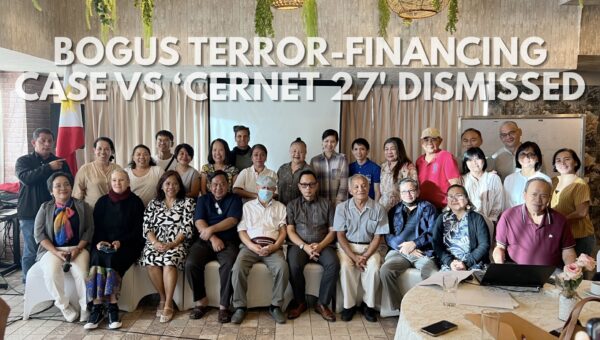
Rights Report Philippines has closely tracked those proceedings, and has separately documented how terrorism financing charges have been deployed repeatedly against activists and journalists — even as courts have found the underlying accusations unsubstantiated.
READ: Press Freedom Can’t be Defended in Isolation from the Broader Assault on Civil Society
The Committee to Protect Journalists, Reporters Without Borders, and Free Press Unlimited jointly nominated Cumpio for UNESCO’s 2026 Guillermo Cano World Press Freedom Prize, describing her as “a beacon of journalism in a country long saddled with abysmal conditions for the press” and calling her case emblematic of the threats facing journalists worldwide.
IWMF president Elisa Lees Muñoz, in announcing Wednesday’s award, described a global shift in how governments treat journalism. “We no longer live in a world of reactive suppression but preemptive deterrence,” she said, “where reporting itself is a liability.”
Cumpio, 27, left the University of the Philippines Tacloban without completing her degree, choosing to run Eastern Vista full time. She had served as editor-in-chief of the university’s student publication, UP Vista, before doing so. She was also a radio broadcaster at Aksyon Radyo Tacloban. She has been held without a single day of freedom since February 7, 2020. Her bail application was denied earlier this year. Her appeal of the terrorism financing conviction is pending. (Rights Report Philippines)