
NEWS ANALYSIS: The ICC handed drug war families something no Philippine court ever did: a real shot at accountability. President Marcos has no excuse not to meet it.
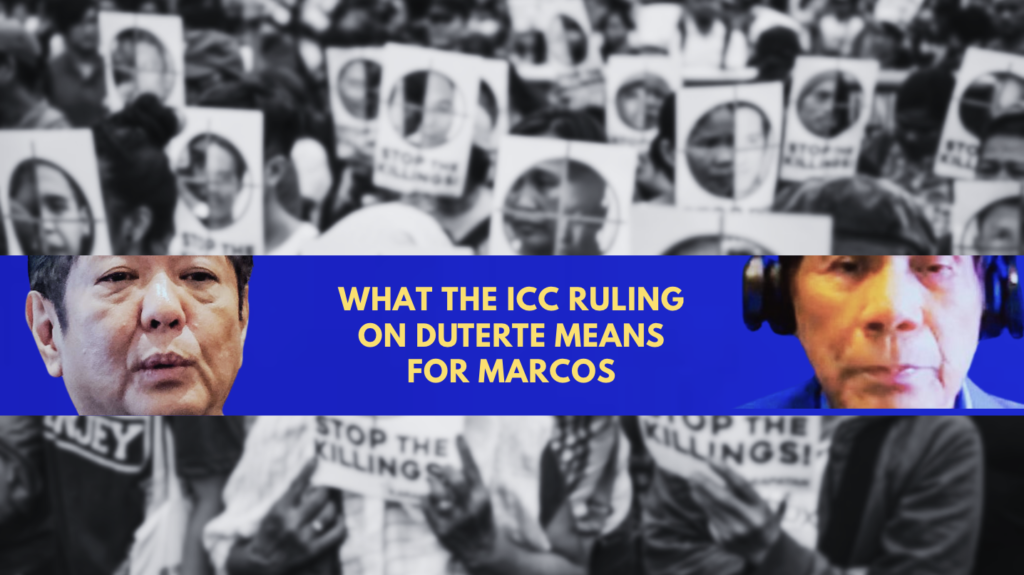
NICHOLAS Kaufman did not sound like a man blindsided on Wednesday. He sounded like a man who had made peace with losing — and had a story ready.
“We weren’t really surprised at today’s decision,” the British-Israeli lawyer who leads Rodrigo Duterte’s defense at the International Criminal Court told reporters outside the court in The Hague. “When I met the former president, I said don’t build up your hopes, and he was stoical.”
Then came the real argument, the one aimed less at the judges in The Hague than at audiences back in Manila: “The court is at the moment in an existential crisis, what with the threat of sanctions from the US,” he said, adding “Duterte is the big catch for this court, and it was never of course my impression that they would let him go that easily… If it had gone our way, there would be nothing left for this court to do, apart from the case of an insignificant human trafficker from Libya.”
It is a sharp line. And it deserves to be taken seriously because Kaufman is not entirely wrong. He just draws the wrong conclusion from a correct observation.
READ: If The Hague Can’t Help, Can Manila?
The ICC is under real pressure. The United States has sanctioned its prosecutor. Russia has convicted ICC officials in a domestic court. The court’s internal credibility has also taken hits closer to the Duterte case itself, including a misconduct investigation into chief prosecutor Karim Khan.
So yes, the court needs this case to matter. But it needs it to matter for the right reasons, not as a spectacle but as proof that international accountability can still function when it is most inconvenient.
Kaufman wants to frame his 81-year-old client as a sacrificial lamb: a convenient symbol seized upon by a struggling institution. What that framing erases is the actual record of what happened — thousands of Filipinos killed in a drug war, mostly poor urban dwellers, over nearly a decade, with no one of consequence ever prosecuted for any of it at home.
What the Court Decided
The legal question the ICC appeals chamber settled Wednesday was specific and consequential: can a government escape accountability by pulling out of the Rome Statute after the alleged crimes have already been committed? In a 4-1 majority decision, the answer was no.
The chamber ruled that the relevant provisions of the Rome Statute — governing when a country’s membership matters for jurisdiction, and what withdrawal actually means legally — must be read together. A state’s right to leave the court, the judges said, does not give it the right to erase what happened while it was still a member. The Philippines’ withdrawal took effect in March 2019. The killings and the preliminary ICC examination into them both began years earlier. That sequence, the court said, is what determines jurisdiction — not the fact of withdrawal itself.
The defense failed on all four grounds of its appeal. Its request for Duterte’s immediate release was declared moot. The judges found no reversible error in any aspect of the lower chamber’s reasoning.
This ruling also closes a door permanently. There are no more jurisdictional appeals available to the defense. Duterte will now face a separate ruling — expected before the end of this month — on whether the evidence is sufficient to confirm the charges and send the case to trial. Kaufman himself acknowledged as much, telling reporters the defense is now focused on trial, which he called the only realistic path by which his client might eventually return to the Philippines.
Applause and Tears
When the ruling was read Wednesday afternoon, applause and tears broke out among drug war victims’ families watching the livestream at the University of the Philippines in Quezon City. These were not people celebrating a legal technicality. They were people who have spent years being told, in every possible way, that the deaths of their loved ones did not merit a real reckoning.
Eight years after the drug war that killed thousands, only nine police officers have been convicted across five cases. No senior official has faced justice. The government’s own justice department admitted in 2025 that destroyed evidence had made domestic accountability essentially impossible — effectively conceding the case to the ICC. The ICC is not the first choice of the families who lost someone. It is their last one. Wednesday’s ruling means that door is still open — and that possibility, however distant a trial may still be, is something no domestic process has offered them.
That is why the Philippine government’s continued refusal to rejoin the ICC deserves far more scrutiny than it has gotten. Malacañang has repeatedly said the president’s position has not changed and that Philippine institutions are capable of handling accountability domestically. No elaboration has been offered. No evidence of that domestic accountability exists. If anything, all evidence points to the contrary.
The government cooperated with Interpol to transfer Duterte to The Hague — a minimum legal obligation, not a moral choice. It has done little else. Meanwhile, analysts and lawmakers have argued that rejoining the Rome Statute is one of the clearest signals the Marcos administration could send about where it actually stands on the rule of law — and that failing to do so reflects an attempt to balance the political pressures of two irreconcilable constituencies rather than a principled position.
Rejoining is not a favor to the ICC. It is an obligation — to Filipino families who have no other credible path to justice, and to an international community that built these institutions because history has shown, repeatedly, that mass violence rarely gets punished without external pressure to do so.
Beyond the Philippines
Kaufman’s “insignificant human trafficker from Libya” line cuts against him more than he seems to realize. It exposes his real argument: that the ICC should measure its caseload by the prestige of the defendants it lets go, not by the gravity of the crimes it pursues. That is not a theory of international justice. It is a theory of impunity with better branding.
The precedent set on Wednesday — that governments cannot simply exit accountability by withdrawing from a treaty — matters well beyond Manila. It matters for Rohingya families who have waited years for any form of justice for what was done to them in Myanmar. It matters for victims in Venezuela, where the ICC is also examining state violence. It matters wherever governments have treated the killing of their own people as a domestic policy choice beyond international reach.
The ICC is fighting for its relevance. Kaufman is right about that. But he is wrong to suggest that Duterte is caught in the crossfire of that fight. The court is doing exactly what it was designed to do — at exactly the moment when doing so is hardest. That is not a crisis of relevance. That is relevance itself. (Rights Report Philippines)
Carlos Conde is the founding editor of Rights Report Philippines. He was the Philippines researcher for Human Rights Watch for nearly 14 years and documented the extrajudicial killings attributed to Duterte during the drug war and when he was mayor of Davao City.
Media outlets are welcome to republish this oped as long as Rights Report Philippines is credited.