
A joint military-police operation targeting a suspected militant left three members of a Zamboanga City family dead. The man they were looking for was not among them.
JUST after 1:30 in the morning on April 23, armed operatives from the Philippine National Police and the Armed Forces of the Philippines moved through the narrow lanes of Sitio Alas-as, a small community inside Barangay Sinunuc in Zamboanga City. Their target was a man named Saddam Siddik — wanted on four counts of murder and suspected of belonging to the Dawlah Islamiya-Abu Sayyaf Group, a militant faction active across the Sulu Sea region. Intelligence operatives had been watching the area for months.
By the time daylight came, three people were dead. None of them was Siddik.
Police identified the dead as Jerry Indan Alfad, 52, a longtime member of the village’s peace mediation council; his 12-year-old son, Salam Aradais Alfad; and his nephew, Rayyan Hassan Alfad, 22. Rushed to a hospital with gunshot wounds were Jerry’s wife Sayra, 40; their daughter Saralyn, 23; and a niece, Mislie, 18.
The killings have set off a blunt and unresolved dispute between security forces and the community — over whether the family resisted, and whether they ever had a chance.
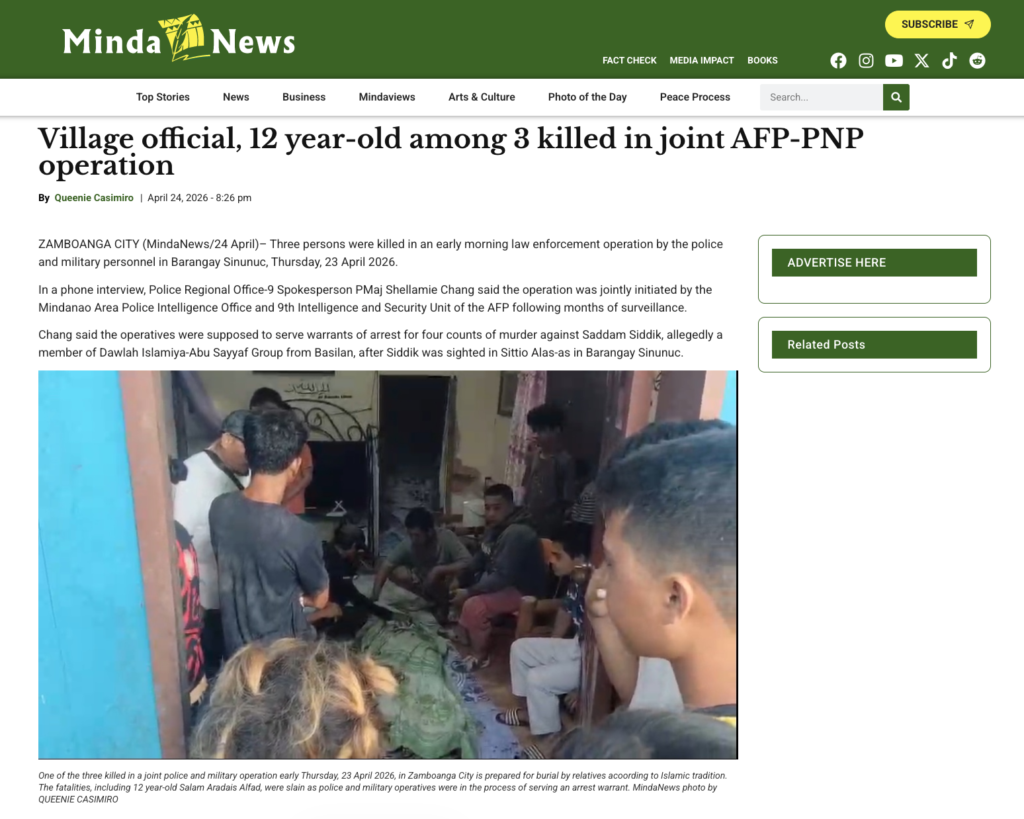
READ: Village official, 12 year-old among 3 killed in joint AFP-PNP operation
“He Should Not Have Been Killed”
The Police Regional Office-9 said operatives knocked on the door, announced themselves as members of the PNP and AFP, and were met with gunfire from inside — prompting them to return fire in self-defense. The office said the operation followed months of surveillance and that the warrant against Siddik was for multiple murder charges.
The family tells a completely different story.
According to a report by GMA News, a relative said the door was opened without a word before the shooting started, and disputed that any firefight took place. “If it were a shootout, at least one of them would have been hit,” the relative said, referring to the operatives. “All of them were there — including the women and the children.”
Barangay Sinunuc chairwoman Pilarica Ledesma, who had known Jerry Alfad for years, entered the house after the shooting. She told MindaNews that Jerry and his 12-year-old son were found lying together on their bed — Jerry dressed only in briefs — suggesting both were asleep when the shooting began.
“I personally know the person,” Ledesma said. “He should not have been killed.”
She added that unlike in previous operations, this one was conducted without any coordination with the barangay — a standard procedure — and that she saw no signs that anyone inside had put up a fight. Siddik, the man the operatives came for, was not found. He remains at large.
A Family’s Questions
The Alfad family has also contested police claims that firearms and explosives were recovered from the house. The Moro-Christian Peoples Alliance, an interfaith civil society group in Mindanao that is identified with the Philippine Left, said in a public statement that the allegation was consistent with longstanding concerns about evidence planting in similar operations. In a statement, the group called for an independent investigation, the release of body-worn camera footage, the suspension of all personnel involved, and a full accounting of the intelligence that sent operatives to the Alfad home in the first place.
“The killing of a Moro child inside his own home is not an isolated case anymore,” wrote Amirah Ali Lidasan, the group’s secretary-general. “It is an indictment of a system that continues to place civilian lives at risk.”
PRO-9 said it is conducting a thorough and impartial investigation and that all documents and body-worn camera footage will be part of that process. A local official in Zamboanga City was more measured. “One thing is clear,” the official said. “The first one they were looking for in the arrest warrant was not the same person who was killed. I don’t want to call it mistaken identity” — though the remark made clear the possibility could not be dismissed.
Jerry Alfad was buried the same day, alongside his son, according to Islamic tradition. Photographs of relatives preparing 12-year-old Salam’s body for burial spread on social media, drawing condemnation from residents and human rights advocates across the country. (Rights Report Philippines)