

NEWS ANALYSIS: The senator once said the Philippines joined the ICC to ensure impunity would never be tolerated. Her son Leandro’s legal battle with the Marcos administration provides a clue for her pivot.
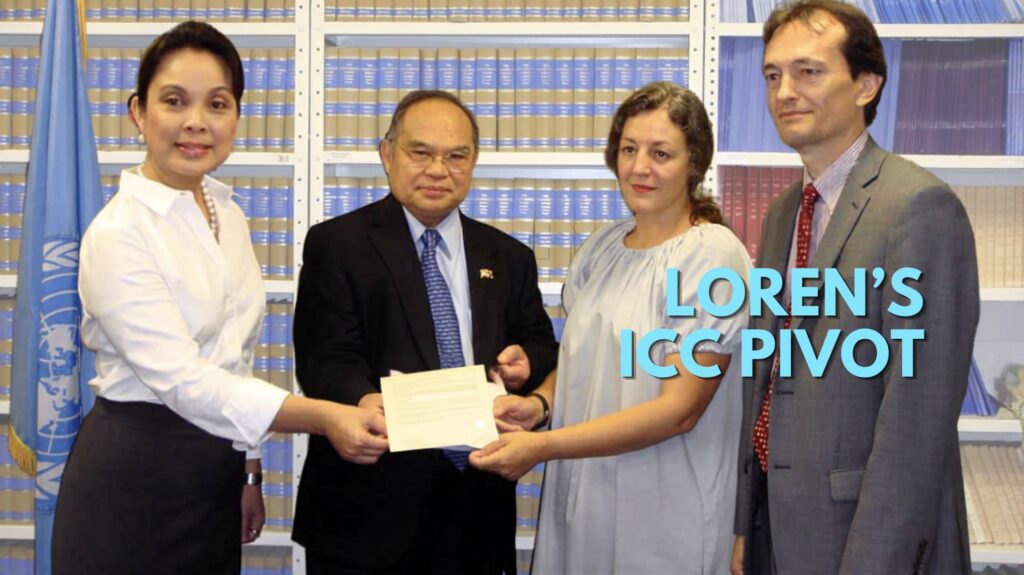
ON Aug. 30, 2011, Senator Loren Legarda stood in New York alongside the Philippines’ permanent representative to the United Nations as her government formally joined the International Criminal Court. As chair of the Senate Foreign Relations Committee, she had been the driving force behind ratification — shepherding the Rome Statute bill through a near-unanimous Senate vote just days before. Afterward, she declared it would “strengthen our stand in protecting human rights” and send a message that the Philippines would “never tolerate impunity.”
Fourteen years later, that court has the former Philippine president Rodrigo Duterte in custody, facing trial for crimes against humanity. One of his closest police chiefs is hiding inside the Senate building to avoid an ICC arrest warrant. And Legarda — now Senate president pro tempore, the chamber’s second-highest post — helped put the people protecting him in charge.
The Coup
The sequence of events on May 11 was, even by Philippine standards, extraordinary.
As the House of Representatives moved toward a second impeachment vote against Vice President Sara Duterte, 13 senators abruptly ousted Senate President Vicente “Tito” Sotto III and installed Senator Alan Peter Cayetano — a known Duterte family ally — in his place. The vote was 13 to 9.
Legarda was among the 13.
Minutes into the session, Senator Ronald “Bato” dela Rosa — who had vanished from public view since November after reports of an ICC arrest warrant against him — reappeared in the chamber to cast a vote. National Bureau of Investigation agents, acting on the warrant, chased him through Senate corridors. He locked himself in his office. That same evening, the ICC confirmed the warrant had been issued confidentially on Nov. 6, 2025. The new Senate majority placed dela Rosa under Senate protection.
As a reward for her vote — or a condition of it, depending on your reading — Legarda was immediately elected Senate president pro tempore, reclaiming the post she held during the previous Congress.
The Trial
Sotto had made no secret of his intentions. He had promised in January to act on any impeachment articles “forthwith” and was brushing up on rules and procedure as recently as April. His removal almost certainly complicates — at minimum — any swift trial of the vice president.
The House had voted 257 to 25 to impeach Sara Duterte, the daughter of the former president now detained at The Hague. The charges include unexplained wealth, corruption, and direct threats against President Ferdinand Marcos Jr. and his family. A Senate conviction requires a two-thirds majority — 16 of 24 votes. Whether Cayetano’s Senate will ever get there is now an open question.
Cayetano, for his part, denied the leadership change had anything to do with impeachment, even as he reversed a statement he had made to reporters minutes earlier in which he denied any coup was underway.” The Senate has decided its own leadership,” was all the Marcos palace would say.
The court that Legarda helped bring to the Philippines has been moving fast.
Former President Rodrigo Duterte was arrested in March 2025 and transferred to The Hague. In April 2026, the ICC’s Pre-Trial Chamber unanimously confirmed all charges — crimes against humanity including murder — and committed him to trial. The charges stem from the drug war he launched after taking office in 2016, a campaign human rights groups say killed between 12,000 and 30,000 people.
Dela Rosa, as national police chief from 2016 to 2018, was the campaign’s primary enforcer. He ran Oplan Tokhang, the anti-drug operation at the center of the killings. The ICC found reasonable grounds to believe he was an indirect co-perpetrator in the murder of at least 32 people during his tenure.
Marcos initially resisted cooperating with the ICC after taking office in 2022. As his relationship with the Dutertes collapsed — rupturing decisively in early 2025 over what observers described as a mix of personal and political grievances — he authorized the arrest of Rodrigo Duterte. His administration now appears less certain about pursuing dela Rosa.
The Sons
In one sense, very little. Legarda has always moved between power centers with considerable fluency. She ran for vice president twice — and lost both times. She stepped away from the Senate in 2019 to represent Antique province in the House, then returned to the Senate in 2022 as the second-highest vote-getter in that election, with 24 million votes. She ran on the UniTeam slate — Marcos and Sara Duterte’s joint ticket — a decision that so alienated her older son, Lorenzo, that he publicly disowned her in an open letter. “I am in utter grief. F*** my mother for abetting this. Their crimes are her crimes now. Make her defend them,” Lorenzo wrote.
In another sense, quite a lot has changed. Legarda had “found herself embattled under the administration of President Marcos.” The reason is partly her younger son.
Leandro Legarda Leviste, 33, won election last year as Batangas 1st District representative with a historic 75 percent of the vote — the highest vote share of any congressional candidate in Batangas history, and the first time since 1972 that the district elected a representative outside its entrenched political families.
His entry into public life was striking. He is the founder of Solar Philippines and sold his controlling stake to Meralco for roughly 34 billion pesos in 2024 before taking office. He filed House bills focused on education funding, pushed for cityhood for three towns in his district, and filed bribery charges against a government engineer over alleged flood control corruption.
But his businesses are now under significant legal scrutiny. The Department of Energy imposed a 24-billion-peso penalty on his Solar Philippines firm for failing to deliver on more than 30 renewable energy contracts — accounting for roughly 64 percent of all terminated contracts in the country. The Ombudsman opened a separate investigation over an allegedly unauthorized franchise transfer. The Department of Energy in May elevated its complaint to the Department of Justice.
Legarda’s enemies within the Marcos administration are now, in a meaningful sense, also her son’s enemies. The Marcos-aligned executive secretary — whose son sits in the House — has been publicly at war with Leandro Leviste. Moving to the Duterte camp, from that vantage, is less an ideological shift than a survival calculation.
The Irony
Legarda’s public statement after taking her new post did not address any of this. She spoke of “order, stability, and respect for the institution.” She vowed to support both the majority and the minority. She said the Senate’s job was to address rising costs for “workers, farmers, fisherfolk, drivers, small businesses, and ordinary families.”
What she did not address was the fact that, in the same session where she took her oath, the man she had helped protect was a sitting senator who ran from investigators carrying a warrant issued by the court she once championed. Or that the new Senate president she now serves as deputy is presiding over an impeachment trial he has every political incentive to delay or derail.
The Philippines ratified the Rome Statute because Legarda, among others, believed accountability mattered. The court she helped build is now, in a direct and literal sense, the thing her new allies are running from. Whether she sees the contradiction — or has simply decided it no longer applies — is the question her vote this week left hanging. (Rights Report Philippines)