Women journalists in the Philippines are among the most targeted in the world, and the attacks online are increasingly designed to follow them into real life. But they are fighting back.
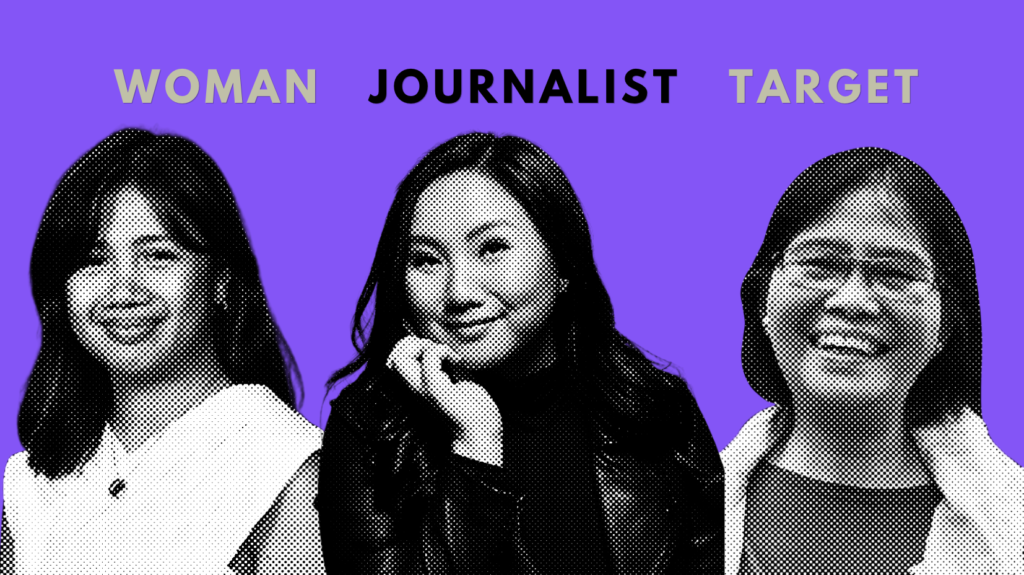
REGINE Cabato knew something had shifted when the attacks stopped being about her work.
A journalist who has covered the Duterte administration’s drug war and the West Philippine Sea (South China Sea) dispute, Cabato has been a target of coordinated online harassment nearly every year since 2020. The insults have come in waves: slurs like “presstitute” and “whorenalist,” mockery of her appearance from pro-Duterte bloggers and supporters, and, most recently, an anonymous account that commented on her private parts.
“It’s especially difficult as a woman,” Cabato told Rights Report Philippines, “because many are empowered to speak to you online in a way they would never do face to face.”
None of this was the life she chose. “As a print-trained journalist,” she said, “I would love nothing more than to not be perceived. I’m not built to be an influencer.” The harassment found her because of the work, not despite it.
Cabato is not alone — and the numbers behind her experience are striking.
A December 2025 report by UN Women, produced with researchers from the International Center for Journalists, City St George’s University of London, and digital forensics lab TheNerve, found that 70 percent of women working in journalism, human rights, and activism said they had experienced online violence in the course of their work. The survey covered more than 640 women respondents from 119 countries.
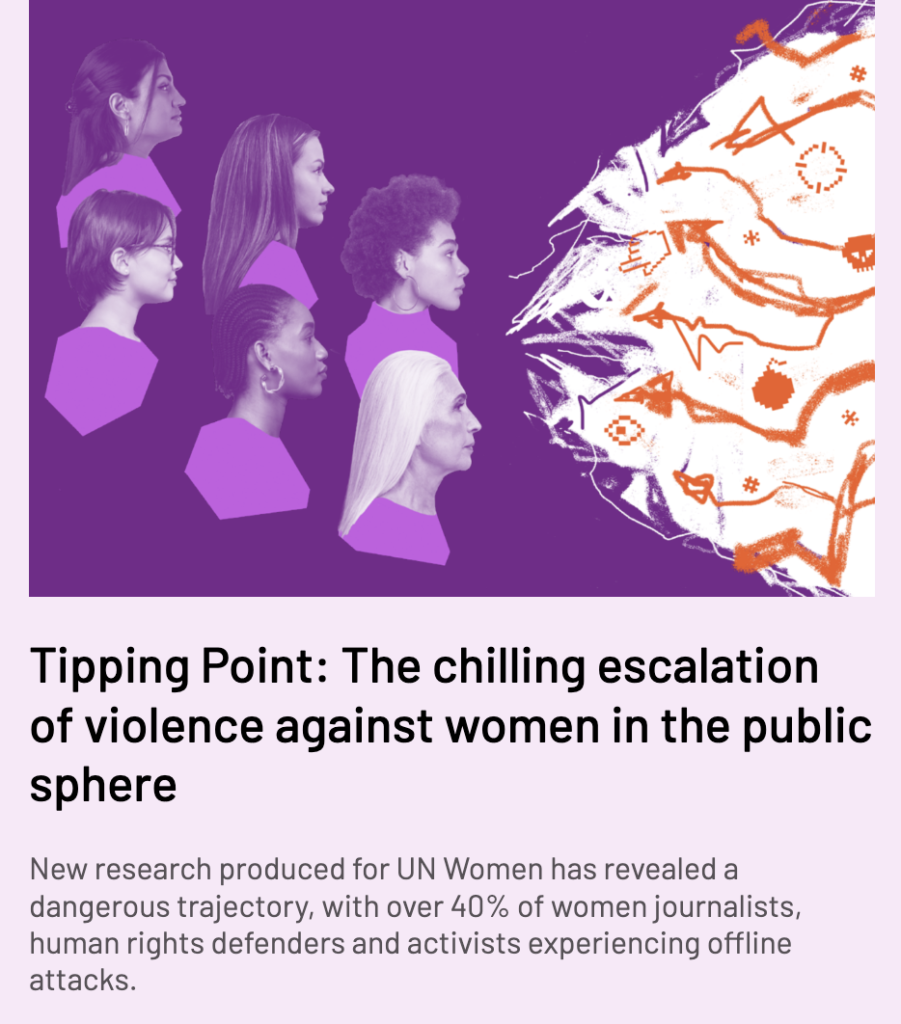
More alarming is where that violence ends up going. Forty-one percent of respondents reported experiencing offline harm — including physical assault, stalking, and verbal harassment — that they directly linked to online abuse. For women journalists specifically, the figure has more than doubled since a comparable survey in 2020, rising from 20 percent to 42 percent. In other words: what begins as a flood of messages and posts is increasingly finding its way into the real world.
Deep Roots, Deep Vulnerabilities
The Filipino women being attacked are not peripheral figures in Philippine media. According to the Center for Media Freedom and Responsibility, Filipino women journalists are highly credentialed and long-tenured: three-quarters hold at least an undergraduate degree, and nearly a third have earned a master’s. A third have worked in the field for 11 to 20 years; nearly one in 10 has been at it for more than three decades.
The history of women in the Philippine press runs back to the 1920s. For decades they were largely confined to what was known as the “lipstick beat” — society pages and lifestyle coverage — before breaking into hard news in the 1980s. When Ferdinand Marcos declared martial law in 1972, women journalists outnumbered men on the frontlines of coverage and led the alternative press, reporting what government-approved outlets would not touch.
Today, many of the country’s most prominent newsrooms — among them Rappler, Bulatlat, Vera Files, the Philippine Star — are led by women. According to a 2011 survey by the International Women’s Media Foundation, half of Filipino women journalists hold positions at parity with men in middle management, including senior editors and chiefs of correspondence.
But visibility and influence have not translated into safety.
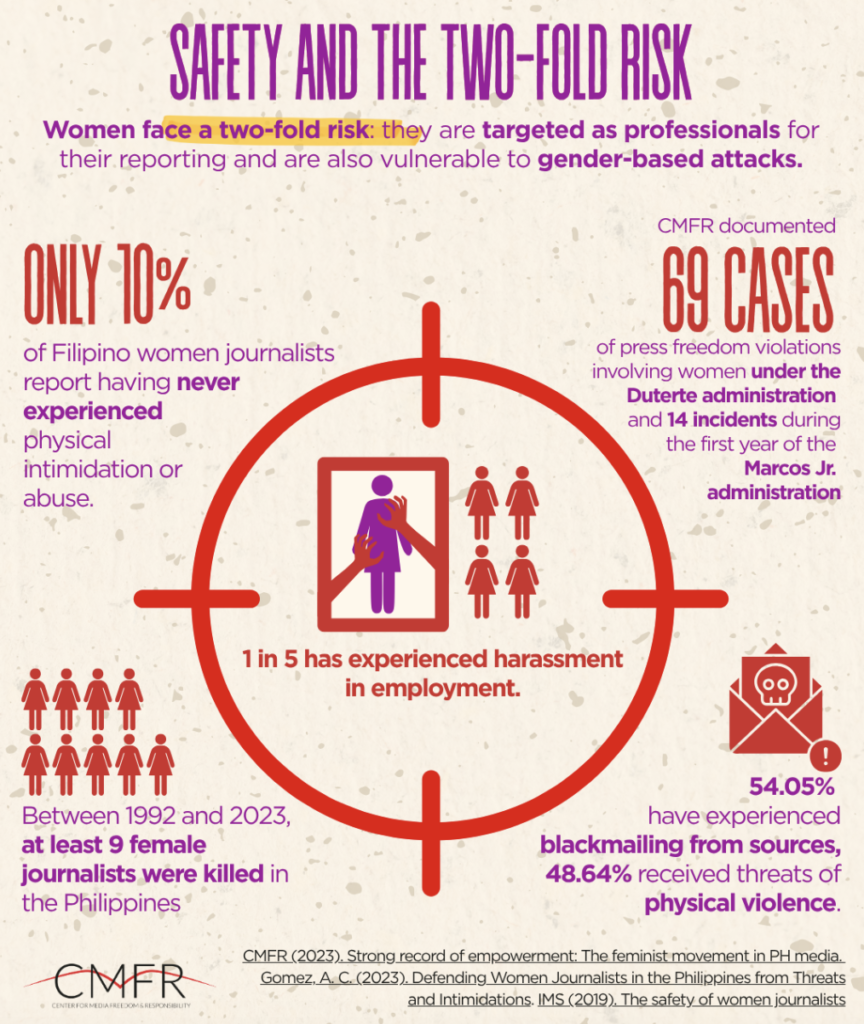
CMFR data, based on research by Luz Rimban and Christina Cox, shows that only 10 percent of Filipino women journalists say they have never experienced physical intimidation or abuse — suggesting the vast majority have, though CMFR does not state this explicitly. More than half — 54 percent — report having been blackmailed by sources. Nearly half have received direct threats of physical violence. One in five has faced harassment at work. Between 1992 and 2023, at least nine female journalists were killed in the Philippines.
Economic precarity compounds the risk. According to the same CMFR data, nearly 28 percent of Filipino women journalists earn below the minimum wage — less than P20,000 a month. Only 60 percent work full-time; many others piece together income through teaching or freelancing. For journalists already working without institutional backing, the cost of being harassed — in time, in mental energy, in lost work — can be devastating in ways that go well beyond the emotional.
The Watershed Case
No account of online violence against women journalists in the Philippines is complete without the case that first drew the world’s attention to what was happening here.
When Rappler published its “Propaganda War” series in 2016 — an investigation into the Duterte government’s use of paid trolls and Duterte “diehard supporters” — the response against its author Maria Ressa, the outfit’s CEO and co-founder, was immediate and overwhelming. At its peak, she was receiving 90 hate messages an hour on Facebook. She faced sustained misogynistic and racist abuse, doxxing, death threats, and rape threats — wave after wave, day after day.
A forensic analysis by the International Center for Journalists, which examined more than 400,000 tweets and 57,000 Facebook posts over five years, found that roughly 60 percent of the attacks were designed to undermine Ressa’s professional credibility. More than 40 percent were classified as personal assaults, many of them misogynistic or explicitly sexual. For every supportive comment on her Facebook page, there were approximately 14 attacking her. Researchers also found links between the coordinated attack accounts and operations tied to China.
The researchers were unambiguous about what the data showed: the online attacks created the conditions for Ressa’s real-world persecution. She faced arrest warrants, detention, and a criminal cyberlibel conviction — all of which the ICFJ concluded were enabled by the climate of hostility manufactured online. She has since been acquitted on multiple charges, with her most recent legal victory coming in June 2025. But her case remains the starkest documented example in the world of how online violence against a woman journalist can be converted into legal and physical harm.
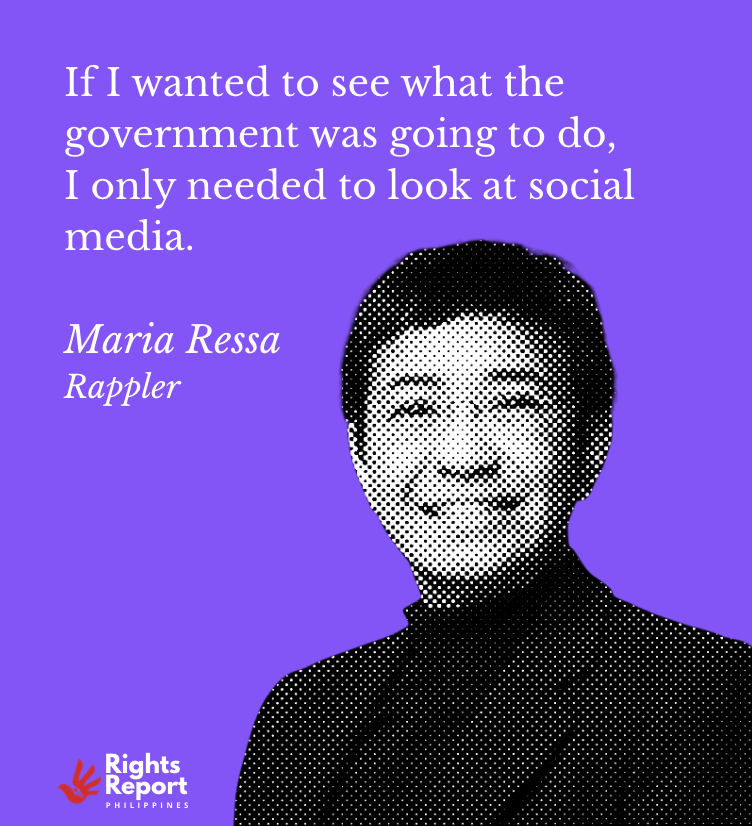
“If I wanted to see what the government was going to do,” Ressa told researchers, “I only needed to look at social media.”
The Nobel Peace Prize, it turned out, was not a shield. When Ressa learned she had won in October 2021, she described a brief moment of national unity — a feeling, she told Harvard Kennedy School, that the Philippines “came together, right-side up for a second.” Then, she said, “the attacks began again, two or three days later.”
The legal machinery kept moving too. Eight months after Oslo, the Court of Appeals upheld her cyberlibel conviction and increased her maximum sentence. Around the same time, the government reaffirmed its order to shut down Rappler. “The ongoing campaign of harassment and intimidation against me and Rappler continues,” she said at the time. It was only through years of sustained legal battles — aided, many believe, by the international pressure the Nobel helped generate — that the cases against her began to unravel. The prize made the indifference of the platforms impossible to ignore: the world’s most prestigious peace award had just gone to a woman who was targetted by coordinated hate on the same social media sites that had done little to nothing to protect her.
And the online abuse never stopped. Although the courts have since decided in favor of Rappler – the Supreme Court ruled on it with finality earlier this month – the attacks continued against Ressa and her colleagues in Rappler, and against other women journalists like Cabato.
The Pattern Continues
The attacks on Cabato — and the broader climate Ressa first put on the global map — are part of a pattern that has kept building, touching women across every platform and every corner of the media landscape.
Lian Buan, an investigative reporter at Rappler known for her in-depth coverage of human rights violations and political corruption in the Philippines, describes a version of it that is by now grimly familiar. She was attacked primarily for her looks. When one of her tweets included a photo of African women jurists, they too were targeted — the abuse directed at them was not just misogynistic but explicitly racist.
And like many of her colleagues, she has been on the receiving end of posts, ranging from vague to explicit, suggesting she has slept with professors or is “in the same bed” as male sources. Sexualizing a woman journalist, she said, is a favorite resort of attackers. At least one post claimed she slept with her University of the Philippines professors in order to graduate with honors. Her response was brief: she had not gone to UP, she noted, and she had not graduated with honors either.
When Rappler reporter Joann Manabat showed up to cover a demolition in Angeles City in March 2024, armed men threatened to shoot her for filming the scene. Members of the demolition team seized the belongings of her colleague, K5 News FM anchor Rowena Quejada. The Commission on Human Rights launched an investigation — but the incident was hardly isolated. It was, as the Foundation for Media Alternatives put it, one in a series of cases that show how physical intimidation and digital abuse increasingly go hand in hand.
A year earlier, veteran journalist Raissa Robles was targeted by former senatorial candidate Larry Gadon, who circulated a video containing misogynistic and sexually explicit remarks about her on social media. The Supreme Court permanently disbarred Gadon for his conduct — a ruling advocates called a rare but important legal precedent in a country where perpetrators of this kind of abuse seldom face consequences at all.
In November 2024, Menzie Montes, a radio presenter in Cagayan de Oro, was doxxed by a fake Facebook account that published her personal information — data apparently pulled from a city government department. Women Press Freedom, which condemned the attack, noted it had documented 23 cases specifically targeting women journalists in the Philippines over the past five years alone.
The ICC proceedings against Duterte brought another wave.
Women journalists covering the case — including Zen Hernandez of ABS-CBN, Mariz Umali of GMA News, and Gretchen Ho of TV5 — were met with coordinated misogynistic attacks online. Umali’s experience had a particular edge: a vlogger deliberately missubtitled a clip of her speaking, putting words in her mouth she never said. The IAWRT-Philippines and the National Union of Journalists of the Philippines both condemned the attacks.
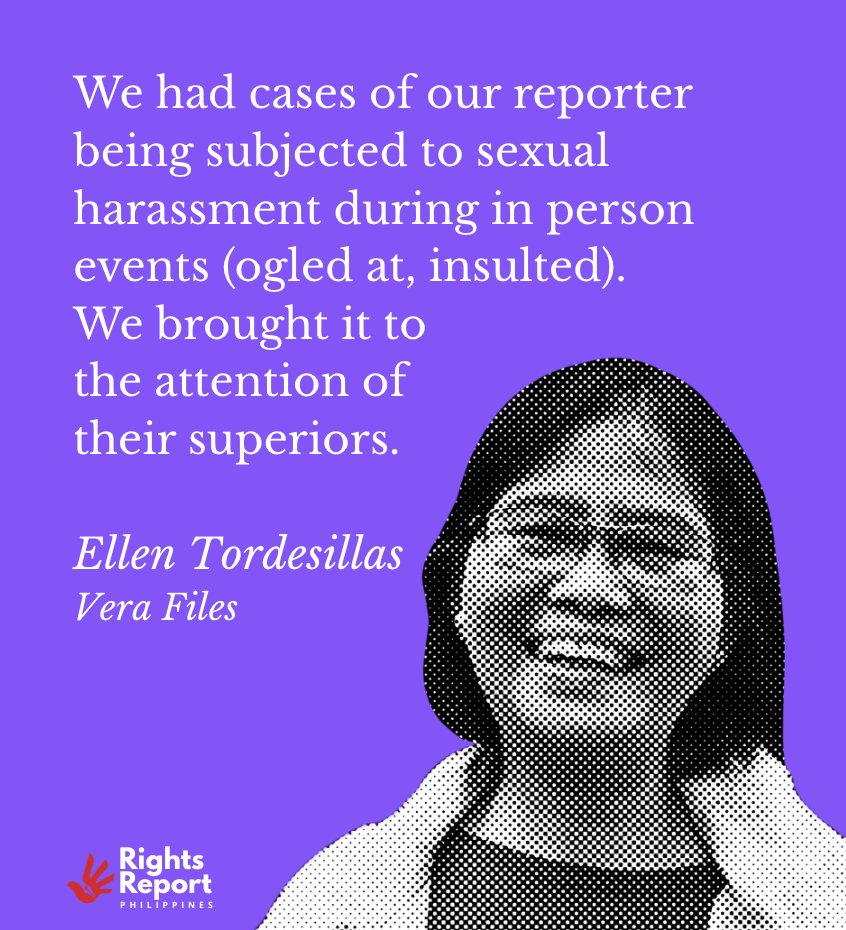
At Vera Files, which has 17 staff members, 11 of them women, executive director Ellen Tordesillas says the harassment has tended to be directed more at the organization than at individuals — the usual accusations of being CIA-funded, biased, or anti-Duterte. She herself has been the exception, targeted personally with attacks on her appearance and her supposed political loyalties. Several of her reporters have also been subjected to sexual harassment during in-person coverage events — ogled at or insulted — incidents the newsroom escalated to the superiors of those responsible. The stories that reliably attract the worst attacks, she told Rights Report Philippines, are those about Duterte’s bank accounts and reporting critical of his administration.
What strikes Cabato most about the attacks is not their volume but their logic — or lack of it. “The most shocking thing,” she said, is being targeted by people who “develop parasocial hate toward me when they could actively choose not to engage with my content at all.”
A Design, Not an Accident
Cabato has thought carefully about what these attacks actually are. Treating them as random cruelty from strangers on the internet, she argues, would be a mistake.
“I have an increasing awareness,” she told Rights Report Philippines, “that it is not enough in this day and age to leave trolls and even those we call ‘true believers’ alone. Their narrative should not go unquestioned.”
The harassment campaigns targeting journalists like her, she argues, are part of a deliberate effort to discredit the press — and they operate within a culture cultivated during six years of the Duterte presidency, when online attack squads normalized aggression as a political tool.
It is a dynamic that lawyer Joel Butuyan, speaking at the International Criminal Court in February, described in another context as the cloning of “mini-Dutertes” — ordinary people who believe they have permission to act on the violence promoted by their idol, without consequence. Cabato sees the same pattern playing out against journalists.
Tordesillas, for her part, is not sure the change of administration has changed much. The worst incidents at Vera Files happened under Marcos, she said, though she is cautious about attributing them to political direction from above. “I think it’s more of the Filipino macho attitude,” she said. “I consider the Filipino macho attitude a symptom of insecurity.”
The UN Women report puts a name to the broader pattern: online violence against women is a deliberate tool — one designed to silence them and chip away at the equality gains they have fought for, a finding that tracks closely with what Cabato, Buan, Ressa, Tordesillas, and other Filipino journalists describe.
Cabato draws on what she describes as the New York Times’s new posture of openly correcting spin about its own reporting: letting journalism speak for itself is, in the words of one Times communications director, “an approach from a bygone era.” The reason, Cabato argues, is structural — audiences no longer share a common reality. “In the past, we could let journalism stand on its own because the public still lived in a single reality; we all watched the same news and developed a baseline consensus on current events and our values,” she said. But today, she added, they choose and customize the version of events that fits their existing beliefs, and they are indifferent to who gets hurt in the process.
She is unsettled by the people doing the attacking. Many diehard supporters who so readily accuse others of weakness, she argues, may not realize they are addicts themselves — hooked on their phones, on the adrenaline of harassing strangers, on the ideology of their political patron. “This needs serious intervention and rehabilitation,” she said. “Play stupid games, win stupid prizes.”
But she is also careful not to flatten them. Two things can be true at once, she says — not just in the Philippines, but generally: that supporters can be victims of systemic violence and disinformation campaigns, and that they can also be perpetrators of real-world harm. Their own experience of trauma or oppression, perceived or real, does not give them the license to traumatize or oppress others.
AI has also entered the picture. Nearly one in four women surveyed in the UN Women report — 23.8 percent — said they had experienced online violence involving artificial intelligence technologies, such as deepfakes, manipulated content, or AI-generated abuse. The researchers are direct about the cause: the release of ChatGPT in late 2022 made it suddenly much easier and cheaper to produce more believable abusive content, which could then be distributed quickly by algorithms tuned to amplify hate, anger, and division.
The Numbers Behind the Pattern
The data amplified by CMFR on digital violence is stark in its own right. According to the watchdog, 73 percent of Filipino women journalists have experienced online violence. Facebook is identified as the primary platform through which attacks are delivered — frequently by political actors whose explicit goal is to drive women into silence or out of public life entirely. One in five of those attacked online said the abuse eventually moved offline.
The mental health toll is real and sustained. Buan says that the combination of online attacks and red-tagging — being publicly branded as a communist or terrorist sympathizer, with all the physical danger that implies — affected her from the start of the pandemic until well into 2024. She felt surveilled and followed. She did not feel safe. She took steps to protect her physical security and moved several social media accounts to private. Buan said formally filing complaints — with the Department of Justice, the National Bureau of Investigation, and the Commission on Human Rights — became necessary only when the red-tagging began because it crossed a line from harassment into something with more direct implications for her safety.
Perhaps the most damning figure in the CMFR data concerns not the attackers, but the newsrooms that were supposed to protect their own staff. Of the women who reported online abuse to their employers, 10 percent were told to “grow thicker skin.” Another 2 percent were asked what they had done to provoke the attack.
According to a 2024 study by the Asian Center for Journalism at Ateneo and Ateneo de Manila University’s Department of Communication, which surveyed 129 women journalists in 14 regions across the Philippines, the most common perpetrators of attacks were not anonymous trolls — they were sources, contacts, and colleagues. And the culture inside many newsrooms actively discouraged disclosure. “There are narratives saying that these attacks are ‘normal’ and the situation can no longer be changed,” Lynda Catindig-Garcia, chapter head of IAWRT Philippines, told Bulatlat in 2024. “So, disclosing that you were attacked is not easy to do.” Women without institutional support largely dealt with it on their own — enrolling in self-defense classes or investing in their own digital security at personal expense.
CMFR documented 69 press freedom violations involving women under the Duterte administration, and 14 more in just the first year of the Marcos Jr. administration — a number that shows the problem did not end with one presidency.
The Bigger Picture
The targeting of women journalists does not happen in isolation. It sits within a much wider pattern of technology-facilitated violence against women in the Philippines that the country’s own data is only beginning to capture.
The Foundation for Media Alternatives documented 144 cases of technology-facilitated gender-based violence across the country in 2025 alone — part of a total of 829 cases mapped since 2012. Women made up 86 percent of survivors. The most common form was “sextortion,” in which perpetrators use stolen or secretly recorded intimate material to coerce and silence victims. Online sexual harassment and public shaming accounted for roughly 38 percent of documented cases. Deepfakes and digitally manipulated content are appearing with increasing frequency.
Facebook, Instagram, and TikTok were the most commonly used platforms for public humiliation and mass distribution of abusive content. Private messaging apps were more often used for coercion, blackmail, and psychological control. In the most severe cases, perpetrators used both simultaneously — combining personal intimidation with public exposure to maximize harm.
The psychological toll was present in virtually every documented case. Economic harm — job disruption, financial extortion, loss of income — is also common and likely underreported. For freelance journalists and women working without a safety net, the two forms of damage are inseparable.
What Newsrooms Are — and Aren’t — Doing
One of the more sobering dimensions of the problem is institutional.
Cabato spent time at The Washington Post, where she had access to a security professional who documented harassment and assessed risk levels. Freelancing now, she no longer has that safety net, though she has sought out equivalent support through journalism safety networks.
But most local newsrooms, she said, still do not take the issue seriously — even though the cost of basic protection is low. A public statement of support or condemnation toward harassers costs nothing. Assigning someone to document evidence for potential platform reports or legal complaints requires no new budget line.
“It is astounding to me that many local newsrooms still do not shield their journalists from this abuse,” she told Rights Report Philippines. “Women always receive the worst impact.”
Some newsrooms are doing more. Vera Files has partnered with the Medical Action Group so that any staff member dealing with mental health difficulties can consult with a doctor at any time; the organization also holds an annual mental health workshop, maintains a hybrid work setup, and sets aside a three-week Christmas break to give its people time to decompress. Tordesillas is frank that financial pressures limit what is possible — the annual company outing, for instance, may not happen this year. But the framework is there. It is a model that costs less than it is worth, and that most Philippine newsrooms have not yet built.
A recent public example of institutional solidarity: Cabato cited ABS-CBN’s public denunciation of a smear campaign targeting journalist Karen Davila as the kind of response that makes a difference — a newsroom standing visibly behind one of its own.
CMFR was clear about what it said the women want to see happen more broadly. They are calling for mandatory safety and self-defense training, and adequate protection for journalists on high-risk assignments. They want ethics investigation committees within media companies to formally handle cases of sexual harassment and abuse. And there is strong consensus, the data shows, for legislation requiring newsrooms to create gender and development units — a permanent, institutionalized mechanism for protecting the women who do the work.
At the global level, the UN Women report calls for legal and regulatory mechanisms that hold technology companies accountable for how their platforms are used to silence women — a demand that has been made before, and that the platforms have largely resisted.
Not Slowing Down
The harassment has not stopped any of these journalists from working. Cabato, in the period following her most recent wave of attacks, produced broadcast reports for Al Jazeera and other international outlets, gave presentations at Stratbase Institute and Philippine Women’s University, published a piece on Filipino journalists covering the West Philippine Sea for the Reuters Institute, and appeared on BBC’s Asia Pacific and TaiwanPlus. The Committee to Protect Journalists and Reporters Without Borders have both expressed support.
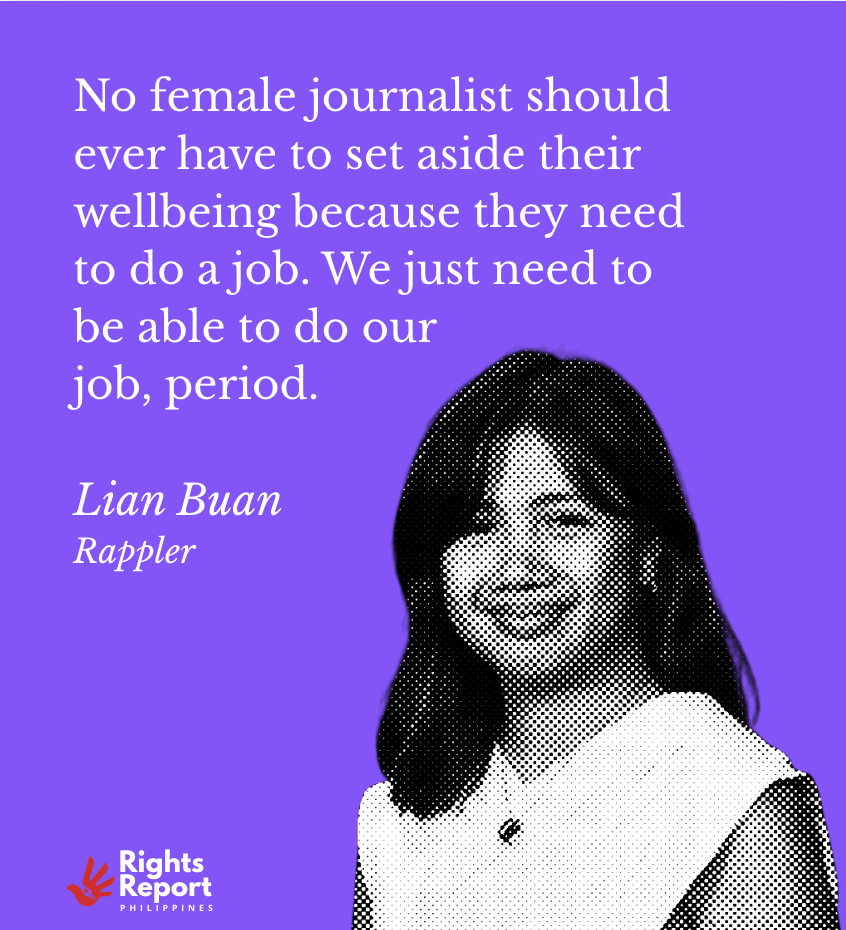
Buan puts it plainly. The attacks, combined with red-tagging, may have slowed her down — but only for days, at most weeks. They have never stopped her. “But that’s not to say it’s okay and I’m brave,” she told Rights Report Philippines. “No female journalist should ever have to set aside their wellbeing because they need to do a job. We just need to be able to do our job, period.”
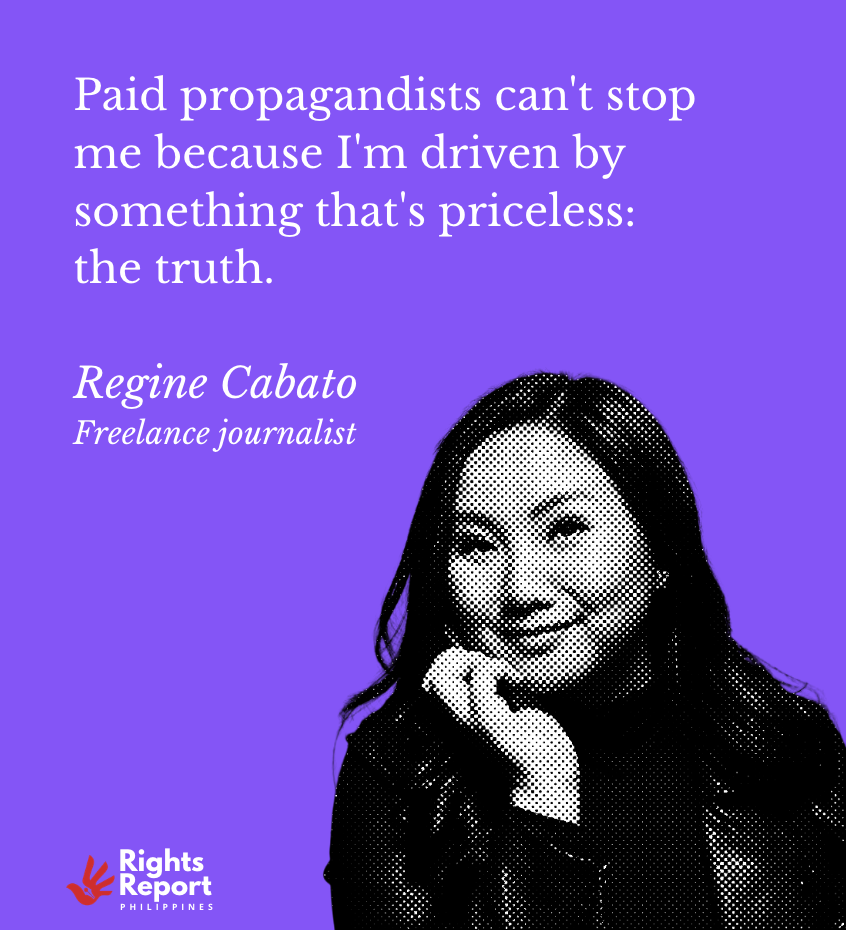
“Paid propagandists can’t stop me,” Cabato said, “because I’m driven by something that’s priceless: the truth.”
But she also knows that kind of drive is finite and that she won’t always have it. She likens influence operations and the fight against them to a marathon that requires mindful pacing. “After all this recent over-exposure, I do hope to have some time for myself until my next investigation,” she said. “Resist, rest, repeat.” (Rights Report Philippines)