Three weeks of toxic smoke from a forgotten landfill sickened thousands. Satellites finally confirm the air is clearing — but the damage goes far deeper than anyone can measure.
QUEZON CITY — A baby arrived at an emergency field hospital struggling to breathe. Hundreds of families in Bulacan packed what they could and fled. Commuters across the capital weighed the heat against the smoke and chose, most days, just to suffer through both.
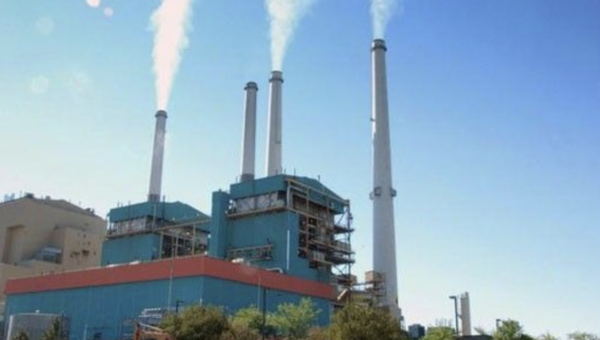
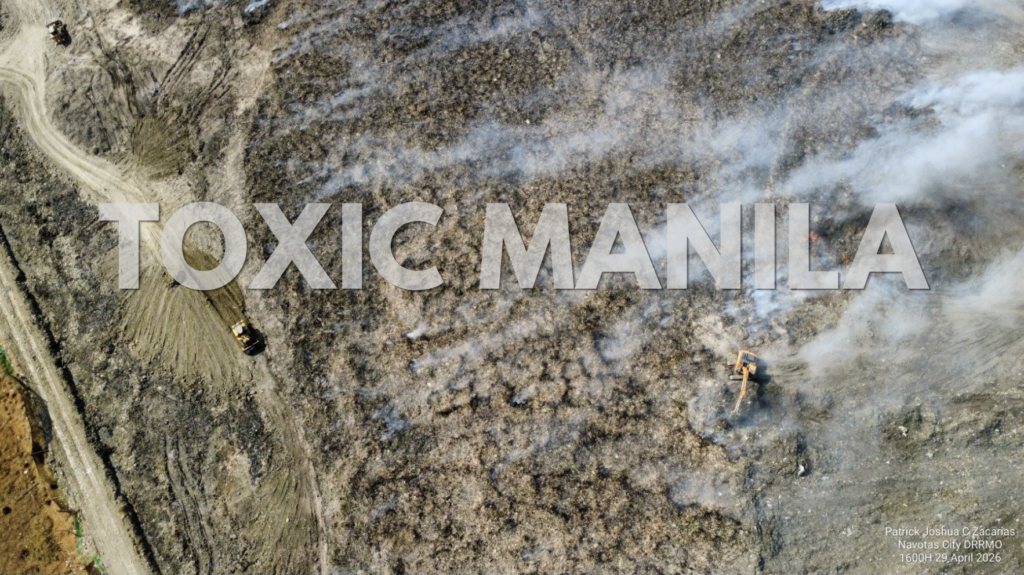
This is what three weeks of a burning landfill looks like from the ground.
From space, it looked different — a dark red stain spreading westward from Navotas, across Manila Bay and over the rooftops of one of the most densely populated cities on earth, all the way to Bataan province, roughly 55 kilometers away. The Philippine Space Agency had been watching it every morning at 8:45, capturing a daily snapshot of how much nitrogen dioxide, a pollutant released by burning, a core component of smoke, was hanging over Metro Manila.
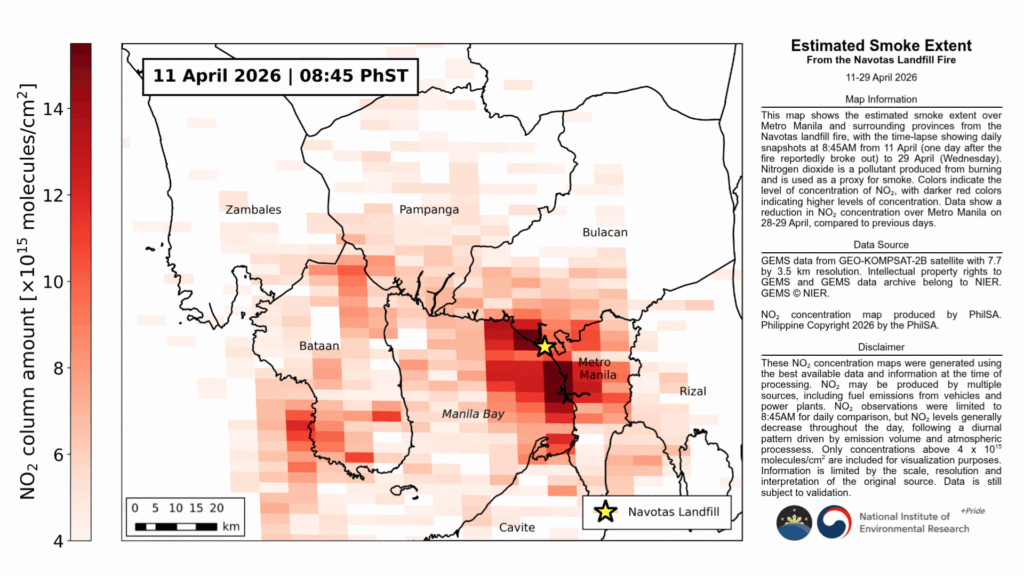
On Wednesday, for the first time since the fire reportedly broke out on April 10, those satellite readings showed NO2 had fallen below pre-fire levels for two consecutive days. Ground monitors from the Environmental Management Bureau confirmed the same. The air, at last, was clearing.
But the fire that produced it had already done its work.
At the height of the crisis, air quality in Caloocan, Malabon, and parts of Quezon City was classified as “Very Unhealthy.” Marikina and Valenzuela hit “Acutely Unhealthy.” A health report by the Ateneo School of Medicine and Public Health warned that even those numbers understated the danger, standard monitors do not detect the dioxins, furans, and volatile organic compounds that burning plastic releases, meaning communities recording only “moderate” readings were still breathing toxic air.
In Obando, Bulacan, 335 people from 111 families were evacuated. Over 3,000 remaining residents were handed N95 masks. The Department of Health set up a field hospital nearby.
In Manila, the crisis was harder to flee. Anne Pineda, a 21-year-old commuter from Cavite with pre-hypertension, found herself caught between two threats at once. “I really can’t do it because it’s already too hot,” she told the The Daily Tribune. “If I wear a mask, I might not be able to breathe at all.”
It was not supposed to reach this point.
The Navotas Sanitary Landfill had been closed since August 2025, its former operator, Philippine Ecology Systems Corp., having withdrawn before completing the required closure and rehabilitation procedures. When the fire ignited, nearly two decades of compacted garbage were waiting for it — waste piled as high as five to seven stories, laced with methane gas that had been quietly building in the compressed layers below until heat gave it somewhere to go. Investigators from the Bureau of Fire Protection and DENR concluded it was spontaneous combustion, the kind of slow, invisible ignition that poorly managed landfills are primed for, and that becomes more likely as temperatures rise.
Both methane buildup and extreme heat are conditions made worse — and more frequent — by climate change.
The Philippines’ dry season, running roughly March through May, brings the kind of hot, stagnant air that allows fires like this to smolder for weeks and pushes pollutants across provincial borders before anyone realizes how far they’ve gone. By April 26, PhilSA’s near-infrared imagery from the Sentinel-2C satellite had mapped a burn scar of 31.95 hectares at the landfill, larger than the Quezon Memorial Circle, with the fire still creeping eastward even as it retreated in the south.
What those maps could not show was where all of it was going next.
Greenpeace Philippines warned that dioxins and furans – toxic chemical compounds released when plastic and other synthetic materials are burned – do not disappear. They settle into soil. They enter waterways. They accumulate in fish, which is a particular concern in Navotas, where the landfill sits adjacent to fishing grounds and aquaculture facilities that local families depend on for both food and income. “These pollutants stay in the environment and do not break down,” the group said in a statement.
Greenpeace added: “This latest landfill catastrophe — the third so far this year — underscores how the government’s approach to waste is a total disaster. Waste disposal, whether in landfills or in burn facilities, does nothing to address the waste problem and, worse, poses serious risks to nearby communities.”
Environmental advocates were blunt about what the fire represented. Ban Toxics, the environment NGO, noted it was the Philippines’ third major landfill disaster in less than four months, following fatal trash slides in Cebu and Rizal earlier this year. The Mother Earth Foundation called it a “clear wake-up call” to move the country away from landfill dependence altogether, toward decentralized, zero-waste systems built around reduction and materials recovery.
The DENR has launched a probe and is pursuing accountability with the Office of the Solicitor General. Environment Secretary Juan Miguel Cuna acknowledged the government was “lacking in capacity” to respond to fires of this scale and said officials were seeking technical partners to fill the gap. A team from Japan’s disaster response program was among those brought in to help.
Wednesday’s satellite readings were, by any measure, good news. PhilSA said it would continue monitoring NO2 levels to track whether the improvement holds, and asked the public to keep following local health advisories. The DOH and DENR-EMB remain the primary sources for updated guidance on when it is safe to go back outside without a mask.
But the question that lingers — over the fishing villages of Navotas, over the school evacuation centers in Bulacan, over the commuters who chose heat over toxic air and lost either way — is not whether the satellite data will eventually return to normal. It will.
The question is what normal was already costing, long before this landfill caught fire. (Rights Report Philippines)