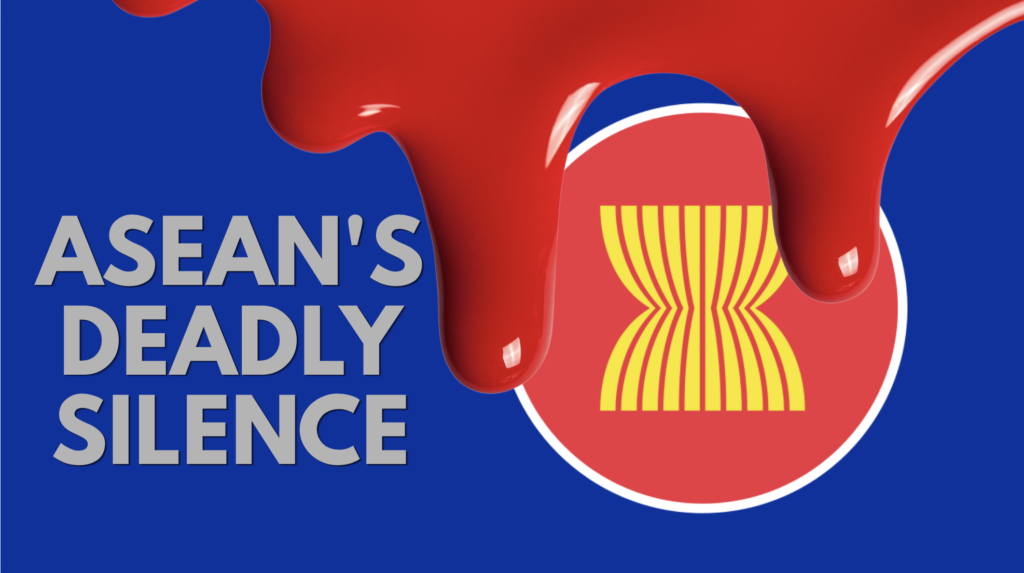
When ASEAN members kill their own citizens, the bloc’s political forums look away, its human rights body says nothing, and its founding doctrine of non-interference provides the institutional cover for all of it, writes Carlos Conde.
First of Two parts
ELEVEN days before the leaders of Southeast Asia nations convened at the Mactan Expo for the 48th ASEAN Summit, 66 families were moved out of their homes. Their community sat about 200 meters behind the venue, close enough to be visible – and inconvenient.
So the national organizing committee relocated them on April 27, 2026. They were members of the Lampara Urban Poor Association, all of them land claimants with no formal title to the homes they were vacating; they were brought to a resort in the neighboring town of Cordova. The government covered everything: accommodation at rates running up to Php5,500 a night, meals, transport. Presidential Security Command and police personnel were deployed to secure the vacated community until the leaders had come and gone.
Officials were careful to say the families were not complaining. The association president said they understood the need to accommodate guests. The mayor said everyone was happy.
What nobody said was the plain thing: that the Philippine government, on the eve of a regional summit it was hosting and chairing, had physically removed poor people from the line of sight of visiting heads of state. The routes were cleaned. The convoys moved smoothly. Cebu, as its governor noted with pride, looked good.
This instinct to make unsightly views – read: urban poor communities – disappear for the summit or any international gathering is not new, and it is not unique to Cebu. It is, in fact, emblematic of how the Association of Southeast Asian Nations (ASEAN) has handled human rights in the Philippines for the better part of a decade.
Today, May 8, 2026, those same leaders are gathered inside the Mactan Expo for the summit’s main session. President Ferdinand Marcos Jr. is the host. The Philippines is also the chair. And if history is any guide, by the time the meeting ends, they will have managed something that should, by now, be impossible to keep pulling off: making the Philippines’ ongoing human rights crisis disappear from the agenda of the region’s most important political forum — as efficiently as 66 families were cleared from its venue.
This is not a new trick. It has been performed at virtually every summit for the past decade. But this week in Cebu — with a journalist’s blood still fresh in Negros Occidental, with a former Philippine president committed to trial at The Hague for crimes against humanity, and with the region’s human rights commission maintaining its customary silence — it is being performed with a particular, almost defiant, shamelessness.
The pattern is worth stating plainly, because ASEAN’s machinery obscures it so effectively: when member governments kill their own citizens, the bloc’s political forums look away, its human rights body says nothing, and its founding doctrine of non-interference provides the institutional cover for all of it. This is not a failure of ASEAN. This is ASEAN working exactly as designed.
***
In November 2017, with thousands of Filipinos already dead from Rodrigo Duterte’s drug war, ASEAN leaders gathered in Manila. Duterte, as the chairman, was also the host. The 26-page Chairman’s Statement that emerged contained two paragraphs about illegal drugs and how member countries were cooperating to fight them. It contained nothing — not a single sentence — about the thousands of people who had been shot dead by police and vigilantes in the preceding 16 months. Nothing about extrajudicial killings. Nothing about accountability. Nothing about human rights at all, save for the ritual boilerplate that appears in every ASEAN communiqué, signifying nothing.
Duterte was emboldened. Within weeks, he reactivated police anti-drug operations that had been briefly suspended following public outcry. He understood what his fellow ASEAN leaders had just communicated through their silence: that as long as you frame mass killing as a domestic law enforcement matter, the region’s premier political body will look the other way. The regional body had abdicated. And the killing continued.
Now, nine years later, the Marcos administration has handed the same forum a different but equally damning body of evidence. The silence looks set to continue just the same.
A Crisis Bigger Than the Drug War
The Philippine drug war was the sharpest and most documented of the country’s human rights crises. But it was never the only one, and focusing on it alone has allowed the ASEAN human rights architecture to avoid answering for a broader, systemic failure.
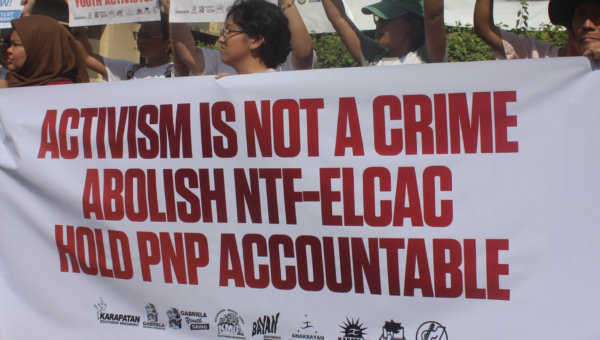
Take red-tagging. For decades, Philippine officials have publicly labeled activists, journalists, teachers, clergy, Indigenous leaders, labor organizers, and lawyers as members or sympathizers of the communist New People’s Army — a designation that, in practice, has often functioned as a death sentence. The practice surged under Duterte and has continued under Marcos with no serious effort to stop it. In May 2024, the Philippine Supreme Court issued a landmark ruling — the Deduro v. Vinoya decision — defining red-tagging for the first time as a direct violation of the right to life, liberty, and security. A domestic court, in other words, found what ASEAN’s human rights commission had never been willing to say. The regional body, predictably, said nothing.
The Philippines also remains one of the most dangerous countries in the world for journalists. Eight have been killed since Marcos took office in 2022. Radio commentator Noel Bellen Samar was shot while riding his motorcycle in Albay province in October 2025 — the eighth victim in three years — and his killing, like most of the others, has yet to be solved. A UN Special Rapporteur who visited the country in early 2024 made specific recommendations, including the creation of a dedicated special prosecutor for media killings. As of mid-2025, the government’s progress was described, in the rapporteur’s own words, as “not enough to make a meaningful difference.”
Enforced disappearances — a particular horror because families are denied even the finality of a death — have continued under the current administration. Human rights group Karapatan documented 14 cases under Marcos, including the 2024 abduction of James Jazmines and Felix Salaveria Jr. in Bicol. Victims are typically activists, land rights defenders, or environmental advocates — people already at risk precisely because of the red-tagging apparatus. The Philippines has not ratified the international convention against enforced disappearances. Congress passed a domestic law against the practice in 2012, but successive governments have refused to fund its implementation.
The 2020 Anti-Terrorism Act has provided a legal architecture for all of the above. Amnesty International has documented how the law authorizes surveillance of communications and social media to track and prosecute activists. Human Rights Watch has reported on the government’s creation of so-called “internal target” lists. On September 21, 2025, police arrested more than 200 people — including children — during Manila protests against corruption, using excessive force and denying those detained access to their lawyers and families.
Each of these crises shares the same basic architecture: an official label applied to make a person a target, followed by violence or disappearance, followed by impunity. Toboso, three weeks ago, shows what that architecture looks like when all its elements operate simultaneously — and what it looks like when the regional human rights body charged with responding does nothing.
Toboso: What Silence Looks Like in Real Time
On April 19, 2026, soldiers from the Philippine Army’s 79th Infantry Battalion conducted operations in Barangay Salamanca, Toboso — a remote farming community in Negros Occidental. By the time it was over, the military declared a successful counter-insurgency strike against the New People’s Army. Rights groups, journalists, universities, and the Philippine Commission on Human Rights told a different story.
Among the 19 people killed: RJ Nichole Ledesma, 30, a journalist and regional coordinator of the Altermidya Network, who colleagues say was not at the initial clash site but was killed in a separate pursuit operation while reporting on the effects of solar and wind projects on farming communities. Alyssa Alano, 22, a University of the Philippines Diliman student council member living alongside Negros farmers. Maureen Keil Santuyo and Errol Wendel, community researchers documenting the conditions of sugarcane workers. Two unnamed minors. And Lyle Prijoles and Kai Sorem — Filipino-Americans from California accompanying local community groups — making the Toboso killings an international incident in the most literal sense.
The Philippine Army maintained all 19 were armed NPA combatants. Defense Secretary Gilberto Teodoro went further, suggesting that anyone found near an armed encounter site alongside rebel groups could face prosecution whether or not they were a combatant. Under international humanitarian law — the Geneva Conventions, to which the Philippines is a signatory — that is not a legal position. It is an admission.
Some 168 households — 653 people in all — were displaced from their communities. AI-generated photos quickly circulated on social media showing the dead holding communist flags — red-tagging, applied posthumously, to preempt accountability.
The Commission on Human Rights launched an independent investigation, noting that “in case of doubt, persons shall be presumed civilians” — one of the most basic rules of armed conflict. House lawmakers filed a resolution calling for a congressional probe. ASEAN Parliamentarians for Human Rights condemned the killings, calling the operation “an indiscriminate attack that violates international humanitarian law.”
And the ASEAN Intergovernmental Commission on Human Rights (AICHR)? Nothing. Not a statement. Not a call for investigation. Not an expression of concern. Just silence.
The killings happened April 19. ASEAN leaders arrived in Cebu on May 6. Nineteen days is more than enough time to issue a statement. The commission has, so far, chosen not to. That is not a bureaucratic delay. It is a decision — made through silence — that the Philippine government’s account of events is not worth scrutinizing at the regional level. It is a signal, received clearly by every military commander and every government in Southeast Asia, that what happens in Toboso stays in Toboso. (Rights Report Philippines)
(Part Two: How the ASEAN human rights commission was built to fail)