

ANALYSIS: The Office of the Solicitor General produced what many legal scholars are calling the most consequential brief in years. It also inadvertently made the case for why the Philippines needs to go back to the ICC, Carlos Conde argues.
THE legal argument is, by most accounts, well developed.
A Philippine law approved in 2009, the government contends, gives the government the power to turn over anyone accused of these crimes to an international court — no ICC membership required, no prior permission from a Philippine judge needed.
The Office of the Solicitor General, the government’s own lawyer, laid this position out in a 73-page “Comment” filed on May 16 before the Supreme Court. Legal scholars have largely praised it as well-reasoned and thorough. (The court has yet to rule on it.)
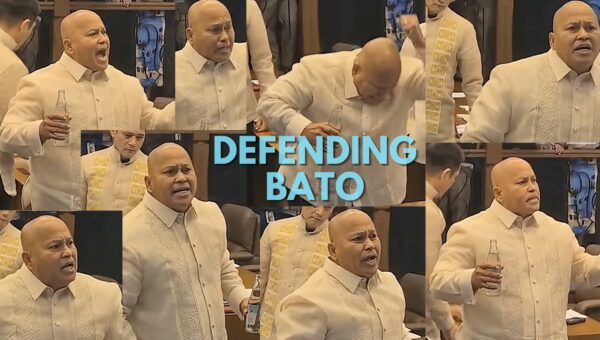
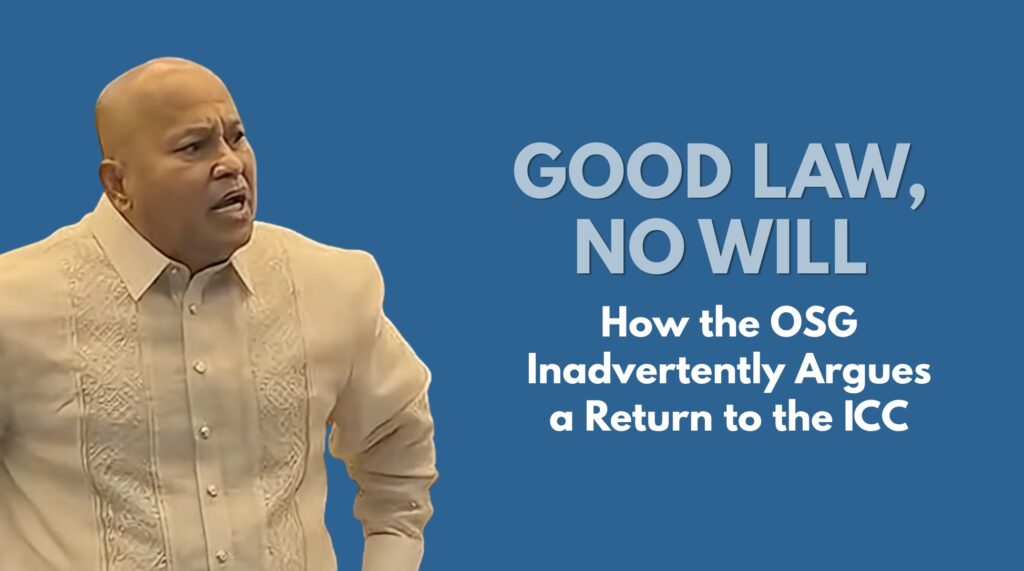
Then Senator Bato dela Rosa, co-accused in the crimes against humanity case in the ICC with former President Rodrigo Duterte, walked out of the Senate at 2:30 in the morning of May 14. Nobody stopped him.
That gap — between what Philippine law may permit and what Philippine governments are actually willing to do — is the central problem no court filing can solve, and no Supreme Court ruling will fix on its own.
READ: RA 9851: When the Law’s Proponents Become Its Enemies
If the court sides with the government, it will settle the legal question of whether the Philippines can hold its most powerful citizens accountable without the ICC. What remains unanswered, and what courts cannot answer, is whether it ever will.
The deeper irony is this: the more convincingly the government argues that its own domestic law is enough — that the Philippines has everything it needs to cooperate with international criminal justice — the more clearly it reveals why that argument falls short.
A law enforced only when it is politically safe is not a real substitute for an international court that operates beyond the reach of local politics. The subtext of the government’s filing is that it is less a case for why the Philippines does not need the ICC, and more an inadvertent argument for why it does.
The Law Was Always There
Republic Act 9851 was never a secret. Passed in 2009, it made genocide, war crimes, and crimes against humanity punishable under Philippine law, and explicitly gave authorities the power to hand over accused persons to international courts already handling relevant cases.
When the Philippines, through Rodrigo Duterte, withdrew from the ICC effective 2019, his government — and later his allies — argued the withdrawal made cooperation with the court legally impossible. RA 9851, the OSG now argues, said otherwise all along.
Nobody in power chose to say so until now.
READ: Can the Marcos Government Arrest Bato dela Rosa? Can It Surrender Him to the ICC? Yes. Maybe.
The government’s filing, submitted in response to a legal motion by dela Rosa and Duterte, argues that RA 9851 works entirely on its own — independent of ICC membership, independent of any treaty. It further argues that the law on crimes against humanity is now considered so fundamental — accepted by virtually every nation — that withdrawing from one treaty does not make it go away.
The Philippine Constitution says the country must follow principles that the world’s nations have broadly agreed on — and the prohibition on crimes against humanity is one of them. No president’s decision to leave a treaty changes that.
None of these are new arguments in international law. What is new is hearing them made this forcefully by the Philippine government itself.
The Fiasco That Proved the Point
On the night of May 13, agents from the National Bureau of Investigation (NBI) were inside the Senate. An ICC arrest warrant against dela Rosa had been made public two days earlier. The senator was physically present in the building, protected by a Senate leadership he had just helped install. Gunshots were fired. The building went into lockdown. And then dela Rosa left with Senator Robinhood Padilla, and nobody stopped him.
READ: A Lawmaker Sprinting in the Halls, an ICC Warrant at the Door, a Senate Reduced to a Joke
The NBI’s own statement afterward was telling.
It said it had no instruction from the President or the Department of Justice to arrest dela Rosa, pointing to pending Supreme Court cases as the reason. President Ferdinand Marcos, through his spokespeople, said he had authorized no arrest and had already instructed government personnel to leave the premises earlier that afternoon — even as NBI agents, by the agency’s own account, remained inside the building for hours.
What the episode exposed was not a problem with the law. The law, as the government’s brief argues, was more than adequate. What was missing was a decision — somewhere inside the executive branch — to use it.
Inadvertent Case for Rejoining the ICC
This is the contradiction the government’s own filing cannot escape. The government says RA 9851 is enough. But that only works if the government is actually willing to use it.
When that willingness disappears, as it evidently did on the night of May 13, the law becomes a mere piece of paper.
International criminal courts exist for precisely this reason. Domestic political systems are poorly built for prosecuting their own powerful people.
An international court’s processes do not pause because a Senate leadership vote has reshuffled the political calculus. Its warrants do not quietly expire because an arrest would be inconvenient that week. No domestic law, however well-written, can replicate that independence.
The government argues the Philippines remains bound by international law and that RA 9851 puts that obligation into practice. That may be legally correct. But the events of May 13 showed that a rule enforced only when the president finds it convenient is not really a rule.
The ICC’s importance was never purely about law. It was about structure — having a court that sits beyond the reach of the very governments it is meant to judge. No local statute recreates that.
If the Supreme Court upholds the government’s arguments, it will have answered whether the Philippines can cooperate with the ICC without being a member. What it cannot answer — and what the events of that night answered in a different way — is whether it will.
READ: EDITORIAL: History Is Patient. So Is The Hague.
That is not an argument for domestic self-sufficiency. It is an argument for the one thing domestic law cannot provide: a court that does not answer to the Philippine government.
The Criticisms
The filing has drawn pointed objections that go beyond dela Rosa’s legal team.
The most serious is straightforward: the government made a compelling legal case on paper while doing nothing when it had the chance to act.
The government’s own filing confirms it had the legal power to act on the ICC warrant months before May 11. If that is true, why did no one move during all those months when dela Rosa was in hiding? The filing does not answer that.
READ: Let’s Be Clear: Marcos Doesn’t Have an ICC Policy. He Has a Duterte Policy.
A second criticism concerns tone. The OSG opens its brief not with a legal argument but with a quote attributed to dela Rosa — “If someone fights back, they’ll die. If nobody fights back, we’ll make them fight back. Produce blood. Instill fear” — and spends its opening pages on the deaths of thousands of drug war victims.
Some critics, including those who hold no sympathy for dela Rosa, say this reads more like a political statement than a court document. The concern is not about the substance but about whether emotional framing substitutes for legal reasoning.
A third objection, raised by dela Rosa’s lawyers and echoed by some legal scholars, questionS whether it is even constitutional.
The government says the ICC already did the job — a panel of judges reviewed the evidence carefully before the warrant was issued, and that should be enough.
Critics disagree, arguing that the Philippine Constitution’s protection against arrest without a locally issued warrant cannot be satisfied by proceedings before an international court, however thorough. This is where legal scholars — many of them have their own political biases or vested interests to protect — most sharply disagree, and where the Supreme Court justices are most likely to differ.
The government also argues that dela Rosa has no right to ask the courts for help at all — because by hiding and running, he has effectively placed himself outside the law’s protection. That argument has been used before in Philippine courts, but only in cases involving local warrants.
Whether the same logic applies to an international warrant — from a court the Philippines has already left — is a question the government raises but does not convincingly answer.
The Praise
Among legal scholars who have commented publicly, the filing has drawn genuine admiration, mainly for how it is built. Rather than resting on a single argument, it stacks several independent ones, so that if the court rejects one, others remain standing.
Some say its research is unusually thorough for a Philippine government brief, drawing on ICC drafting history, rulings from constitutional courts across multiple jurisdictions, and decisions from international tribunals.
Several lawyers have singled out the treatment of the difference between handing someone over to the ICC versus extraditing them to a foreign country as particularly well-argued — a distinction the government explains carefully, step by step, rather than simply declaring to be true.
The filing is, by most accounts, the government’s strongest legal argument. Whether it proves sufficient — before a court, and against a political culture that has long found ways to protect its most powerful — is a question no brief, however well-constructed, can answer on its own. (Rights Report Philippines)