When pricing systems deepen poverty, they implicate the state’s duty to protect, particularly when the state created those systems.
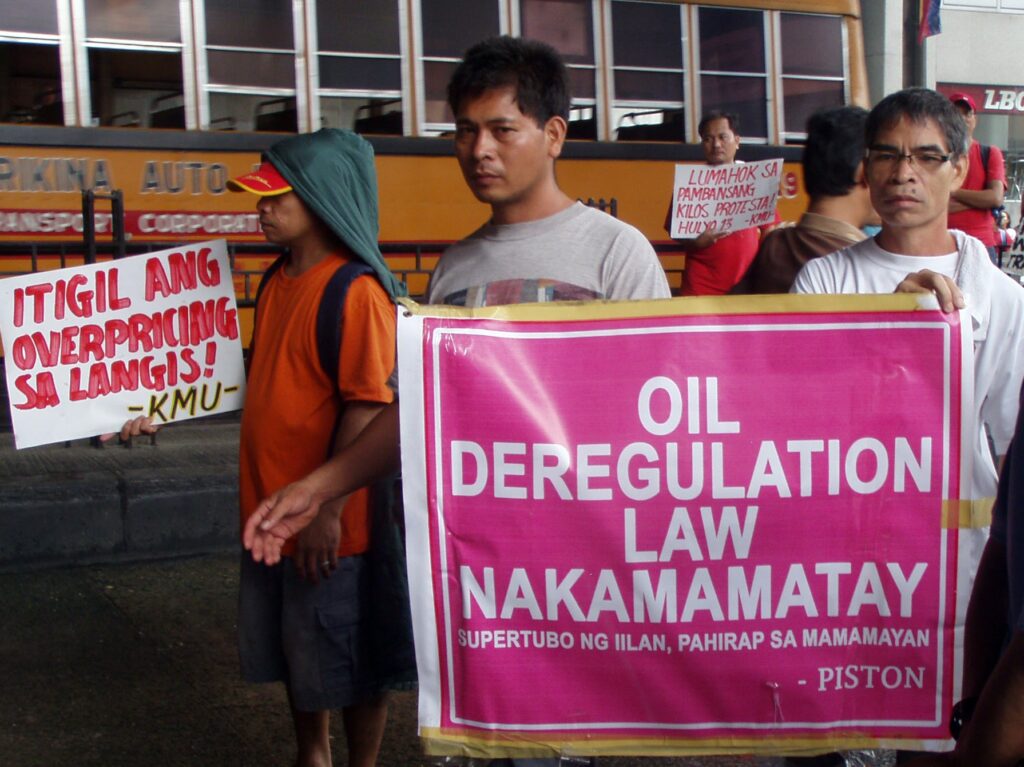
OIL price hikes are not just about economic hardship. It is, as human rights economists argue, a violation of the right to an adequate standard of living enshrined in the International Covenant on Economic, Social and Cultural Rights, to which the Philippines is a state party. When pricing systems deepen poverty, they implicate the state’s duty to protect, particularly when the state created those systems.
Why Is Philippine Oil So Expensive?
The short answer is taxes, margins, and market structure. The longer answer starts with the Oil Deregulation Law — Republic Act 8479, signed by President Fidel Ramos in 1998 under pressure from the International Monetary Fund and World Bank as part of structural adjustment conditions attached to post-crisis lending.
Before deregulation, the government’s Oil Price Stabilization Fund absorbed global price shocks and kept pump prices from swinging wildly. Deregulation abolished that buffer. It also removed the state’s power to set or cap prices, leaving pricing entirely to the three dominant players — Petron, Shell Philippines, and Caltex (operating under Chevron Philippines) — who together control the bulk of the retail market.
IBON Foundation, the independent research group that has tracked oil pricing for decades, has repeatedly documented how these companies move in lockstep: when one raises prices, others follow within days, a pattern more consistent with oligopoly coordination than genuine competition. “The so-called free market in oil is a fiction,” IBON executive director Sonny Africa has said. “What we have is a cartel operating under legal cover.”
Taxes compound the problem. The TRAIN Law (Tax Reform for Acceleration and Inclusion, 2017) significantly raised excise taxes on fuel — Php10 per liter on gasoline, Php6 on diesel, Php5 on kerosene — ostensibly to fund infrastructure and social programs. The revenues have been real; so has the burden on consumers, especially the poor, who spend a disproportionate share of income on transport and goods that depend on fuel.
Why Are Price Increases So Frequent?
Under deregulation, oil companies are free to adjust prices as often as they like, pegged loosely to Mean of Platts Singapore (MOPS), the regional benchmark price, plus their own margin calculations. In practice, increases come nearly every week when global prices rise. Rollbacks, when they happen, are smaller and slower.
This asymmetry is not accidental. IBON and the Freedom from Debt Coalition have both documented the pattern: oil firms pass on increases quickly and completely, but absorb rollbacks partially, pocketing the difference as expanded margins. The Department of Energy has the power to monitor this — but not to stop it.
Who Actually Benefits?
The deregulation framework was sold to the public as a pro-consumer reform that would bring competition and lower prices. The beneficiaries have been largely different.
Petron, Shell Philippines, and Caltex have posted substantial profits in most years since deregulation. Petron — majority-owned by San Miguel Corporation, one of the Philippines’ largest conglomerates — reported net income of over Php10 in 2023. These are not companies struggling to survive global volatility; they are companies whose structure allows them to profit from it.
Deregulation also created favorable conditions for a two-tiered fuel market: large corporations and wealthy motorists absorb higher prices with relative ease, while small transport operators, farmers, and fisherfolk — for whom fuel is a direct production cost — are squeezed from both sides.
How It Pushes Filipinos Deeper Into Poverty
Social Weather Stations data consistently shows that transport is among the top expenditure items for low-income Filipino households. When fuel prices rise, jeepney and tricycle operators either absorb the loss — cutting into already-thin margins — or pass it on through informal fare increases that regulators rarely catch in time.
The ripple effects are wide. Higher diesel prices raise the cost of shipping food from Mindanao to Manila. Higher kerosene prices hit households in areas with no electricity. Higher LPG prices, driven by the same deregulated logic, affect the millions of Filipino families who cook on gas.
IBON estimates that each Php1 per liter increase in fuel costs adds measurably to the consumer price index, with the burden falling hardest on the bottom 40 percent of income earners — households that spend far more of their income on food and transport than they do on savings or investments that might hedge against inflation.
This is not just economic hardship. It is, as human rights economists argue, a violation of the right to an adequate standard of living enshrined in the International Covenant on Economic, Social and Cultural Rights, to which the Philippines is a state party. When pricing systems predictably and structurally deepen poverty, they implicate the state’s duty to protect — particularly when the state created those systems.
What Can Be Done?
Critics, including the Makabayan bloc in Congress and civil society groups like IBON and the Confederation for Unity, Recognition and Advancement of Government Employees (COURAGE), have pushed for several reforms:
Re-regulation of oil prices, at minimum establishing a price ceiling mechanism or restoring a buffer fund to absorb global shocks. Windfall profit taxes on oil companies during periods of unusually high margins. Repeal or suspension of the fuel excise taxes introduced by TRAIN, particularly for diesel and kerosene used by the poor. Breaking up the oligopoly through stronger anti-trust enforcement and by developing a viable state oil company with real retail presence.
None of these are radical ideas by global standards. Many countries in the region, including Malaysia, Indonesia, and Vietnam, maintain some form of fuel subsidy or price regulation. The Philippines, under IMF-era orthodoxy, stripped those tools away, and has not seriously moved to restore them.
The question is not whether the tools exist. It is whether the political will does — in a Congress where oil industry interests are well-represented, and where the dominant economic framework still treats deregulation as gospel rather than as a policy choice that can be revised.
Until that changes, the price at the pump will remain, above all, a political number. (Rights Report Philippines)