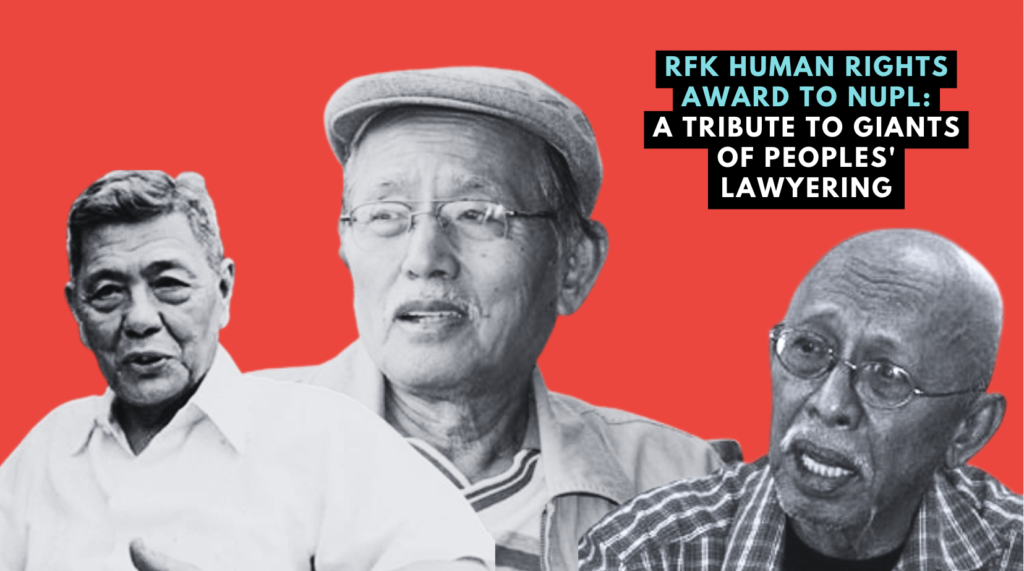
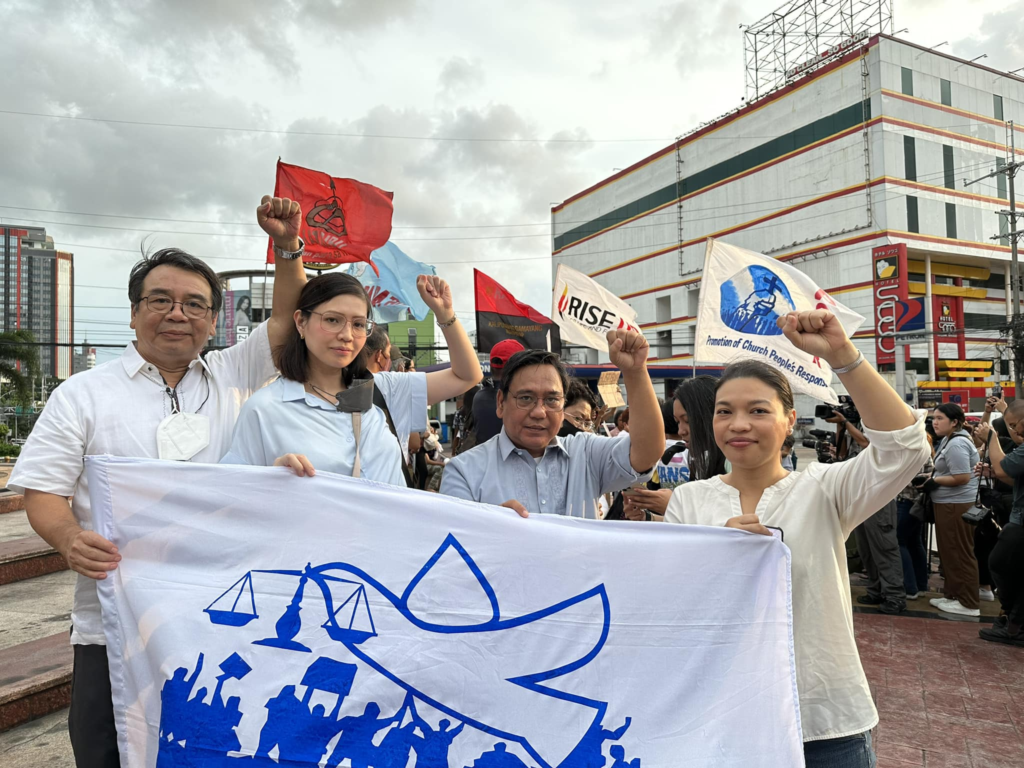
The 43rd RFK Human Rights Award goes to the National Union of Peoples’ Lawyers, whose members have faced killings, red-tagging, and state harassment for defending the poor and the oppressed. NUPL, like other legal aid groups before it, was born out of the Philippines’ long struggle for justice and accountability.
A GROUP of Filipino human rights lawyers is receiving one of the most recognized honors in international advocacy, and the timing could not be more pointed.
The Robert & Ethel Kennedy Human Rights Center has named the National Union of Peoples’ Lawyers (NUPL) as the recipient of its 43rd annual Human Rights Award, placing the Philippine organization in the company of activists and defenders from 31 countries who have carried the award since its founding in 1984. The center, led by Kerry Kennedy — daughter of the late Sen. Robert F. Kennedy — described NUPL as an organization that stands up to oppression “at grave personal risk in the nonviolent pursuit of human rights.”
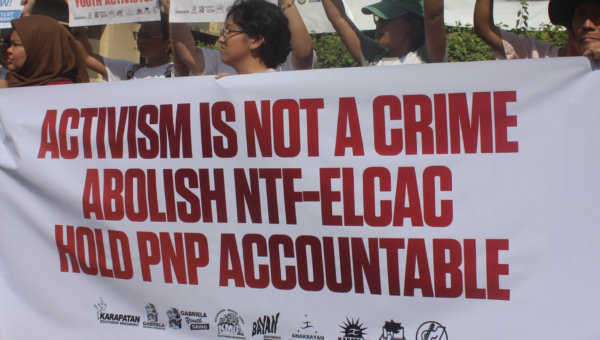
NUPL has documented killings, enforced disappearances, and systematic harassment of its own members going back nearly two decades. Three of its lawyers were killed between 2022 and 2023 alone. Dozens more have been subjected to red-tagging — a practice in which state officials publicly label lawyers, journalists, and activists as communist sympathizers or terrorists, often serving as a prelude to worse.
The group was founded in 2007 in direct response to a wave of extrajudicial killings and political persecution during the Gloria Macapagal-Arroyo administration. More than 500 lawyers, law students, and legal workers now belong to it, organized through regional chapters across the country with national leadership based in Manila. They work largely pro bono, representing peasants, indigenous peoples, political prisoners, migrant workers, and victims of state violence — clients that, as NUPL puts it, most lawyers “cannot, would not, or do not” take on.
Justice Gap
For many Filipinos, the award carries meaning that extends well beyond the courtroom battles NUPL is best known for. The country faces a deep and persistent access-to-justice crisis: court costs are prohibitive for the poor, case backlogs stretch for years, and legal information remains largely out of reach for rural and marginalized communities. As recently as 2018, only 20% of Filipinos were able to access legal help, leaving four in five without any legal assistance at all. High costs, lengthy delays, and a widespread lack of information about how the justice system even works remain among the biggest barriers, particularly at the local level.
For the farmers facing land-grabbing, the workers cheated of their wages, the indigenous communities up against mining companies, and the political detainees held without due process, NUPL’s lawyers are often the only ones who show up. The Kennedy award matters here in a direct, practical way: the financial recognition and the strategic partnership it unlocks — with one of the world’s most prominent human rights organizations behind it — means NUPL can do more, reach further, and take on cases it might otherwise have lacked the resources to pursue.
Rooted in Dictatorship
To understand what NUPL’s recognition means, it helps to understand where it came from — and that story begins not in 2007 but in 1974, in the darkest years of Ferdinand Marcos Sr.’s martial law regime.
That year, Sen. Jose W. Diokno — himself a political prisoner who had spent 718 days in Marcos’s jails — walked out of detention and immediately got back to work. Together with Sen. Lorenzo Tañada and lawyer Joker Arroyo, he founded the Free Legal Assistance Group (FLAG), the Philippines’ first human rights legal organization. It was a direct act of defiance. The press had been shut down, the legislature padlocked, and activists labeled enemies of the state.
FLAG’s response was to represent them — pro bono, methodically, and at serious personal risk. At least twelve FLAG lawyers were murdered during the Marcos years. FLAG also pioneered the use of paralegals for what it called “first aid legal aid,” a model that other organizations soon replicated. That innovation — bringing legal help to people who had never seen the inside of a law office — became the template for everything that followed.
When Marcos fell in 1986, the infrastructure FLAG built did not disappear. It expanded. Activist lawyer Romeo Capulong, who had himself fled the country under martial law and founded the Filipino Lawyers Committee for Human Rights in New York in 1980, returned to the Philippines and in 1989 established the Public Interest Law Center (PILC), the country’s first public interest law firm. Although he was not a member of FLAG, Capulong worked and thrived in the same broader legal support ecosystem that FLAG pioneered.
Capulong and Gapuz
Where FLAG was a nationwide network of volunteer lawyers and paralegals, PILC was a dedicated institution: a small, professional team that took on the cases most law firms would never touch, from Hacienda Luisita farmworkers fighting for land rights to overseas workers on death row abroad. Capulong became the defining figure of a generation of people’s lawyers, and PILC became the training ground for many who would go on to lead the movement after him.
In 2005, Frederico M. Gapuz — a Mindanao lawyer who had joined progressive legal formations during martial law and endured detention — founded the Union of Peoples’ Lawyers in Mindanao (UPLM), recognizing that the particular crises facing Mindanao’s farmers, indigenous peoples, and communities caught in armed conflict required organized legal muscle on the ground in the south. Two years later, in 2007, Capulong and Gapuz joined younger progressive lawyers to co-found NUPL as a national federation, bringing PILC’s institutional tradition, UPLM’s regional reach, and FLAG’s founding spirit under a unified movement. UPLM subsequently became recognized as NUPL-Mindanao, maintaining its own structure while operating as the federation’s southern anchor.
Today, FLAG, PILC, UPLM, and NUPL form a continuum — distinct organizations with their own histories, structures, and specializations, but drawing from the same wellspring. They share founders, share cases, and share enemies. All three of NUPL’s closest allies — PILC and UPLM among them — have been publicly branded as “communist fronts” by state officials, with no evidence beyond what authorities called military intelligence. That label, in the Philippine context, has historically preceded violence.
UPLM lost two lawyers in the 2009 Ampatuan Massacre, the deadliest single attack on journalists and civilians in the country’s history. UPLM vice chairman Juan Macababbad was shot dead outside his home in 2021 after years of defending indigenous communities against mining companies. The names of murdered FLAG lawyers are inscribed on the wall at the Bantayog ng mga Bayani, the national monument to those who resisted the Marcos dictatorship.
What the RFK Human Rights Award recognizes in NUPL, then, is not just one organization. It is half a century of a movement — one that was born in a jail cell, built by lawyers who chose the poor over profit, and sustained through assassinations, red-tagging, and relentless state pressure.
More Than a Philippine Story
What makes the award to NUPL notable beyond the Philippines is what it represents for the global community of human rights defenders.
The RFK Human Rights Award has historically functioned as more than a citation. Past laureates have used the recognition and the strategic partnership it unlocks — with Kennedy’s team of lawyers, advocates, and international networks — to amplify their work in ways that domestic recognition rarely provides. The center’s legal advocacy has, over the years, helped free political prisoners and defend the rule of law in authoritarian settings. Others have leveraged the platform to pursue cases before international tribunals.
But NUPL’s selection also offers something arguably more durable: a model. The organization was built from scratch by lawyers who refused to accept that their profession required neutrality in the face of systematic abuse. It has survived harassment, the murder of its members, and sustained government pressure — and it has grown. That story resonates far beyond the Philippines, in countries where civil society is under pressure and lawyers who take on the wrong clients find themselves in the crosshairs.
From Myanmar to Bangladesh to parts of Latin America and sub-Saharan Africa, lawyers who defend human rights defenders, political prisoners, and marginalized communities face risks that their bar associations are rarely equipped to handle. NUPL’s decades of experience building an organized, resilient, voluntary network of people’s lawyers — sustaining it through multiple administrations and escalating threats — is the kind of institutional knowledge that cannot be easily replicated but can serve as a blueprint. The Kennedy center’s decision to spotlight it is, in effect, a call to lawyers in similar situations worldwide: this is what organized, principled resistance looks like, and it can last.
For NUPL, the partnership with the Kennedy center could also accelerate its work at the international level. NUPL has been involved in proceedings before the International Criminal Court, where an investigation into thousands of drug war killings under former President Rodrigo Duterte has been grinding forward. It maintains ties with the International Association of Democratic Lawyers and has submitted reports to the UN Human Rights Council. The Kennedy center’s resources and visibility could make those efforts harder to ignore — and harder to suppress.
“Those with the courage to enter moral conflict will find themselves with companions in every corner of the globe,” Sen. Kennedy once said. It’s the phrase the center uses to describe what laureates gain from the award: not just recognition, but solidarity made institutional.
A Year of Heightened Stakes
The selection also arrives against a backdrop in which the defense of civil liberties is under strain in multiple democracies simultaneously — not just in the Philippines. The Kennedy center itself broke with its own tradition last year, honoring two sitting U.S. government officials among its 2025 laureates, citing what it called the “alarming erosion of democracy in the United States.”
Choosing a frontline lawyers’ group from Southeast Asia this year sends a different kind of message — that the award’s attention is turning back to the places where the risks to human rights defenders are most immediate and most physical.
Former NUPL president Edre Olalia, a veteran of landmark cases including serving as private prosecutor in the conviction of retired Army Maj. Gen. Jovito Palparan for the 2006 disappearance of two University of the Philippines student activists, has spoken plainly about what international recognition means in that environment. When the International Bar Association honored former NUPL chair Neri Colmenares in 2020, Olalia said such awards serve as “a mantle of protection for human rights lawyers” operating in a country where dozens of their colleagues have been murdered.
The Kennedy award, carrying one of the most recognized names in American human rights history and backed by the TramutoPorter Compassionate Leadership Human Rights Defenders’ Fund, may function in exactly that way — drawing enough international attention around NUPL and its members that targeting them becomes costlier for those who would do so.
The Kennedy center forges what it describes as “strategic partnerships” with laureates — combining resources, legal expertise, and access to international platforms to help advance their work after the award ceremony. For an organization like NUPL, whose members operate on tight resources in one of Asia’s most difficult environments for civil society, that partnership may matter as much as the honor itself.
The award will be presented at the 43rd annual ceremony. A formal date has not been announced. (Rights Report Philippines)