The Philippine government’s own human rights body released this week an important report on red-tagging, its second in six years. It lays out exactly what needs to happen. The harder question is whether anyone in power will act on it this time.
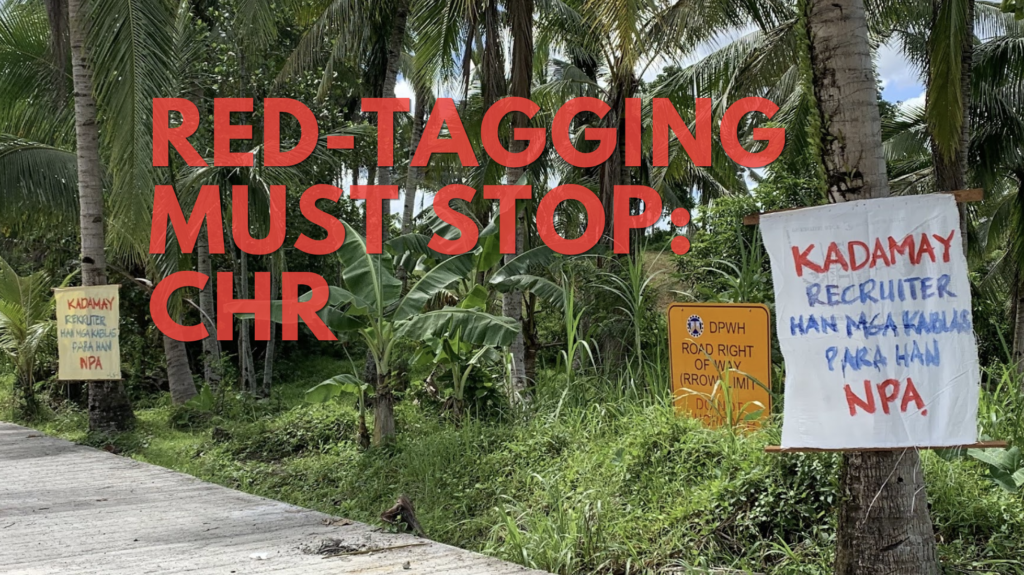
MANILA — The Philippine government’s own human rights body spent much of 2024 gathering sworn testimony about what happens when the state brands you a “communist terrorist.” It released its report yesterday, more than a year after the last public hearing wrapped up, and it amounts to a detailed to-do list addressed to a government that has spent years not reading the previous one.
The Commission on Human Rights’s report, titled “National Inquiry on the Current Situation of Human Rights Defenders in the Philippines with a Focus on Incidents of Red-Tagging,” is a document that is careful, legally rigorous, and, in its broad outlines, almost identical to an inquiry the same body conducted in 2019. That repetition is the story.
The numbers accumulated between the two inquiries are not abstract. The United Nations Human Rights Office documented at least 248 human rights defenders, legal professionals, journalists, and trade unionists killed in relation to their work between 2015 and 2019 in the Philippines. From July 2016 to November 2019, the domestic rights group Karapatan documented 293 extrajudicial killings linked to the government’s counterinsurgency program, 167 of those victims being human rights defenders — averaging one to two killed every week.
The Ateneo Human Rights Center recorded 456 red-tagging incidents in just the first six months of 2024. Women were targeted at three times the rate of men, often with threats of sexual violence attached. Kilusang Mayo Uno, the country’s largest left-leaning labor federation, says 72 of its leaders and members have been killed since 2016.
The practice at the center of all of this — publicly labeling individuals or organizations as communist insurgents or enemies of the state, without evidence or due process, in ways that expose them to harassment, arrest, and death — has no specific law against it in the Philippines. That is the core of what the commission wants changed.
For Congress, the recommendation is direct: pass a law.
Several bills are pending before the 20th Congress. In the Senate, Senate Bill No. 1071, filed by Senator Jinggoy Ejercito Estrada, would impose up to 10 years in prison and a lifetime ban from public office for those convicted. In the House, bills filed by Reps. Leila de Lima, Renee Louise Co and Antonio Tinio jointly, and Sarah Jane Elago would punish both the labeling itself and violence arising from it. The commission is also pushing Congress to revisit the Anti-Terrorism Act of 2020 — witnesses testified it is routinely weaponized against the same people being red-tagged — and to pass a CHR charter granting the commission power to refer perpetrators for prosecution and provide immediate remedies for victims.
For the executive branch, the commission says existing efforts don’t go far enough.
In September 2025, President Ferdinand Marcos Jr. signed Executive Order No. 97, adopting omnibus guidelines that prohibit state agents from labeling workers’ organizations as communist fronts. But the order covers only the labor sector and carries no meaningful penalties for violators. The commission wants a government-wide prohibition, with real consequences, covering all sectors — activists, journalists, indigenous communities, anyone targeted for their advocacy.
It is worth noting what EO 97 built on: an earlier order, Executive Order No. 23 signed in April 2023, which created an inter-agency committee to address ILO concerns about violence and red-tagging against workers. EO 23 established the coordination mechanism; EO 97 adopted the actual operational guidelines. Together, they represent the Marcos administration’s most concrete responses to the problem. Yet neither has stopped the practice.
The commission is also calling for an independent review of Executive Order 70, the 2018 Duterte-era order that created the National Task Force to End Local Communist Armed Conflict, or NTF-ELCAC, an agency the commission has documented as a source of red-tagging incidents, even as it claims to have shifted toward a “positive peace” framework.
For the judiciary, the commission urges the Supreme Court — which ruled in May 2024 that red-tagging constitutes a threat to life, liberty, and security — to update the rules governing protective writs, ensure faster resolution of cases involving human rights defenders, and promote legal aid access. That ruling has not visibly changed behavior on the ground.
Why has none of this happened? The answer involves both politics and institutional design. Red-tagging is operationally convenient for an administration that chairs NTF-ELCAC and has rejected repeated calls from UN Special Rapporteurs to dissolve it. President Marcos told reporters in May 2024 that it is “not the government that is red-tagging” — a claim the Ateneo monitor’s data directly contradict, which found that 61.2 percent of the primary red-taggers are from government agencies such as the Philippine National Police, the Armed Forces of the Philippines, and NTF-ELCAC.
The institutional incentives also run the wrong way. The NTF-ELCAC’s barangay development program has channeled more than P30 billion in public funds to villages since its inception, distributing money only to communities certified as “cleared” of communist influence — creating a financial incentive for local officials to identify, or manufacture, communist threats. The commission calls for an independent review of this structure. It stops short of recommending the task force’s dissolution, even though two UN Special Rapporteurs — Ian Fry, who covered human rights and climate change, and Irene Khan, who covers freedom of expression — and civil society and rights groups here and abroad have done so explicitly.
The International Labour Organization sent a high-level mission to Manila in 2023 and found the government had done “very little” to address red-tagging or protect labor rights. At least four union activists were killed after that mission concluded, according to Human Rights Watch.
Human Rights Watch has called on the European Union — currently in free trade negotiations with the Philippines — to use that leverage directly. The EU has human rights clauses in its trade agreements and has previously suspended trade preferences from other countries over labor rights violations. The CIVICUS Monitor rates Philippine civic space as “repressed” — a designation unchanged through years of international engagement. (Rights Report Philippines)