
Bullets recovered from five victims are consistent with high-velocity rifles. One woman may have bled to death. And no, none of the fatalities looked like corned beef. “You know what they look like?” Dr. Raquel Fortun asked. “People.”
MANILA — The bodies told stories that the official death certificates did not.
That was the central finding presented Thursday by Dr. Raquel Fortun, one of the Philippines’ most prominent forensic pathologists, who has spent the past two weeks conducting independent autopsies on five of the 19 people killed in a military operation in Negros Occidental on April 19.
The 19 died in Barangay Salamanca, Toboso, a town in Negros Occidetal, during an operation by troops from the Army’s 79th Infantry Battalion. The military has maintained that all 19 were armed fighters of the New People’s Army killed in a legitimate encounter. Relatives of some of the dead, along with human rights groups, dispute that account, saying some of those killed were civilians.
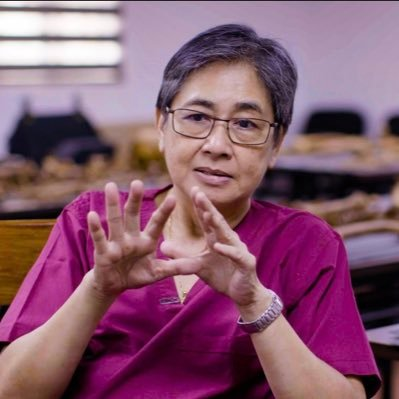
What Fortun found, she said, pointed not only to serious questions about how the victims died, but also to a near-total breakdown in how authorities handled the bodies, the crime scene, and the evidence that might one day hold someone accountable.
“The bodies are evidence,” Dr. Fortun said at a press briefing in Manila. “You must hear the version of the dead. You cannot only listen to the living — especially when the living are the ones in control of everything.”
The government pushed back Thursday against what it called premature conclusions. In a statement, Usec. Ernesto Torres Jr., executive director of the National Task Force to End Local Communist Armed Conflict, said Dr. Fortun’s findings were insufficient to establish a massacre and urged the public to wait for a full official report. He also defended the handling of remains, saying troops and police conducted recovery operations in a hazardous area where improvised explosive devices, booby traps, and armed fighters were still a real threat. The wrong body delivered to one family, he said, resulted from the identification and claiming process by relatives, not from any intent to conceal evidence.
Torres also invoked the laws of armed conflict, arguing that persons who actively participate in hostilities are lawful targets as long as they have not surrendered or been put out of action. He said one of four NPA fighters who escaped the firefights and was later arrested told authorities that their commander had ordered the group to hold its position and fight rather than surrender. “Deaths in armed conflict are always unfortunate,” Torres wrote. “But unfortunate does not automatically mean unlawful.”
A Forensic Examination Built From Almost Nothing
Of the 19 people killed, families of five agreed to seek independent autopsies after growing dissatisfied with official accounts. Those five bodies were flown from Negros Occidental to Manila, where Dr. Fortun and a team of doctors and morticians received them beginning April 25 at the Philippine General Hospital.
What greeted them was far from ideal. The bodies, ranging in age from 22 to 40, were in varying states of decomposition — some in what Dr. Fortun called early decomposition, others in moderate to advanced stages. At least some, she said, had been found in water, which accelerates the breakdown of remains and complicates forensic analysis.
READ: In #Toboso19 Aftermath, the Struggle for Healing
“Fresh is best,” she said. “But then you’re in the Philippines.”
Before beginning any procedure, she insisted on X-rays — a step she said is essential to locating bullets that might otherwise go undetected. The PGH Department of Radiology accommodated the team and waived its fees. Without those images, she said, critical evidence would have been invisible.
Bullets or bullet fragments were recovered from three of the five bodies. All three showed multiple gunshot wounds — to the head, torso, and in some cases the limbs. At least three victims were shot in the head. At least five sustained wounds to the trunk. Dr. Fortun said the bullets recovered were consistent with what she described, in general terms, as high-velocity rifles.
The two remaining cases, she said, were still under analysis.
‘Which One Killed Her?’
Among the most striking disclosures Dr. Fortun offered — carefully, without identifying any of the victims by name — was the case of a woman who had been shot four times.
Three of those wounds, she explained, were not immediately fatal. The fourth struck her leg, lacerating blood vessels. She bled to death.
“Of the multiple gunshot wounds, which one killed her?” Dr. Fortun said. “Can you explain how it happened?”
The implication was stark. She said she raised the question directly with the lawyers present: if the woman was injured but not immediately killed, and no one came to her aid, could that constitute a war crime under international humanitarian law?
“It means she bled at the scene, and you did nothing,” Dr. Fortun said.
In a second case, a victim appeared to have aspirated blood — meaning blood entered the airway — after being struck in the throat. These kinds of findings, she said, are precisely what a thorough forensic examination is designed to uncover. “If you do not examine the body, you do not do a forensic autopsy, you lose these things,” she said.
Missing Clothes, Wrong Labels, Junk Science
Perhaps more alarming than what Dr. Fortun found in the bodies was what she did not find surrounding them.
Clothing, which she described as critical forensic evidence — bullet holes in fabric can confirm wound locations and suggest the range from which a shot was fired — was largely absent. Of the five cases, she received only two bags of clothing. One was mislabeled. The other had no label at all.
“Who decided back in Negros who these people are?” she asked. “What happened?”
She said there was no evidence that basic crime scene investigation had been conducted — no documentation of where each body fell, no systematic effort to preserve the scene before the bodies were moved.
One of the five bodies she received was so wrapped in plastic — face included — that identity could not be confirmed by visual inspection. After comparing her post-mortem findings against physical descriptions provided by the family, she concluded the body was not who they had been told it was. The family is that of Errol Wendel, a community researcher whose relatives say he was among those killed on April 19. She has since reclassified the body delivered to them as an unidentified adult male and is working with a DNA analysis laboratory at the University of the Philippines Diliman to pursue identification.
“I promise you we will look for him,” she said, speaking of the family who believed their relative was among those returned to them.
She also took sharp aim at the use of the paraffin test — a decades-old technique used to check for gunpowder residue on a suspect’s hands — which Philippine law enforcement continues to employ. Forensic scientists and courts in other countries began rejecting the test by the 1970s because of its high rate of false positives; the U.S. Department of Justice has described it as “now-discredited.” Dr. Fortun, who has criticized the test in the Philippines for three decades, places its obsolescence even earlier.
“I have been criticizing the paraffin test for 30 years,” she said. “It hasn’t been used since the 1960s. It’s junk.”
She pointed to one victim who had been submerged in water — a condition that renders the test entirely meaningless, since trace residues would have washed away — and was still reported as testing positive.
The evidence, she said, suggested that the body had been paraffin-tested before it was released to the family: a bag of clothing she received from that case still had candle wax on it, a byproduct of the paraffin process.
“You should be ashamed,” she said, addressing authorities who continue to use the method.
Death Certificates That Told Little
Each of the 19 victims, Dr. Fortun said, had a death certificate issued in Negros Occidental. When she requested copies, she found them to be largely inadequate. Some listed cause of death as blank. Others contained only vague language — “gunshot wounds of the head” — with no additional clinical detail.
She said she considered requesting corrections to those certificates but concluded it was not practical, given that many had already been registered. Her autopsy reports, she said, will document the discrepancies.
“Forensic pathology is weak” in the Philippines, she said. “But this is the reason why we check.”
Bullets With Nowhere to Go
Three of the five autopsies produced physical bullets that, under proper forensic procedures, could be matched to a specific firearm and potentially to a specific shooter. Dr. Fortun said the process — called firearms identification — is technically feasible and is used routinely in other countries.
The Philippines, she said, has an Integrated Ballistics Identification System, or IBIS. But she questioned whether the government maintains reference data on the weapons carried by state agents, without which the system cannot be used to make matches.
“Ideally, yes,” she said. “But will that happen in the Philippines? It has not happened in the past.”
She described a career defined by recovering evidence that goes nowhere — reports she has written over 30 years that have never made it to a courtroom, bullets with no chain of custody, cases with no accountability.
“I get away with murder here,” she said, describing the country’s culture of impunity — not as a personal confession, but as a broader indictment. “And it can happen to anybody. It can happen to you.”
‘They Look Like People’
One of the few moments during the briefing when Dr. Fortun appeared to step back from clinical language came near the end.
She addressed a description that had circulated on social media comparing the condition of the victims’ remains to canned meat — a remark she called not only inaccurate but dehumanizing.
“No, they don’t look anything like corned beef,” she said. “Take it from me, because I see a lot of dead bodies. You know what they look like? People. People with injuries. People who were killed.”
She appealed to the public and to the families of the other 14 victims still buried in Negros Occidental not to cremate the remains — and to cooperate with efforts to exhume and re-examine them. She said she still hopes to conduct autopsies on all 19.
“Two have been cremated,” she acknowledged, “but the rest were buried, because there is still this hope that we can exhume.”
The reports from the five autopsies she has completed are still being written. Histopathology slides — tissue samples examined under a microscope — have not yet been returned from the lab. She said she would release findings when they are complete, but offered no timeline. (Rights Report Philippines)