
A Cebu court found the charges rested on a terrorist designation that did not exist when the alleged acts took place — exposing a prosecution that critics say was never about terrorism.
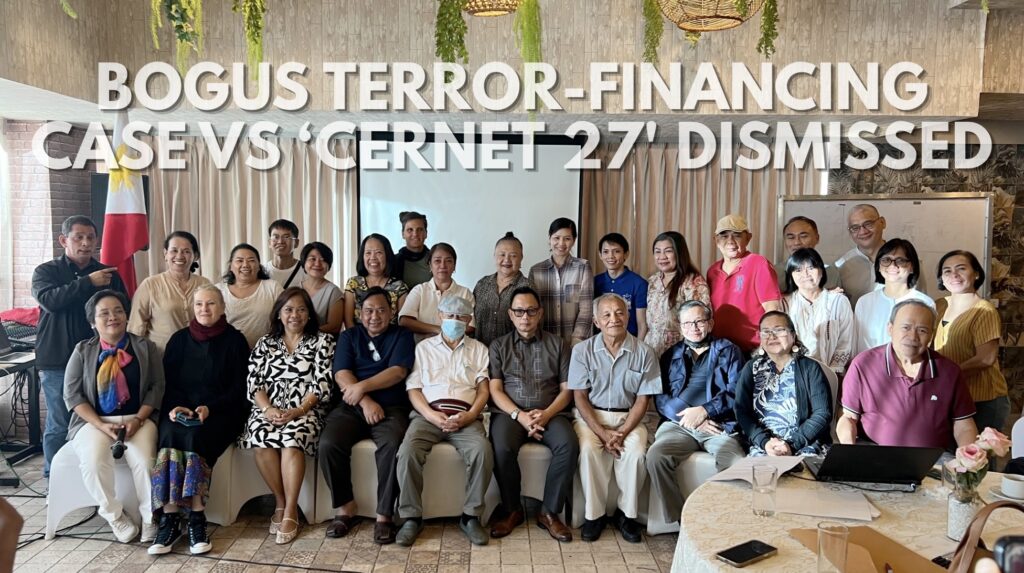
A Philippine court has dismissed terrorism financing charges against 27 current and former members of a Visayas-based humanitarian network, ruling that the acts they were accused of committing were not a crime under any law in effect at the time.
The decision, dated May 15 and made public late Monday, ended a three-year legal ordeal for directors and staff of the Community Empowerment Resource Network (Cernet), a Cebu City nonprofit that has worked in impoverished rural communities since 2001.
In a statement it posted on its Facebook page around midnight on Monday, Cernet said the court found that the charges could not stand because the government’s prosecution rested on a retroactive application of a terrorist designation that did not exist when the alleged act took place, a violation of the legal principle that no one may be prosecuted for conduct that was not a crime when committed.
The ruling lays bare how counterterrorism laws in the Philippines have been stretched to target development workers and human rights advocates and how, in this case, that effort collapsed under its own legal contradictions.
READ: Philippines’ Terrorism-Financing Machine Is Breaking Down in Court. But the Damage Keeps Spreading.
It is also the latest in a string of defeats for the government’s terrorism financing machinery in Philippine courts. In February, a Tacloban judge threw out all charges against Jazmin Jerusalem, executive director of the Leyte Center for Development, finding — on precisely the same legal grounds as in the Cernet case — that no valid domestic terrorist designation existed at the time of the alleged acts. Courts have reached similar conclusions in cases against labor organizers, rural aid workers, and members of the clergy, typically because the evidence rested on the unverified testimony of alleged former rebels.
A Case Built on Shaky Foundations
The prosecution alleged that Cernet members had provided ₱135,000 to the Communist Party of the Philippines-New People’s Army in September 2012. While the US had designated the CPP-NPA a foreign terrorist organization in 2002, the Philippine government’s own designation under the very law used to charge the “Cernet 27” did not come until December 2017, under President Rodrigo Duterte — five years after the transaction in question. The court ruled that foreign designations were not sufficient to activate criminal liability under Philippine law.
The complaint was originally filed in May 2023 by then-Colonel Joey Escanillas, commander of Joint Task Force Cebu. A year later, Senior Deputy State Prosecutor Peter Ong, who led the Department of Justice’s Task Force on Counter-Terrorism and Terrorism Financing that coordinated closely with National Task Force on Ending Local Communist Armed Conflict (NTF-ELCAC), filed the formal charges before RTC Branch 74 in Cebu City. Three of the 27 named individuals had already died before the complaint was filed; warrants were issued against them regardless.
The proceedings drew sharp criticism from the accused themselves, who said in their affidavits that prosecutors had conducted the investigation without proper verification of who actually belonged to Cernet, and without meaningful evidence. During a court hearing in May 2025, a witness from the Anti-Money Laundering Council failed to produce a single document supporting the prosecution’s claims.
The case took a severe human toll. Cristina Dimataga Muñoz, a social worker and former executive director of Cernet who had been battling cancer when the case was filed, died in January from stage 4 breast cancer. Of the remaining accused, 15 are senior citizens, many with pre-existing medical conditions, for whom the protracted proceedings were particularly punishing.
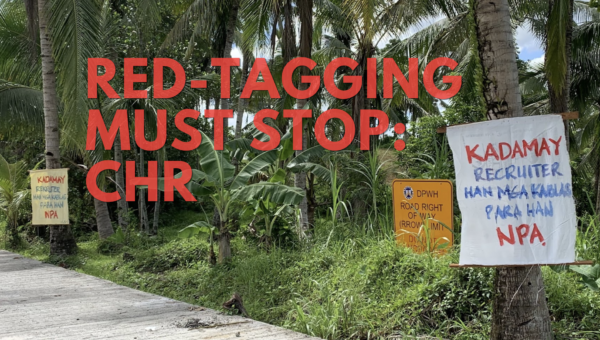
Red-Tagging and the Grey List
The wave of terrorism-financing prosecutions did not emerge in a vacuum and the Cernet case was not isolated.
After the Financial Action Task Force placed the Philippines on its financial grey list in 2021 for deficiencies in its anti-money laundering and terrorism financing regime, the government mounted an aggressive campaign to demonstrate compliance. Terrorism financing complaints surged by 371 percent in 2024 alone, according to the National Union of Peoples’ Lawyers. A confidential police memorandum obtained by the Philippine Center for Investigative Journalism named the operation directly: “Project Exit the Greylist.” The Philippines was removed from the FATF list in February 2025.
Human Rights Watch documented a pattern in which Philippine authorities filed terrorism financing charges against civil society groups and activists, apparently to secure removal from the “grey list” of the Financial Action Task Force, a global anti-money laundering watchdog. Courts dismissed many of those charges for lack of probable cause, while the prosecutions themselves disrupted the operations of legitimate organizations. Cernet was forced to suspend programs after a bank freeze severed support for more than 200 partner groups in the central Philippines.
READ: UN Experts Urged to Call Out Anti-Terrorism Frameworks by UN, FATF that Enabled Targetting of Journalist, Activists
The UN Special Rapporteur on Human Rights Defenders warned that the targeting of Cernet members appeared to be direct retaliation for their peaceful advocacy work and risked cutting off vital humanitarian services to marginalized communities. Cernet was far from alone: the Rural Missionaries of the Philippines, the Leyte Center for Development, and other NGOs faced similar accusations, with some having their bank accounts frozen by the Anti-Money Laundering Council mid-operation.
Civil society groups have urged UN special rapporteurs to examine whether FATF and broader UN counterterrorism frameworks share responsibility for enabling the crackdown, having created compliance incentives that governments like the Philippines exploited to prosecute dissent under the cover of financial regulation. Human Rights Watch warned in February 2025 that the Philippines was using FATF requirements as a pretext while its courts quietly dismantled case after case for lack of evidence
Accountability Now on the Table
With the dismissal secured, the accused say they are preparing to file criminal, civil, and administrative complaints against those who brought the case against them.
“Those who orchestrated, enabled, and perpetuated these baseless accusations must be held accountable under the law,” said Dr. Oliver Gimenez, one of the accused and currently Cernet’s board chair. Gimenez, the only doctor in his municipality, said court delays had kept him away from patients throughout the proceedings.
Nancy Estolloso, another of the accused, said accountability must extend to public officials — not only ordinary citizens. Estrella Flores Catarata, a third respondent, said the victory belonged not only to the Cernet 27 but to all those defending human rights and development work amid what she called shrinking civic space.
The dismissal arrives as the Philippine Congress considers legislation that critics say would expand the state’s power to criminalize dissent. The terror grooming bill — Senate Bill 1366, filed by Senator Ronald dela Rosa in September 2025 — would penalize what it calls the “systematic manipulation” of vulnerable people toward extremism.
Lawyers and academics warn that the bill’s vague language would instead expose community organizers, teachers, and advocates to prosecution. Dela Rosa is currently evading an ICC arrest warrant for alleged crimes against humanity stemming from his role as national police chief during the Duterte drug war; his whereabouts remain unknown after he fled the Senate building last week. (Rights Report Philippines)