A new CIVICUS report documents a sweeping pattern of criminalization, torture, fabricated charges, and red-tagging against peaceful protesters, human rights defenders, journalists, and land rights activists across the Philippines.
THE Philippines’ already fragile civic space continued to narrow in the months between late 2025 and early 2026, according to a new report by the CIVICUS Monitor published this week. The country’s civic space rating remains ‘repressed’ — the second worst in the Monitor’s five-tier scale — and the latest findings document a relentless cycle of arbitrary detention, torture allegations, sedition charges, red-tagging, and censorship directed at those who speak out.
The report lands as the country grapples with a historic legal moment: on February 23, 2026, the International Criminal Court opened pretrial hearings against former President Rodrigo Duterte on three counts of crimes against humanity for the deadly anti-drug crackdowns he oversaw while in office. Meanwhile, a February 2026 Human Rights Watch report found that serious violations continued under President Ferdinand Marcos Jr., including extrajudicial killings and enforced disappearances, with security forces rarely held accountable.
Torture and Criminalization of Protesters
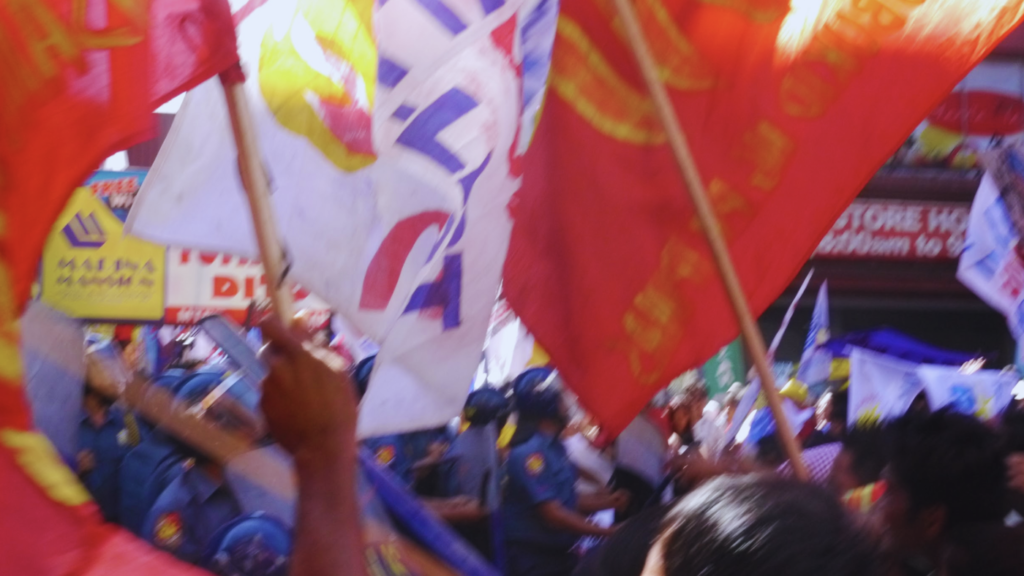
Some of the most alarming findings concern the government’s response to the massive anti-corruption marches of September 21, 2025. Tens of thousands rallied in Manila and across the country against graft in flood-control and infrastructure projects. Police arrested more than 200 people, including 91 children, and denied those detained access to lawyers and family members.
In November 2025, Amnesty International reported that 10 individuals it interviewed described being punched, kicked, and struck with batons — including children — as they were arrested. All described being brought to what was referred to as a “notorious blue tent” in Mendiola, an unmarked holding area apparently supervised by police, where beatings continued. Injuries were severe enough to require medical treatment. Manila police denied the allegations, maintaining they had observed “maximum tolerance.”
The legal fallout proved equally severe. By November 2025, the Department of Justice had filed charges against 97 protesters, including sedition, incitement to sedition, and violations of the Anti-Cybercrime Prevention Act. Among them was Bagong Alyansang Makabayan (Bayan) president Renato Reyes Jr., who called the charges “entirely manufactured.” At least four student leaders also received subpoenas, including a PUP student council president and a UP Diliman student council chairperson.
EDSA Anniversary Arrests and Continuing Harassment
The pattern of criminalizing peaceful assembly continued into 2026. On February 25 — during a march marking the 40th anniversary of the People Power Revolution — the Philippine National Police arrested development worker Edel Parducho and youth human rights defender Three Odeña near the EDSA Shrine in Mandaluyong. The Philippine Alliance of Human Rights Advocates (PAHRA) said the charges — including direct assault and physical injury — were contradicted by video evidence and eyewitness accounts. Parducho was serving as a protest marshal; Odeña was photographing events when she was pulled by her hair and detained. Both were released on bail on 28 February.
In January 2026, seven anti-mining protesters were arrested in Dupax del Norte, Nueva Vizcaya — including two elderly women — after forming a human barricade to block a mining company’s vehicles. The provincial prosecutor later dismissed all charges as baseless. In February, 21 farmers and residents in Cabuyao, Laguna were detained after security guards linked to a real estate developer forcibly dismantled a protest camp. They too were released after a prosecutor dismissed the charges.
Journalist Convicted; Red-Tagging Persists
The gravest blow to press freedom came with the conviction of journalist Frenchie Mae Cumpio, executive director of the Eastern Vista news website, who was found guilty of terrorism financing in January 2026 and sentenced to at least 12 years in prison — after nearly six years in pretrial detention. Her former roommate, human rights activist Marielle Domequil, was convicted alongside her. UN human rights experts called the conviction “deeply troubling,” saying the charges had been widely criticised as baseless retaliation for their human rights work. A bail petition was denied in February 2026.
In contrast, writer and peasant organizer Amanda Echanis was acquitted in January 2026 of illegal possession of firearms after more than five years in detention — one of the few bright spots in an otherwise grim period for civil liberties. Courts found the prosecution had failed to establish the essential elements of the case.
Red-tagging — the practice of publicly branding individuals as communist sympathizers to put them at risk of arrest or worse — continued unabated. In December 2025, retired military officer Antonio Parlade Jr. publicly red-tagged environmental lawyer Antonio La Viña for representing former party-list lawmakers. The Union of People’s Lawyers in Mindanao condemned the action as a direct assault on the right to counsel. In the Bicol region, posters appeared at schools and universities implicating labor and community leaders in a military encounter with the NPA, a textbook example of guilt by association, according to the labor group Center for Trade Union and Human Rights.
Counter-terrorism financing laws were also wielded as tools of repression. In late December 2025, two activists — a Bohol barangay councillor and a Baguio labor organizer and musician — were arrested on terrorism financing charges that human rights groups dismissed as fabricated. Both were eventually released on bail, but their arrests signalled what groups called an emerging trend of using counter-terrorism laws against activists.
A Court Win and a Warning
One notable legal victory came in November 2025, when a Quezon City court voided a National Telecommunications Commission order that had blocked 27 news websites, including the independent news outlet Bulatlat. The court ruled that the blocking constituted unconstitutional prior restraint — a significant precedent for press freedom in the country.
The CIVICUS Monitor’s findings depict a system under considerable strain. This system is characterized by a government that employs sedition laws, terrorism financing legislation, red-tagging, and direct physical violence to stifle opposition, with judicial bodies offering only sporadic resistance. As the ICC proceedings against Duterte move forward — a case built on the premise that accountability must come from somewhere — advocates are watching whether the Marcos administration will live up to its stated commitments on human rights, or deepen the repression that has come to define civic life in the Philippines. (Rights Report Philippines)