IN CONTEXT: The Campus Journalism Act of 1991 was meant to uphold freedom of the press and to protect student journalists. Three decades later, it keeps getting used against them. And a bill seeking to replace it is languishing in Congress.
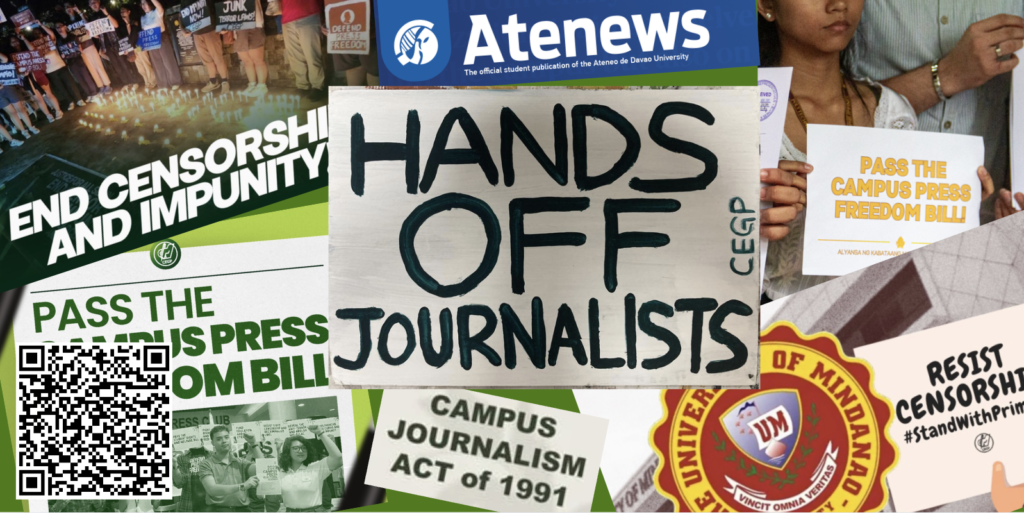
WHEN the entire editorial board of Primum, the student publication of the University of Mindanao in Davao City, resigned en masse in early March, it was both a dramatic act of protest and a sadly familiar story.
The trouble had been building for weeks. In February, Primum published an article about Sen. Robin Padilla’s remarks calling today’s youth weak. Then, on Feb. 20, a writer using the pseudonym Silakbo posted “Alegorya ng Mananakbo” — Allegory of a Runner — a political allegory written from the point of view of Vice President Sara Duterte. It imagined her outrunning even the late Asian “sprint queen” Lydia de Vega while fleeing the problems and allegations trailing her. That same day, hours after it went up, two school officials called the editors in and ordered them to take the piece down for being “too political.”
From that point, the pressure mounted. Screenshots circulating online showed an alleged exchange between university officials directing the student staff to “be apolitical,” with warnings that scholarships could be revoked and the publication shuttered if they did not comply. On March 6, the editors and staff of Primum resigned. The Facebook page was deactivated, then reopened days later with an announcement seeking a new staff; its comment section was turned off.
The University of Mindanao has not issued a formal statement.
This was not an isolated incident. It was the latest in a long pattern, one that the Campus Journalism Act of 1991 – the very law supposed to prevent it – has proven powerless to stop.
Three Decades of Broken Promises
Republic Act 7079 was signed on July 5, 1991, by President Corazon Aquino, who understood firsthand what a captive press looked like. Campus journalists had been among the most fearless voices during the Marcos dictatorship. The law was a tribute to that courage, a declaration that student publications deserved the same press freedom protections as the mainstream press.
In practice, it handed school administrators a roadmap to do the opposite.
Consider what happened at the University of Santo Tomas in February 2024. The University’s Office of Student Affairs ordered TomasinoWeb, the school’s digital media organization, to delete a photo of students in uniform entering a convenience store, on the grounds that it caused “public ridicule.” The publication’s adviser, journalist Leo Laparan II, resigned in protest, calling the order a blatant act of censorship. Once Laparan stepped down, UST’s Office of Student Affairs placed the publication’s social media operations on hold, citing its rule that an organization cannot operate without an adviser.
That episode exposed one of the law’s most dangerous structural flaws: the undefined “technical guidance” role assigned to faculty advisers. The CJA limits advisers to providing “technical guidance” — but never defines what that means. Critics say this has led some administrators and faculty advisers to define the term based on their own “understanding or misunderstanding of the journalism profession,” compromising editorial independence in the process. An overreaching adviser — or a university willing to use one as a proxy — can kill or alter stories, and the law, as written, does not stop them.
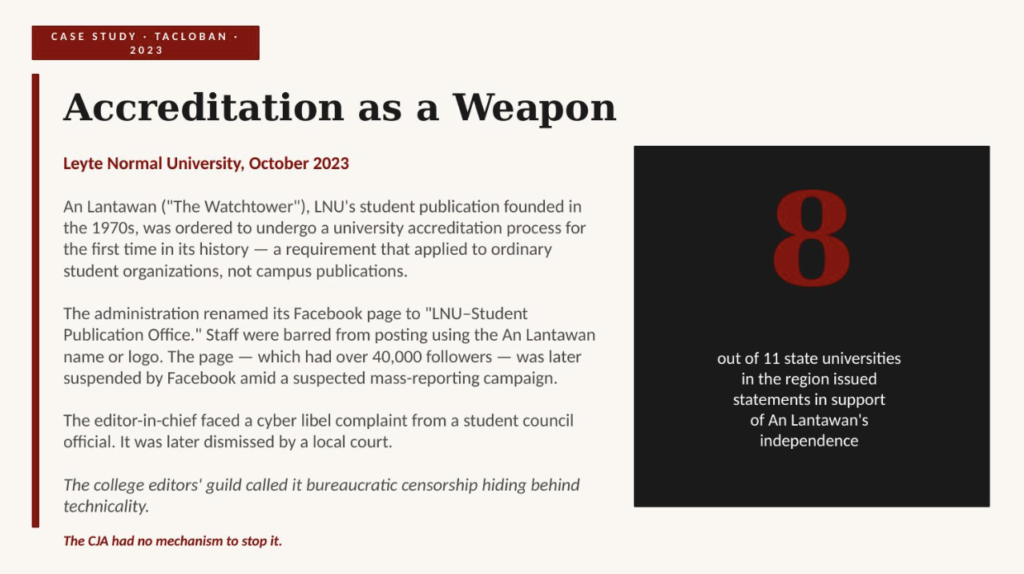
A year earlier, in late 2023, the student publication An Lantawan of Leyte Normal University was subjected to what the College Editors Guild of the Philippines described as “repressive” university policies that effectively paralyzed its operations — another case where the CJA offered no meaningful protection.
Press Freedom Under Fire in Davao
The Primum case was not the only one putting Davao campus journalism under a spotlight. Not far away, the Atenews of Ateneo de Davao University faced a different kind of attack, one that came not from its own administration, but from outside the campus walls.
Following the arrest of former President Rodrigo Duterte by the International Criminal Court in March 2025, Atenews published a joint statement of the Ateneo Publications Alliance calling for justice and a sober reckoning with the Duterte legacy. What followed was a flood of hate comments and “red-tagging” – the practice of accusing critics of being communists – some of it from the university’s own alumni community. The attacks were traced to pro-Duterte blogger Tio Moreno, whose real name is Alex Destor, who published a now-deleted post claiming the Atenews statement did not reflect the broader Ateneo community’s position. Destor went further, doxxing the publication’s staff by posting the names of its editors.
The Atenews editor-in-chief told Rappler the only measure she could think of as a response to the harassment was to instruct her staff to lock their Facebook profiles. Unlike Primum, however, the Atenews was not alone. The university president and the student council condemned the online attacks and called on their community to approach the ICC issue with restraint — a reminder that institutional support, when it exists, makes a critical difference.
The College Editors Guild of the Philippines‘ Davao chapter said the two incidents reflect what student journalists in the region face constantly: “censorship, administrative pressure, and restrictions that undermine their ability to report freely within their own institutions.” As the UM Debate Society put it in a statement after the Primum resignations: “A censored press weakens scrutiny, shields institutions from accountability, and denies the public access to information necessary for informed judgment.”
The Law’s Structural Failures
The problems with the CJA are not cosmetic. They are baked into its text.
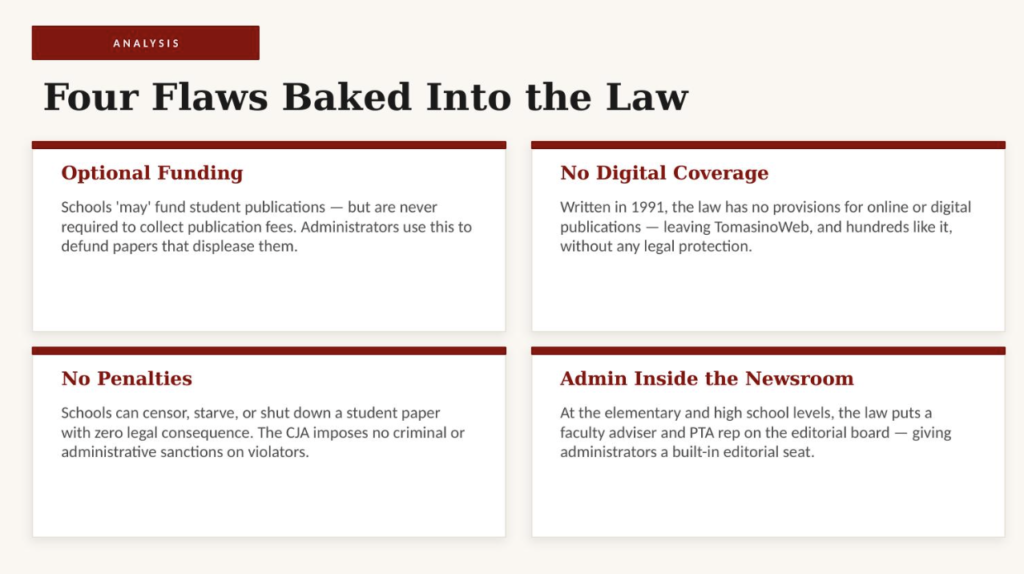
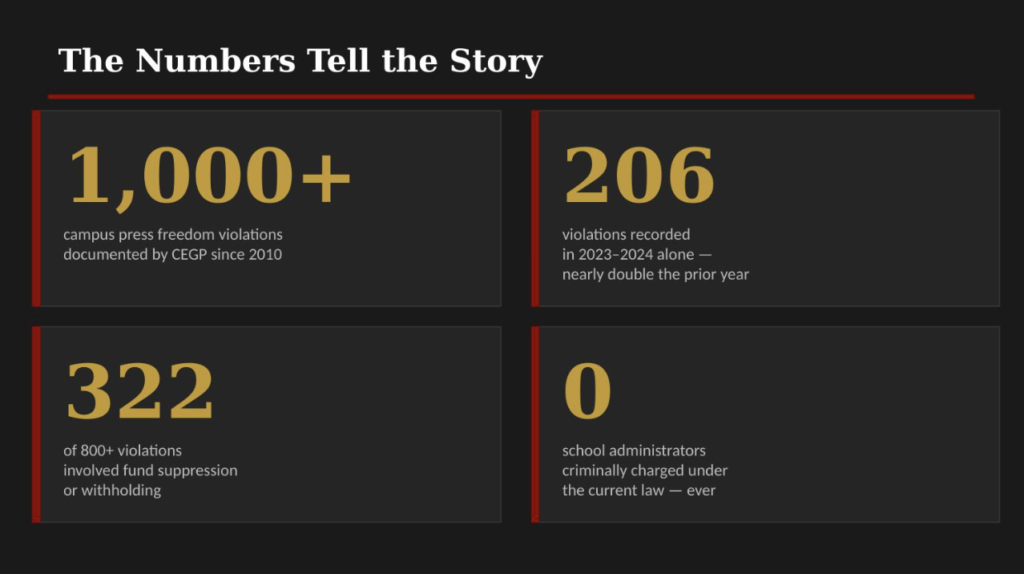
The most consequential flaw is funding. The law says student publications “may” receive money from school savings, subscriptions, and other sources, but it does not require schools to collect publication fees. Critics say this gives administrators a power of the purse over campus journalists, allowing them to withhold funds as a means of silencing critical reporting, in the same way Congress uses budgets to pressure agencies. CEGP has recorded more than 800 campus press freedom violations since 2010; 322 of them involved inconsistencies and suppression of funds.
The law also has no penalty provisions. A school can censor, shut down, or starve a student paper of resources, and the CJA offers no mechanism to punish the offenders. It does not require all tertiary institutions to have a school paper. It does not require closed publications to be reinstated. And it provides no penal sanctions against administrations that repeatedly violate campus press freedom.
Then there is the digital gap. The law was written in 1991, well before the internet. It never anticipated digital media, leaving online campus publications without clear legal protection — a gap the UST case made impossible to ignore. And as the Atenews experience shows, the threat to digital publications now comes not just from school officials, but from coordinated online harassment campaigns the CJA has no tools to address.
At the high school level, the structural problem is even starker. At the elementary and secondary levels, the editorial board is composed of a faculty adviser, the qualified student editor, and a PTA representative — and together they determine editorial policies. That means administrators have a built-in seat at the editorial table in basic education, where student journalists are youngest and most vulnerable. With the CJA’s implementing rules and regulations allowing moderators to determine editorial policies and making them responsible for a publication’s contents, publication advisers tend to go well beyond their mandate of providing technical assistance.
From 2023 to 2024, the CEGP recorded 206 campus press freedom violations nationwide, nearly double the 100 cases tallied the year before.
The Bill That Keeps Dying
The proposed replacement for the Campus Journalism Act has a history almost as dispiriting as the law it’s trying to fix.
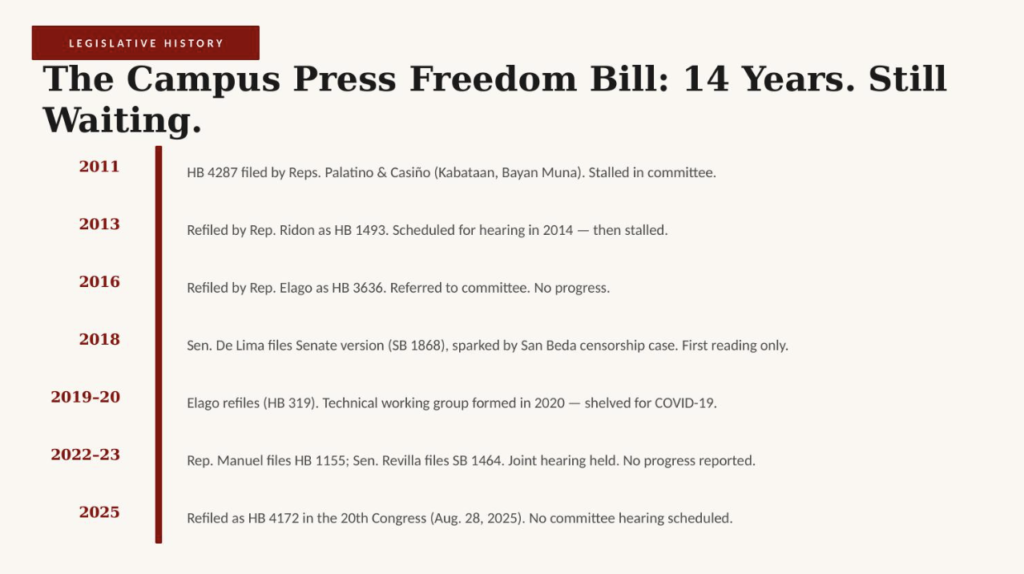
The first version, House Bill 4287, was filed Feb. 28, 2011, by then-Kabataan Party-list Rep. Raymond Palatino and Bayan Muna Rep. Teodoro Casiño. Their explanatory note was blunt: while the CJA had strong provisions on paper, it was “insufficient and lacking in material aspects to fully maintain the existence of the campus press.” It cited the non-mandatory collection of publication fees, the absence of penalty clauses for violators, and broad loopholes that left student papers at the mercy of their school administrations.
That bill went to committee and died there. So did a refiled version in 2013 under then-Rep. Terry Ridon, and another in 2016 under then-Rep. Sarah Elago. A Senate version filed by then-Sen. Leila de Lima in 2018 — inspired partly by San Beda University’s decision to ban the distribution of 1,700 copies of its senior high school student paper over content it deemed too critical — made it only to a first reading.
Elago filed yet again in 2019; a technical working group was formed in 2020, then shelved when Congress redirected its attention to COVID-19 legislation. In 2022, Rep. Raoul Manuel filed the House version as HB 1155 while Sen. Ramon “Bong” Revilla filed a Senate counterpart. A joint committee hearing was held in early 2023 but no progress followed.
The bill was refiled on Aug. 28, 2025 — two days before National Campus Press Freedom Day — this time as House Bill 4172, again carried by the Kabataan Party-list and supported by the ACT Teachers Party-list under the Makabayan bloc. It now sits in the 20th Congress, where it faces the same uncertain fate as all its predecessors. As of this writing, no committee hearing has been scheduled.
What the bill would do, if passed, is significant. It would require all educational institutions to establish a student publication, mandate the collection of subscription fees during enrollment, and allow campus publications to assert genuine editorial independence.
It would also impose penalties for campus press freedom violations — a fine of up to P200,000 and imprisonment of one to five years upon conviction. Critically, it would define “technical guidance” clearly enough to prevent administrators from using the term as cover for editorial interference, and it would extend legal protection explicitly to online and digital publications.
The bill has no organized opposition on the record — no bloc of lawmakers has argued publicly against it. But its repeated failure to advance through 14 years and multiple xongresses tells its own story. Inertia, competing legislative priorities, and the political cost of taking on school administrations — many of them deeply embedded in local communities and politics — have been enough to keep it bottled up.
There are also real tensions within the bill’s various versions that have slowed consensus. The Senate version includes a provision allowing school authorities to block materials they consider libelous, oppressive, or contrary to ethical journalism standards. Student press freedom advocates have pushed back hard against this, arguing it simply recreates the censorship loophole they are trying to close — this time written directly into the replacement law. If administrators retain the discretion to decide what qualifies as “oppressive” content, critics say, the bill will not be meaningfully better than what it replaces.
The CEGP, which has been calling for the repeal of the Campus Journalism Act since 1996, put it plainly in a position paper: the CJA “is usually used against campus journalists instead of protecting their rights.” The guild has documented more than 1,000 campus press freedom violations since 2010. Not a single school administrator has faced criminal charges under the current law — because the current law imposes none.
Why Campus Journalism Matters
The stakes go well beyond student newspapers. The Philippines has one of the most dangerous and politically pressured media environments in Asia. Mainstream news organizations face red-tagging, defamation suits, and ownership pressures. In this landscape, campus publications often fill gaps that commercial media cannot or will not — covering local governance, military operations, land rights conflicts, and the day-to-day abuses that never make it to national broadcasts.
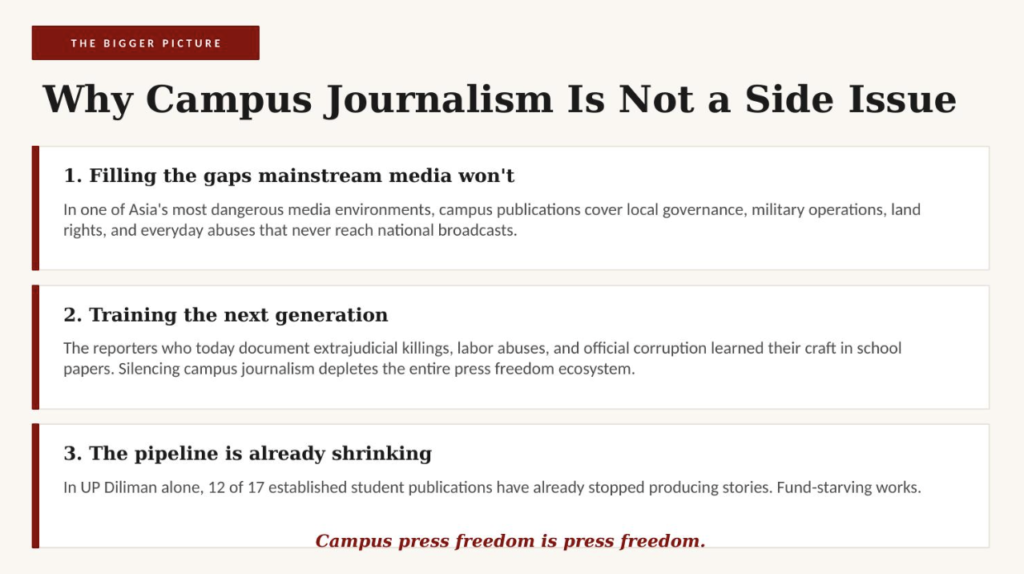
Campus journalism is also where the next generation of journalists is trained. The reporters who document extrajudicial killings, labor abuses, and official corruption today learned their craft in school papers. Letting administrators silence those papers does not just harm student journalists — it depletes the entire press freedom ecosystem.
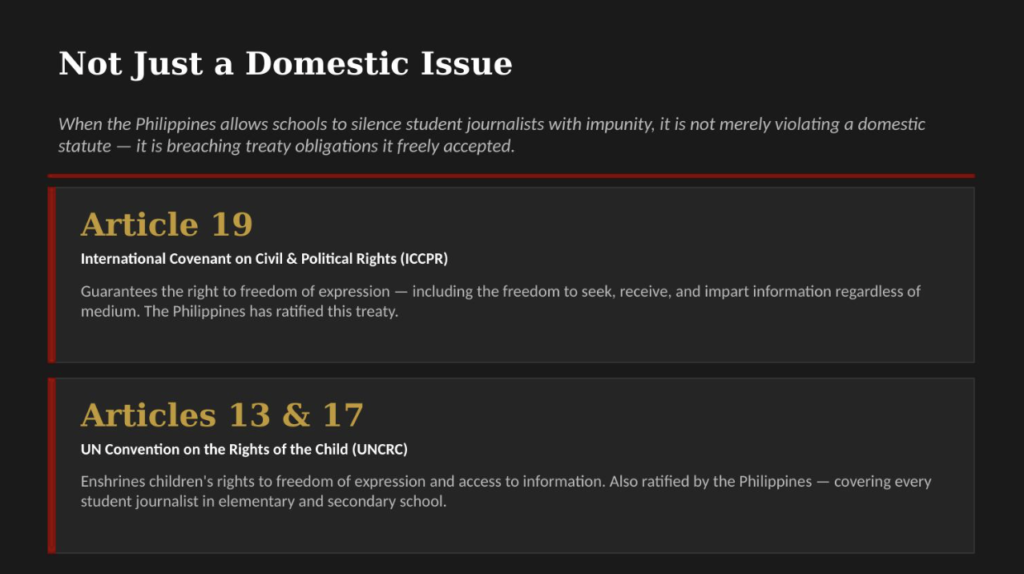
Beyond the local picture, the Philippines has international legal obligations it ignores every time it allows a student publication to be shuttered without consequence. Article 19 of the International Covenant on Civil and Political Rights, which the Philippines has ratified, guarantees the right to freedom of expression — including the freedom to seek, receive, and impart information. The U.N. Convention on the Rights of the Child, also ratified by the Philippines, enshrines children’s rights to freedom of expression and access to information under Articles 13 and 17. When school administrators threaten student journalists with scholarship revocation, order content taken down, or padlock a publication’s office, they are not just violating a domestic statute — they are breaching treaty obligations the Philippine government freely accepted.
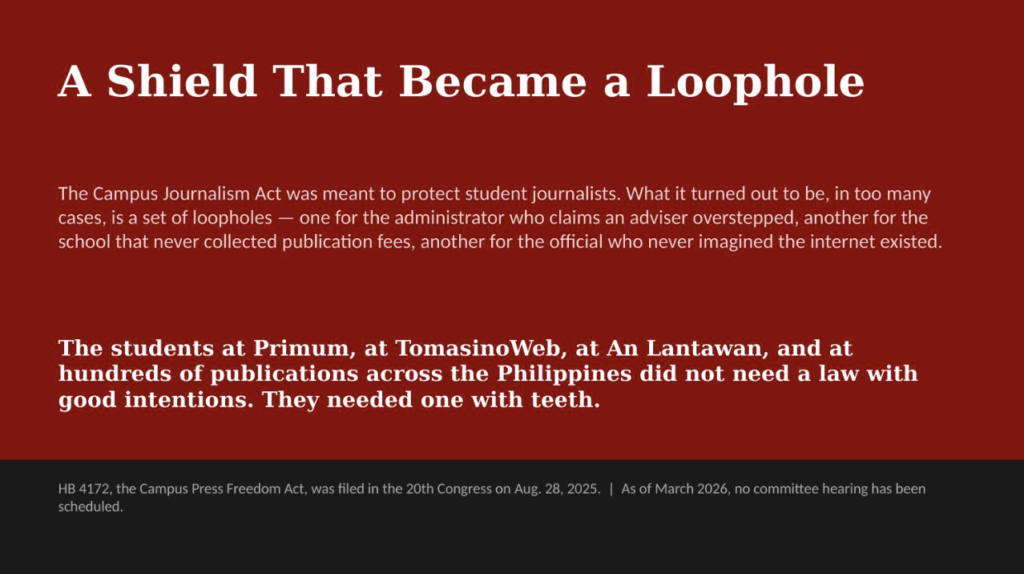
The Campus Journalism Act was meant to be a shield. What it turned out to be, in too many cases, is a set of loopholes — one for the administrator who claims an adviser overstepped, another for the school that never bothered to collect publication fees, another for the official who never imagined the internet existed. The students at Primum, at TomasinoWeb, at An Lantawan, at Atenews, and at hundreds of other publications across the country did not need a law with good intentions. They needed one with teeth.
The students who walked away from Primum — and the hundreds before them who faced censorship, fund withholding, red-tagging, and threats — have been waiting for Congress to act for the better part of two decades. They are still waiting. (Rights Report Philippines with a report from Tyrone Velez)
If you have experienced censorship as a campus journalist, let us know about it.