A police post, a deleted Facebook page, and the machinery that keeps running anyway.
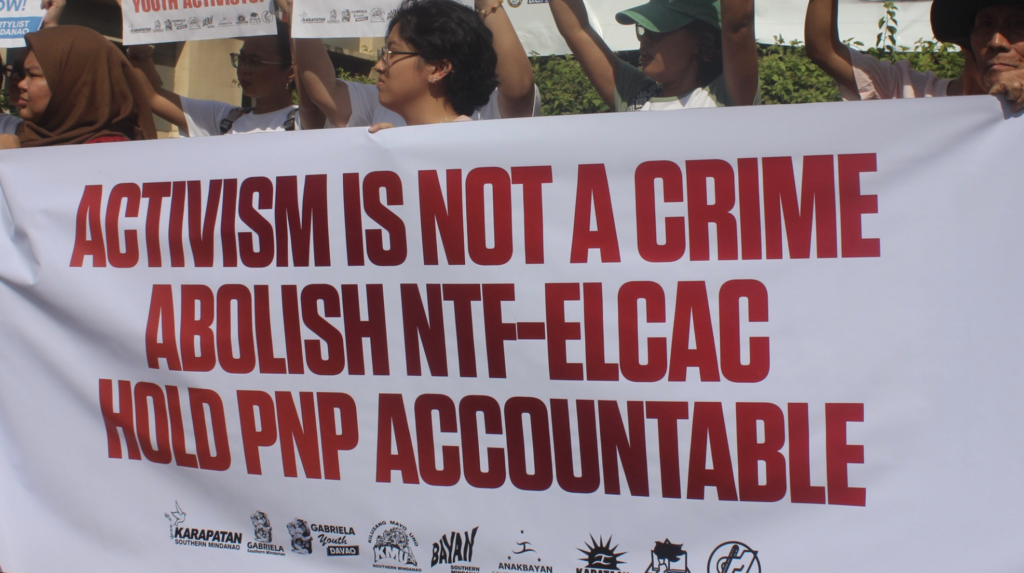
CONSIDER what it means when 14 activists in Davao City are branded “active wanted persons” by a police station 200 kilometers away, in a post the Philippine National Police later deleted from Facebook.
The station is in Cateel, Davao Oriental, a three-hour drive across from Davao City, which is in another province — a distance that raises an obvious question: why is a remote precinct compiling lists of urban activists it has no jurisdiction over?
The 14 people on that list include local members of Bayan, Karapatan, Gabriela (including a party-list nominee), Kabataan Party-list, and four UP Mindanao student leaders. None of them had any connection to Cateel.
The station commander, Major Michael Celecio, issued an apology afterward, explaining that there was an error that “inconvenienced” the 14 individuals and assured the public there were no standing warrants against them.
That word “inconvenienced” does not match with what actually happened. One of the youth leaders tagged in that post described how the post “opened the floodgates for troll attacks, misinformation campaigns, harassment, and ridicule” on him and even on his friends and family.
His group, Kabataan Party-list, was direct about it: “…collating information — accurate or not — and creating publicity material and posting it online is not a clerical error,” the group said.
The Cateel post is gone now, scrubbed from Facebook after it drew attention. But the machinery it represents — the labeling of organizers, advocates, and student leaders as threats to public order, without warrant or evidence, through whatever platform is available — has been running for years in the Philippines, largely without consequence.
This is disinformation and vilification — state-sponsored, at that. The effects are indistinguishable from red-tagging: it brands rights defenders as “enemies” without proof, causing fear among the individuals and their families.
“These individuals have not committed any crime, yet they are being branded as criminals — a grave violation of their right to due process,” said Karapatan Secretary General Cristina Palabay.
Karapatan has documented a pattern where activists were red-tagged and later arrested, such as the case of the “warrant factory” judge in Agusan del Sur who released 76 arrest warrants over eight years targeting activists as far away as Manila. Fifty-seven of those cases were dropped or resulted in acquittals, as courts found the warrants to be faulty.
This pattern is not accidental. It creates a climate of fear that outlasts any single court ruling, and the activists in Davao know it firsthand.
In 2020, a series of “wanted” posters with no signatories appeared all over Davao in the middle of the pandemic, vilifying about a dozen activists and Lumad advocates as NPA recruiters and “berdugo” — murderers — at the time the Anti-Terrorism Act was signed into law.
At least two people on those 2020 lists later faced state-orchestrated legal attacks. Jay Apiag, the former Davao secretary general of Karapatan, was arrested in 2024 while in hiding in Digos, and faces six cases of attempted murder and illegal possession across three areas: Davao, Digos, and Bukidnon.
Labor leader Paul John Dizon was visited at his home by NTF-ELCAC agents in 2023, who told him to “surrender” to clear his name — standard NTF-ELCAC procedure, and no less coercive for being routine. Dizon withdrew from organizing work after that incident.
Also included in that 2020 wanted poster was UCCP Bishop Hamuel Tequis, who opened his church as sanctuary for Lumad students and families in Talaingod.
ACT union secretary Pilar Barredo was also included. In a later interview, she traced her inclusion to then-Mayor Sara Duterte’s anger at ACT for campaigning for a local allowance subsidy from the Davao City government. Barredo said the red-tagging contributed to her husband’s death: he died in 2021 of cardiac arrest, brought on by much anxiety.
One name appears on both the 2020 posters and this year’s Cateel list. Dr. Jean Lindo is Gabriela Party-list’s third nominee in the 2022 and 2025 elections. She has been vocal on gender and environmental issues in Davao and was at the forefront of calling out Rodrigo Duterte’s misogyny.
The environment group Kalikasan People’s Network for the Environment has drawn a direct line between this vilification and Mindanao’s resource conflicts. They documented development aggression incidents in Mindanao from 2017 to 2022 affecting four million people — Lumad, farmers, settlers — the same communities championed by Gabriela and Kabataan, who raised these concerns in Congress and in the streets.
Facebook’s role in all of this deserves more scrutiny than it typically receives. Amnesty International found that NTF-ELCAC’s vilification operations — amplified on the platform — instill fear especially among youth activists. The Human Rights Foundation noted that the NTF-ELCAC page has 290,000 followers, “reaching a good portion of the population with regularly published red-tagging posts.”
Activists repeatedly reported offending posts and accounts to Facebook. Most reports went nowhere.
“Inadequate content moderation and ad approval mechanisms, and a failure to track the effectiveness of its risk mitigation measures, have turned Facebook into an enabling environment that contributes to serious human rights violations,” said Wilnor Papa, Head of Activism and Mobilization at Amnesty International Philippines.
The Davao activists are not without recourse. Lawyer Antonio La Viña, lead convener of Movement Against Disinformation, said they can file administrative charges before the National Police Commission against Celecio and other Cateel PNP officials for conduct unbecoming and grave abuse of authority.
“They must be investigated under Republic Act 9745 (Anti-Torture Act) and the Anti-Terror Law’s own provisions against abuse — because the deliberate use of state platforms to terrorize civilians is itself a form of terror,” La Viña added.
A civil case is also possible, modeled on the one filed by GMA News reporter Atom Araullo against former NTF-ELCAC spokespersons who repeatedly red-tagged him.
This is happening openly, despite a Supreme Court ruling that red-tagging endangers the lives and liberties of rights defenders, and a Commission on Human Rights report calling on state agents to stop the practice.
The CHR has recommended passing a law to penalize red-tagging, and a review of the Anti-Terrorism Act and the Terrorism Financing Prevention and Suppression Act of 2012, both of which have been used to suppress civil rights.
Congress has the tools and the mandate to act. The question is whether it will use them before the next “wanted” poster appears in some other far-flung precinct — Barobo, perhaps, or somewhere no one is watching. (Rights Report Philippines)
Natan Lim once worked with the NGO community and is currently a communications consultant.