
Water cannon incident is just the latest in a string of abuses in Laguna Technopark ecozone. Advocates are urging the European Union to enforce GSP+ human rights-tariff scheme, saying this and previous violations fall within its purview.
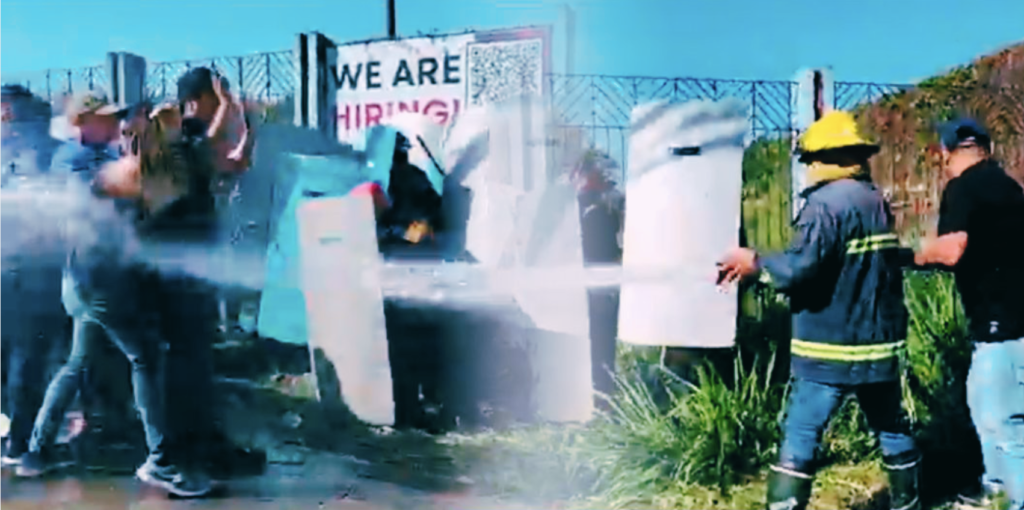
SECURITY forces armed with water cannons and wooden batons moved against workers outside a factory owned by billionaire Lucio Tan in Laguna last week, drawing swift condemnation from a labor rights group while renewing focus on the Philippines’ special economic zones and why these have become safe havens for companies that want to avoid accountability.
The Center for Trade Union and Human Rights (CTUHR) condemned Package World Inc. – a packaging manufacturer based in the Laguna Technopark Special Economic Zone in Cabuyao, Laguna, and an affiliate of Asia Brewery — after the company called on the zone’s private security forces to disperse workers from the Package World Inc. Workers Independent Union (PWIWIU). A Facebook post on March 23 by a union member shows security personnel using water cannons against the crowd.
The workers were not rioting. They were protesting a deadlock in collective bargaining agreement (CBA) negotiations that union members say has dragged on since early February. The union is asking for a PHP 50 wage increase per year over three years. Management’s counteroffer was PHP 23.
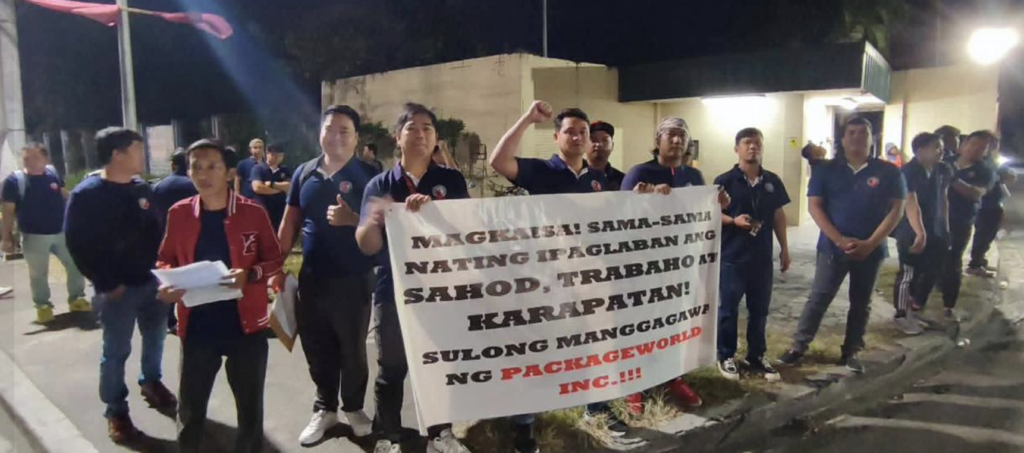
“This incident is a clear violation of workers’ right to hold peaceful protests to air their concrete grievances and legitimate demands,” said Kamz Deligente, CTUHR’s executive director. “It should be investigated and those responsible — from the Package World management to the Laguna Technopark administration — should be held accountable.”
The Zone Problem
What happened at Package World Inc. is not a one-off.
Workers and labor advocates have long reported that an informal “no union, no strike” policy is effectively enforced in many of these special economic zones to maintain “investor-friendly environments,” often leading to harassment, dismissals, and police intervention against labor actions.
The legal framework underpinning this is Republic Act 7916, or the Special Economic Zone Act of 1995, which created the Philippine Economic Zone Authority (PEZA). On paper, it guarantees workers in these zones, also called ecozones, the same rights as everyone else. Employees in PEZA-registered enterprises are entitled to salaries and benefits no less than those provided under the Philippine Labor Code.
But on the ground, advocates say the zones routinely operate by their own rules. Ramon Certeza, an organizer at IndustriAll Global Union, has said conditions in zones like the Cavite Free Trade Zone, in the adjacent Cavite province, involve very bad working conditions and “many, many violations of labor standards of Philippine labor law.” Workers there, he noted, are often young, from rural provinces, and unfamiliar with their rights, making them especially vulnerable.
Academic research on labor disputes in these ecozones has documented how, as one zone administrator told a researcher two decades ago, these officials function as an investors’ “one-stop shop” for government transactions, including the informal mediation — or suppression, according to CTUHR and other groups — of labor disputes, operating under an understanding with DOLE that inspectors “can’t come in here without going through us first.”
The result is a parallel governance structure that places capital interests ahead of worker protections, often before a complaint ever reaches a formal channel.
The disconnect between law and practice is not a secret to the government. The DOLE itself has flagged this. In one stark example, DOLE found that a factory inside a Cavite ecozone had committed multiple violations of general labor standards and safety regulations — the opposite of what PEZA’s own investigation had concluded. That incident prompted the labor department to revoke a standing agreement that had given PEZA authority to conduct labor inspections inside the zones.
Laguna and Cavite, the industrial core of the CALABARZON region south of Manila, are where these tensions are most concentrated. Both provinces host some of the country’s largest export processing zones and both have a well-documented history of labor disputes, violent dispersals, and anti-union harassment.
The situation got so bad that workers from over 40 factories in Laguna marched to Manila in 2019 to draw attention to labor conditions in these ecozones. Human Rights Watch documented union leaders in Laguna operating under near-constant threat, including one union president inside Laguna Technopark who said he regularly avoided going home for weeks out of fear for his safety.
Violence and Surveillance
The repression extends well beyond water cannons. For many union organizers, the danger is personal and sometimes fatal.
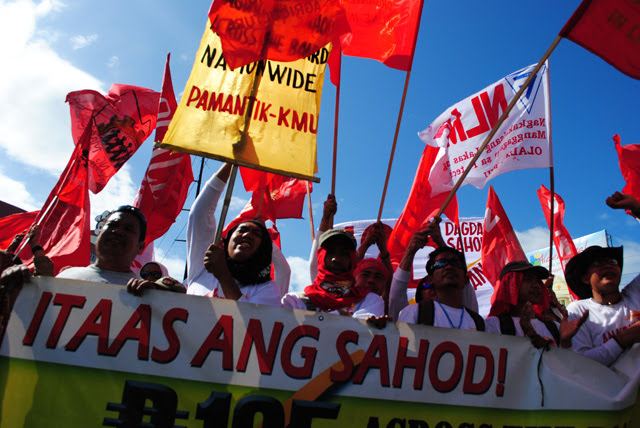
In a September 2024 report,HRW found local officials, police, and military repeatedly visiting the homes of union leaders in the Southern Tagalog region and pressuring their families to cut ties with labor federations — a practice that included “red-tagging” that labels unionists as communist insurgent sympathizers. The Supreme Court declared in May 2024 that red-tagging is a threat to people’s life, liberty, and security, yet the practice has continued.
In 2019, in a case dubbed “Bloody Sunday” by labor and rights groups, police raided a compound of trade unionists in Cavite and killed nine activists who had often been red-tagged before the raids. In September 2023, KMU organizer Jude Thaddeus Fernandez was shot dead by police in his home. The KMU reports 72 workers and unionists killed since 2016.
The ILO’s High-Level Tripartite Mission, which visited the Philippines in January 2023, concluded that there was “very little policy and/or legislative action” taken to address labor rights violations, including the killings of trade unionists.
The mission observed that a “mindset” had been created linking parts of the union movement to insurgency without due process, and that military and police continued to interfere in union activities and labor relations — contributing to a climate of impunity that undermined decent work. Trade unions submitted a total of 360 documented violations to the mission, including 16 extrajudicial killings of trade unionists, 68 cases of arrest and detention, and 58 cases of red-tagging.
At least four more killings of union activists occurred after the mission departed. The Commission on Human Rights said it had been tracking these patterns since 2020, noting that legitimate union activities had been “increasingly and dangerously clamped down.”
Toll on Workers at Foreign Companies
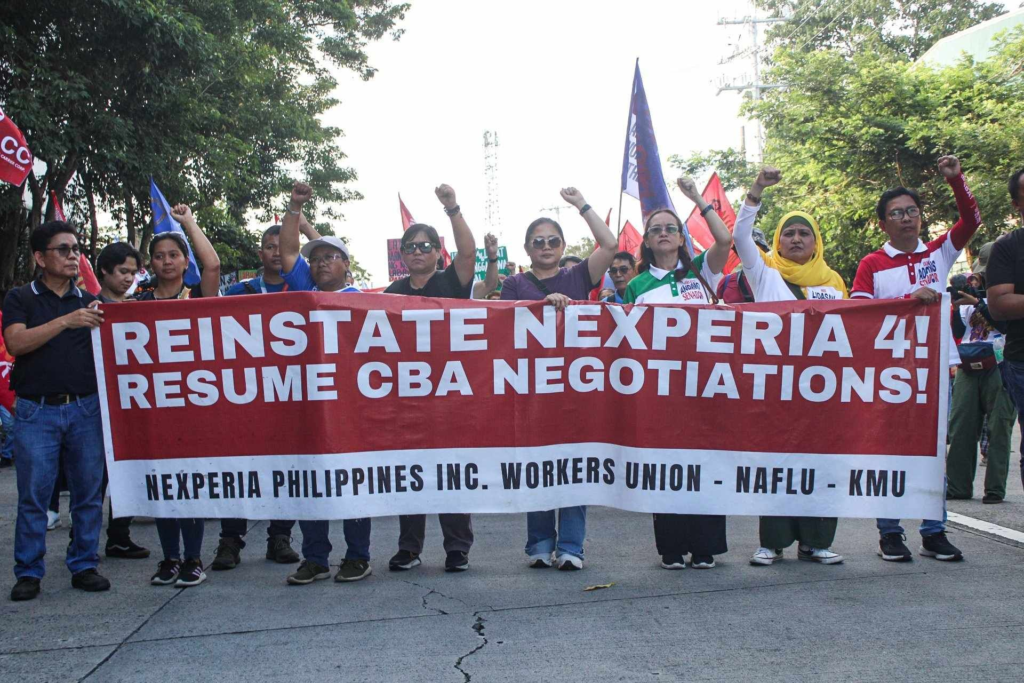
The cases at foreign-owned firms are particularly stark. At Nexperia Philippines — a Netherlands-headquartered semiconductor company now owned by Chinese conglomerate Wingtech Technology, with operations in Cabuyao — a union shop steward identified only by HRW as Maria A. described how a 2022 Facebook video falsely labeled her and a colleague, Allan Bagas, as New People’s Army recruiters. Bagas died by suicide in September 2022 after the repeated government harassment. Maria A. was dismissed in October 2023 after 25 years of service and has since gone into hiding. CTUHR described the Nexperia dispute as a “litmus test for the government in upholding labor and human rights.”
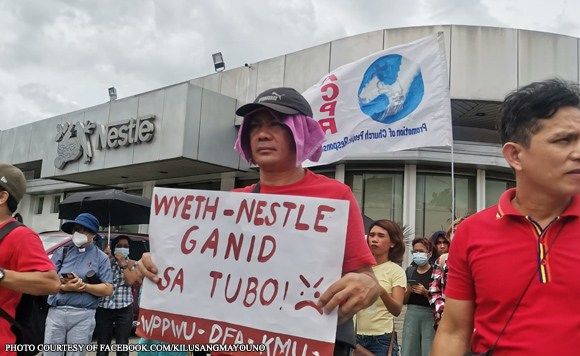
Swiss food giant Nestlé has faced similar scrutiny in the same region. In May 2023, workers at Wyeth Philippines — a Nestlé subsidiary — arrived at their factory in Laguna only to be barred from entering. Management then announced the dismissal of 140 workers, including 125 union members, 10 union officers, and five other employees, which the union described as a gross violation of their CBA and a “clear-cut case of union busting.” CTUHR condemned the move, warning that Nestlé’s wider retrenchment scheme could deepen the impact on workers in the Philippines, and backed the International Union of Food Workers (IUF) in calling on the company to put people over profits.
The pattern at Nestlé in the Philippines runs deep and bloody. In 1989, union president Meliton Roxas was shot dead in front of the picket line during simultaneous strikes at Nestlé plants across the country, with more than 100 workers laid off in the aftermath. His successor, Diosdado Fortuna, was extrajudicially killed in Cabuyao, Laguna, in 2005, while leading another workers’ strike, this time over the company’s refusal to include retirement benefits in the CBA, despite a Supreme Court ruling ordering it to do so. The killings were documented by theIUF, the Asian Human Rights Commission, and the Business and Human Rights Resource Centre, but none of the cases resulted in convictions.
Labor rights defenders say the pattern is unmistakable. In the economic zones, red-tagging and union-busting function as a pincer — the state supplies the threat of violence and the label of “communist,” while management supplies the pretext for dismissals. Together, they grind down organized labor without any single actor having to bear full responsibility. Amnesty International’s Philippines section has documented how contractualization compounds the problem, with precarious employment status stripping workers of adequate social security protections — a regression from hard-won labor rights earned over more than a century of struggle.
International Stakes
The incident carries implications beyond Laguna. The Philippines is the only Southeast Asian country with access to the EU’s Generalized Scheme of Preferences Plus (GSP+), which grants preferential tariff rates on nearly 7,000 product lines worth over €150 million in annual duty savings — conditioned on compliance with 27 international conventions, two of which directly govern the rights being violated here: ILO Convention No. 87 on Freedom of Association and Convention No. 98 on Collective Bargaining.
In March 2025, the EU deployed its fifth monitoring team to the Philippines to review compliance, with findings feeding directly into the next report to the European Parliament and Council. EU Ambassador Massimo Santoro has said publicly that human rights is a “fundamental element” for maintaining GSP+ eligibility, and that the European Commission and Council can open formal proceedings against countries where things go in the wrong direction. The EU Parliament passed a resolution calling for suspension of GSP+ if obligations go unmet but that got nowhere.
The stakes are higher still because the EU and Philippines are now actively negotiating a full free trade agreement, which reached a fifth round in Brussels in March 2026. If passed, the agreement will supplant the GSP+, which is set to expire in 2027. Labor groups including Trade Justice Pilipinas have urged the EU to pause talks until measurable improvements on workers’ rights are delivered, warning that the FTA’s labor enforcement mechanism only allows for consultations and cannot trigger trade sanctions — making it largely toothless in practice. HRW has specifically called on the EU to press Manila on red-tagging within the FTA framework as a condition of continued trade benefits.
What happened in Cabuyao — a company using an economic zone’s own security forces to break up a wage protest, in a region already well-documented for state-backed harassment of unionists — fits directly into that broader pattern of impunity. For now, CTUHR is calling on the government to investigate both Package World Inc. and the Laguna Technopark administration and to pursue long-overdue reforms. Until then, Deligente said, workers like those at PWIWIU are left with little more than the right to show up and hope nobody turns the hose on them again. (Rights Report Philippines)