A preliminary report by Workers’ Rights Watch paints a grim picture of the state of labor rights in the Philippines. Accountability is practically zero while much-vaunted mechanisms to stop or mitigate the violations, like the EU’s GSP+, have proven ineffective.
NINE years. At least 105 trade union members killed. Zero convictions.
That was the grim headline from a preliminary report on the state of workers’ rights in the Philippines, presented by the Federation of Free Workers (FFW) and the Danish Trade Union Development Agency (DTDA) on March 26 in Iloilo City.
The 2025 State of Freedom of Association in the Philippines Report, produced by the Workers’ Rights Watch (WRW), painted a sobering picture: workers organizing for better pay and safer conditions are still being killed, harassed, and thrown in jail — and the people responsible are rarely, if ever, held accountable.
“Rights on paper are good. Justice in practice is better. Workers need both,” said Jose Sonny Matula, national president of the FFW.
The numbers in this year’s report tell a story of a monitoring system working harder than the justice system it’s watching.
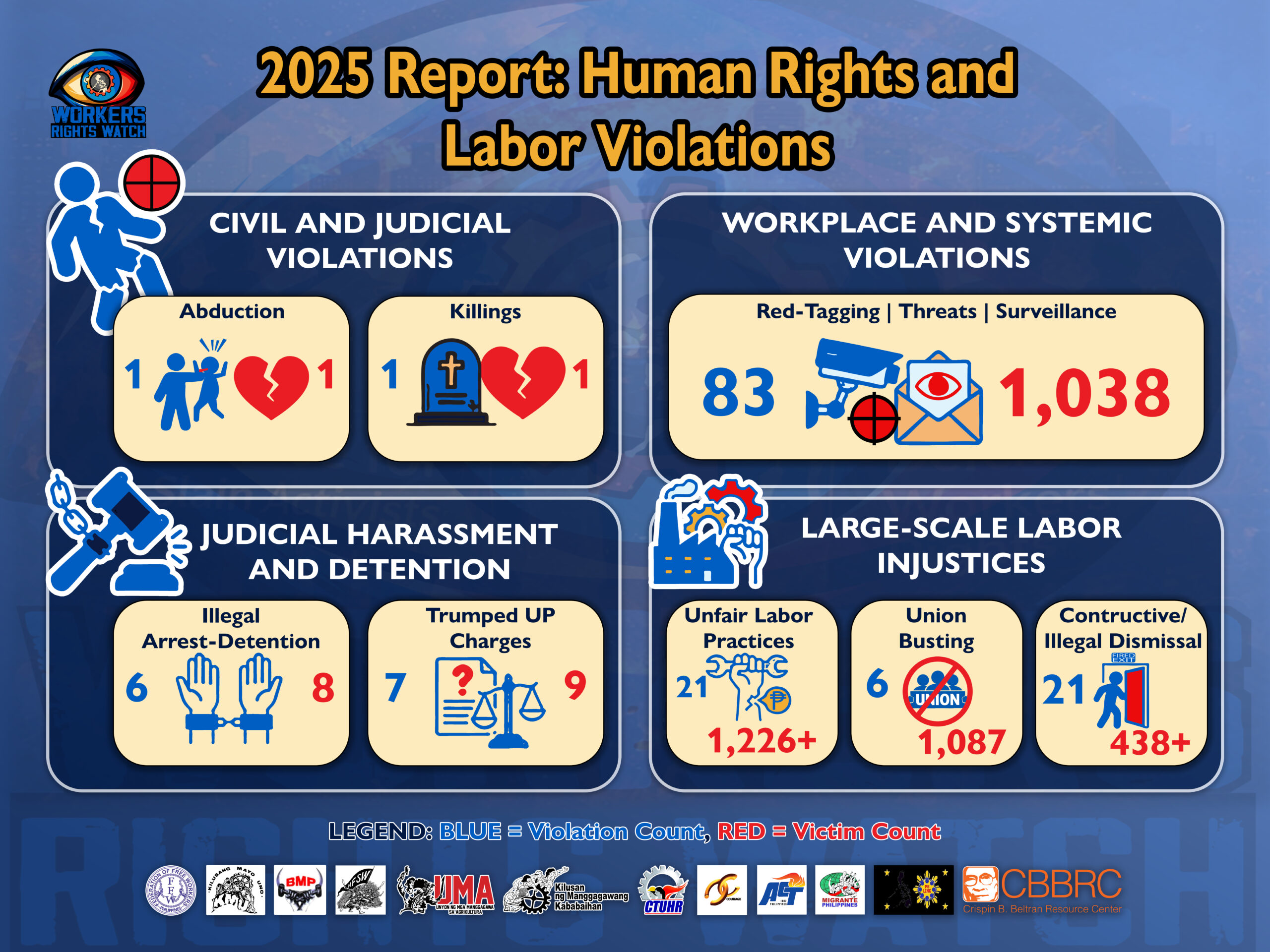
Since 2016, WRW has documented 105 cases of trade union killings — not one of which has moved forward in Philippine courts, according to the group. Meanwhile, violations in 2025 kept pace at roughly one documented case per week. These ranged from outright killings and illegal arrests to red-tagging, surveillance, and threats against workers and their families.
The data WRW presented during the March 26 press conference show the breadth of the problem: 83 incidents of red-tagging, threats, and surveillance affecting more than 1,038 victims. Six cases of illegal arrest and detention. Seven cases involving trumped-up charges. Twenty-one cases of unfair labor practices affecting more than 1,226 workers, and six cases of union busting displacing some 1,087 workers.
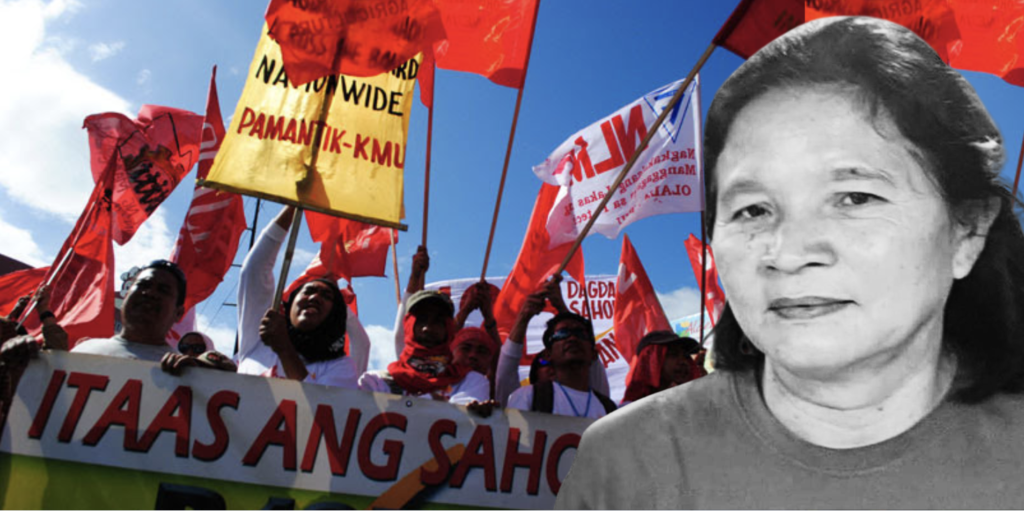
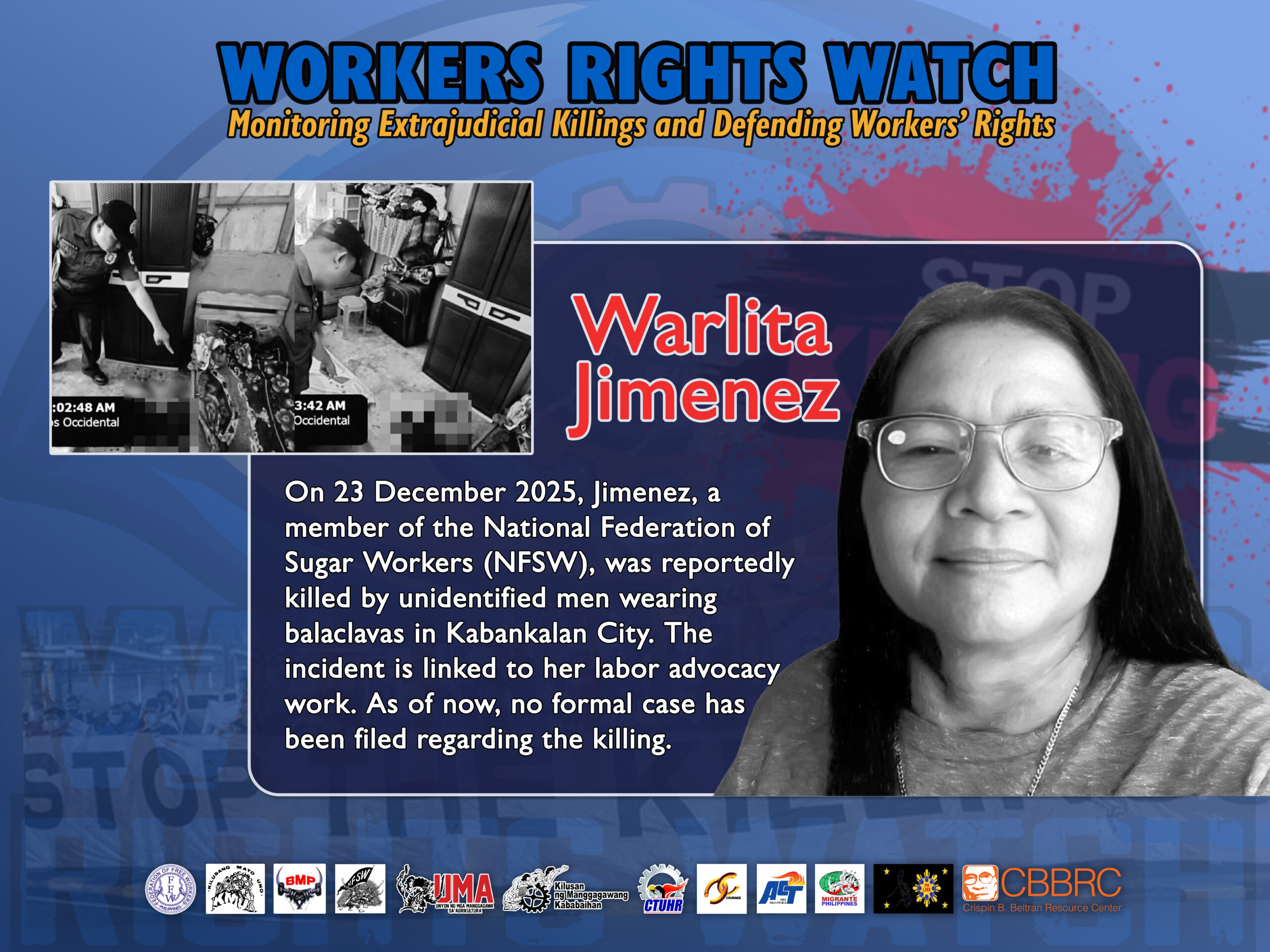
One of those victims was Warlita Jimenez, a member of the National Federation of Sugar Workers (NFSW). Two days before Christmas, on Dec. 23, 2025, she was shot and killed in Kabankalan City by unidentified men wearing balaclavas. Her killing has been linked to her labor advocacy work. As of the report’s release, no formal case has been filed.
“We are calling for a living wage but the government’s response is red-tagging and linking our efforts to terrorism,” said Mario Tapi-on, spokesperson for the NFSW. “We only want respect for our rights and protection as we fight for justice.”
Names Behind the Numbers
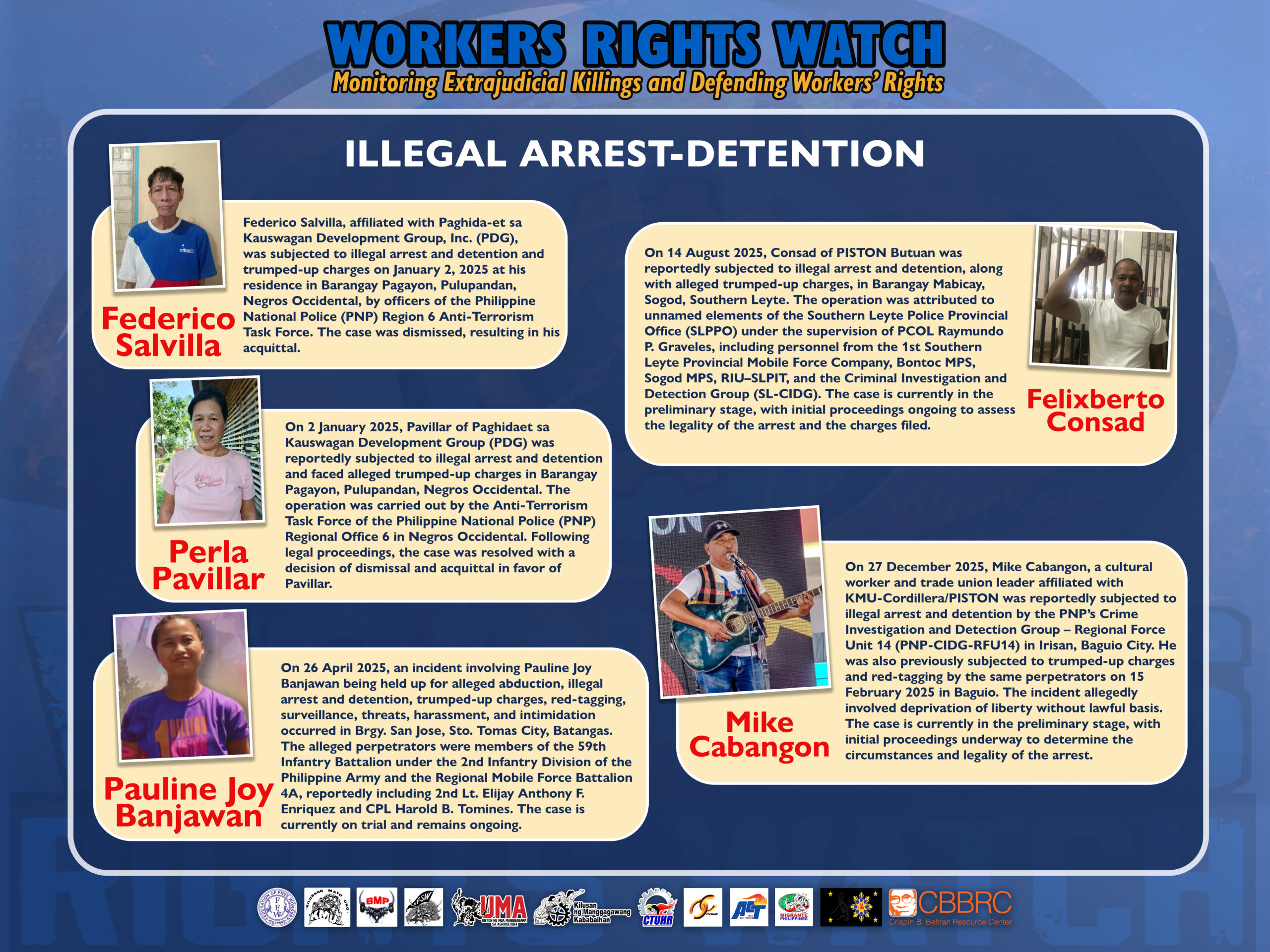
The report highlighted several cases of illegal arrest and detention that underscore how the harassment of labor organizers plays out on the ground.
On Jan. 2, 2025, Federico Salvilla and Perla Pavillar, both affiliated with Paghidaet sa Kauswagan Development Group, were arrested at their homes in Barangay Pagayon, Pulupandan, Negros Occidental, by officers of the Philippine National Police’s Region 6 Anti-Terrorism Task Force. Both were hit with charges WRW described as trumped-up. Both were eventually acquitted after legal proceedings.
RELATED STORY: Work Without Fear: Proposed Law Seeks to End Workplace Violence, Abuse
In April 2025, Pauline Joy Banjawan was subjected to what the report described as abduction, illegal arrest and detention, and red-tagging in Barangay San Jose, Sto. Tomas City, Batangas. Soldiers from the 59th Infantry Battalion were identified as the alleged perpetrators. Her case remains on trial.
In August 2025, Felixberto Consad of Piston Butuan was arrested in Barangay Mabicay, Sogod, Southern Leyte, by elements of the Southern Leyte Police Provincial Office. His case is in the preliminary stage.
And on Dec. 27, 2025, Mike Cabangon, a cultural worker and trade union leader affiliated with KMU-Cordillera/Piston, was arrested without lawful basis in Baguio City by the PNP’s Crime Investigation and Detection Group. He had already been red-tagged by the same unit in February 2025. That case is also pending.
A Law Without Legs
Last year, President Ferdinand Marcos Jr. signed Executive Order No. 97, which acknowledged freedom of association as a fundamental right of workers — not a privilege granted by the state. At the time, labor groups welcomed it as a step forward.
But Matula said the goodwill has since run dry. “An executive order cannot do the walking if the government will not move its feet,” he said.
READ: International Community Needs to ‘Walk the Talk’ on Accountability for Rights Abuses
The report found that the Inter-Agency Committee on Freedom of Association, created under Executive Order 23, has failed to produce concrete outcomes — including any prosecution in high-profile cases. At the same time, continued government funding for the National Task Force to End Local Communist Armed Conflict (NTF-ELCAC) has intensified threats against trade unionists and human rights defenders, according to the report.
Beyond violence, the report flagged a deeper structural problem: the Philippines has one of the lowest union participation rates in the region.
Only 4% of the country’s workforce belongs to a trade union. Collective bargaining agreements cover just 1% of workers, despite a labor force participation rate of around 60%. That gap means the vast majority of Filipino workers have little organized recourse when their rights are violated.
Lucy Francisco of Kilusan ng Manggagawang Kababaihan (KMK), a federation focused on women workers’ rights, said the picture is even bleaker for women in the workforce, whose health and reproductive rights are routinely ignored or used as grounds for discrimination. “Women’s rights are workers’ rights and human rights that we need to defend as well,” she said.
Laws Being Broken
The violations WRW documents do not happen in a legal vacuum. They cut across multiple layers of law — domestic and international — that the Philippine government is formally bound to uphold.
In the Philippines, the Philippine Labor Code explicitly protects the right to organize, bargain collectively, and be free from illegal dismissal and unfair labor practices. The 1987 Philippine Constitution enshrines freedom of association and guarantees due process — meaning no one may be arrested or detained without legal basis. Every warrantless arrest in the WRW report is, on its face, a potential constitutional violation.
READ: Philippines Lands on Global Rights Watchlist Amid Crackdown on Activists
Critics and legal groups have also raised alarms about the Anti-Terrorism Act of 2020 (Republic Act 11479), which allows authorities to hold suspects without a judicial warrant for up to 24 days. Amnesty International has expressed concern that the law is being misused as an instrument of harassment against labor leaders, activists, and civil society organizations — particularly through red-tagging, the practice of labeling individuals as linked to communist rebels without substantial evidence.
On the international front, the Philippines ratified two cornerstone ILO conventions in December 1953: Convention No. 87 on Freedom of Association and the Right to Organise, and Convention No. 98 on the Right to Organize and Collective Bargaining. Both are binding treaty obligations requiring the government to protect workers from retaliation for union activity — the precise opposite of what WRW’s data shows happening on the ground week after week. The Philippines has also ratified the International Covenant on Civil and Political Rights, which prohibits arbitrary arrest and guarantees the right to life and personal security — rights implicated in every killing and warrantless detention the WRW report documents.
Trade Deal with EU
There is also an economic lever that, so far, has not been fully pulled.
The Philippines is a beneficiary of the European Union’s Generalized Scheme of Preferences Plus (GSP+), a trade arrangement that grants Filipino exporters zero or sharply reduced tariffs on thousands of goods sold to EU markets — from fruits and textiles to vehicle parts and metals. The Philippines has reached a record-high 80% utilization rate of its GSP+ trade perks.
But those benefits come with conditions. To qualify for GSP+, a country must ratify and effectively implement 27 international conventions covering human and labor rights, good governance, and environmental protection. The ILO conventions the Philippines ratified in 1953 — Conventions 87 and 98 on freedom of association and collective bargaining — are squarely among those 27. In other words, the labor violations WRW documents every week are not just a human rights problem. They are also, formally, a trade compliance problem.
The European Parliament and the EU Special Representative for Human Rights have already urged the Philippines to halt abuses and end impunity in compliance with its GSP+ obligations. The parliament went further still, previously passing a resolution calling on the European Commission to set clear, public, and time-bound benchmarks for Philippine compliance with human rights obligations, and to begin procedures that could lead to the temporary withdrawal of GSP+ preferences if no substantial improvement was made.
That withdrawal has not happened. Despite serious and documented human and labor rights violations, the Philippines continues to benefit from GSP+ preferences. With the EU and Manila now in active negotiations toward a full free trade agreement, some critics worry that larger trade ambitions are muffling the bloc’s willingness to enforce the human rights conditions already on the books.
The EU has said it will continue to monitor the Philippines’ compliance with its international obligations and pursue dialogue to encourage further improvement, language that labor groups on the ground may find more diplomatic than decisive. As long as workers like Warlita Jimenez are killed with impunity and trade union leaders face terrorism charges for organizing, that dialogue has a long way to go.
The EU supported the founding of the WRW, which was formed in May 2024 by a coalition of Philippine labor groups — including the FFW, Kilusang Mayo Uno, NFSW, and several others — in partnership with the DTDA. Its mandate is to document, monitor, and respond to labor violations. (Editor’s note: This section about the GSP+ is not included in WRW’s preliminary report.)
Julius Cainglet, FFW vice president for research, advocacy, and partnerships, said the group plans to deepen its work across regions and push the government to live up to its obligations under ratified international labor standards.
Lotte Ellegaard, head of the DTDA Asia Office, called on the government, employers, and civil society to become active labor rights defenders — not just passive observers.
“Continue monitoring cases of workers’ rights violations and let violators know that we are demanding respect and accountability,” she said.
The full 2025 report is expected to be released later this year. (Rights Report Philippines)